Solving Warehouse WiFi Coverage and Uptime IssuesDesign reliable warehouse WiFi coverage and uptime with warehouse wifi 6 ap, industrial wireless access points, and warehouse poe switches for racks and docks.
OLT Capacity Planning for GPON Access NetworksPlan OLT capacity for GPON OLT systems and EA5800 capacity planning, optimizing GPON split ratio and OLT uplink design for scalable fiber access.
Enterprise OLT Platform Selection for Fiber AccessDesign enterprise OLT platform strategy for GPON OLT platform, modular OLT chassis, and OLT service boards to scale passive optical LAN and XG-PON evolution.
Scale Data Center Networking Under Long Lead TimesScale data center networking faster under long lead times with data center spine switches, leaf spine data center designs and Cisco UCS fabric interconnects.
Tunnel Video Surveillance VLAN Stability over FiberDesign stable tunnel video surveillance VLANs using optical transport backbone and Arista fiber aggregation for resilient Huawei OptiX OSN CCTV networks.
Fiber vs Copper in Industrial Networks Design GuideCompare fiber vs copper in industrial ethernet, plan hybrid industrial fiber network designs, and select rugged ethernet switches and industrial SFP transceivers.
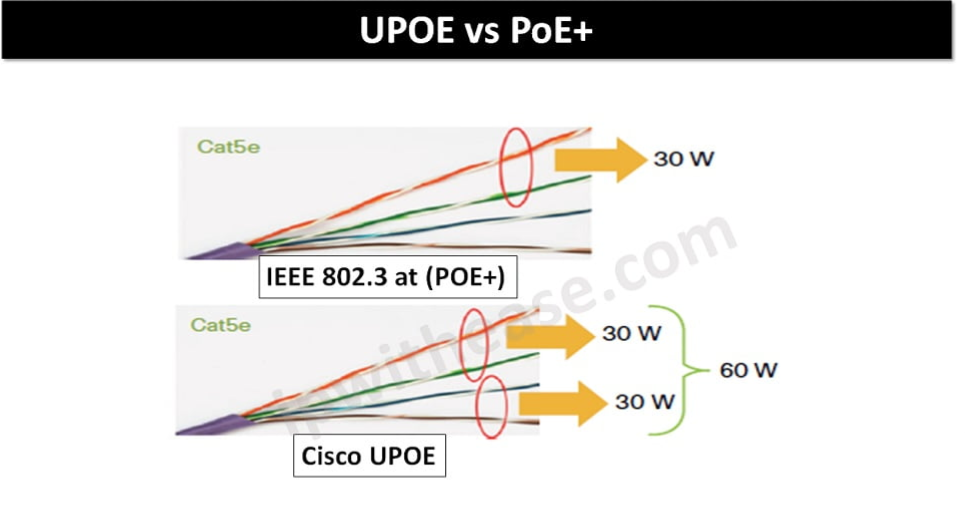
Power over Ethernet (PoE) technology allows data and power delivery over a single Ethernet cable, simplifying network deployments. As device power requirements increase, enhanced PoE solutions are essential. UPoE vs PoE+ represents a major evolution: while PoE+ (IEEE 802.3at) provides up to 30W, Cisco's Universal Power over Ethernet (UPoE) delivers up to 60W, and UPoE+ extends this to 90W. This FAQ explains the key differences, deployment implications, and why UPoE may be critical for your modern network.
What is PoE and PoE+?
Power over Ethernet (PoE) supplies DC power over copper Ethernet cabling while carrying data.
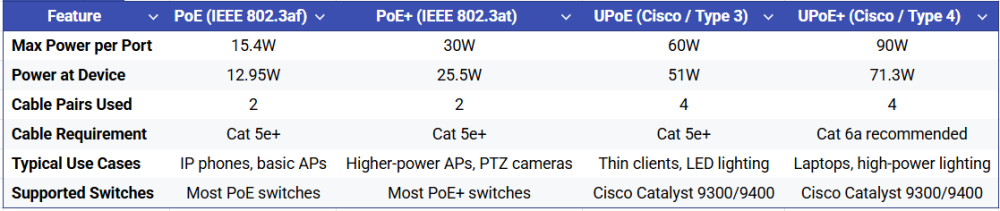
PoE (IEEE 802.3af): Up to 15.4W per port (12.95W at the device), using two twisted pairs. Suitable for IP phones, basic IP cameras, and entry-level access points.
PoE+ (IEEE 802.3at): Up to 30W per port (25.5W at the device), also using two twisted pairs. Supports higher-power access points, video phones, and PTZ cameras.
Both maintain data speeds up to 1 Gbps over the same cable.
What is UPoE?
Cisco Universal Power over Ethernet (UPoE) extends PoE capabilities by using all four twisted pairs in the Ethernet cable.
UPoE: Provides up to 60W per port (51W at the device). Aligns with IEEE 802.3bt Type 3 PoE standard.
UPoE+: Provides up to 90W per port (71.3W at the device). Aligns with IEEE 802.3bt Type 4 PoE standard. Cat 6a cabling is recommended for maximum delivery.
The primary differences between UPoE and PoE+ are power delivery and cable pair usage.
Comparison Table
When Should You Use UPoE Instead of PoE+?
Choose UPoE/UPoE+ when your devices require more power than PoE+ can provide, including:
Charging laptops and thin clients over a single Ethernet cable.
Advanced LED lighting, allowing daisy-chaining multiple fixtures while reducing cabling.
Pass-through PoE devices to power compact switches that also power downstream devices.
High-power wireless access points requiring more than 30W.
Large digital building deployments for simplified cabling and reduced power installation costs.
UPoE reduces the need for local power outlets, simplifies management, and supports modern, power-hungry endpoints.
People Also Ask
Q1: What is an UPoE port?
An UPoE port on a Cisco switch delivers up to 60W (or 90W with UPoE+) using all four twisted pairs, powering high-demand devices like laptops and LED lighting.
Q2: What is the difference between PoE+ and Hi PoE?
Hi PoE is not a formal standard. Generally, “Hi PoE” refers to power levels beyond PoE+ (30W), aligning with UPoE/UPoE+ which deliver 60W and 90W, respectively.
Q3: What is the power output of UPoE?
UPoE provides up to 60W per port (51W at the device), while UPoE+ can provide up to 90W per port (71.3W at the device).
Q4: What is the difference between PoE, PoE+, and PoE++?
PoE: 15.4W max (12.95W at device).
PoE+: 30W max (25.5W at device).
PoE++ (UPoE/UPoE+): 60W (51W) or 90W (71.3W) using four pairs, for high-demand devices.