Cisco 4331 EOL: End of Life Status, Risks, and Upgrade Strategy (2026 Guide)
Selene Gong
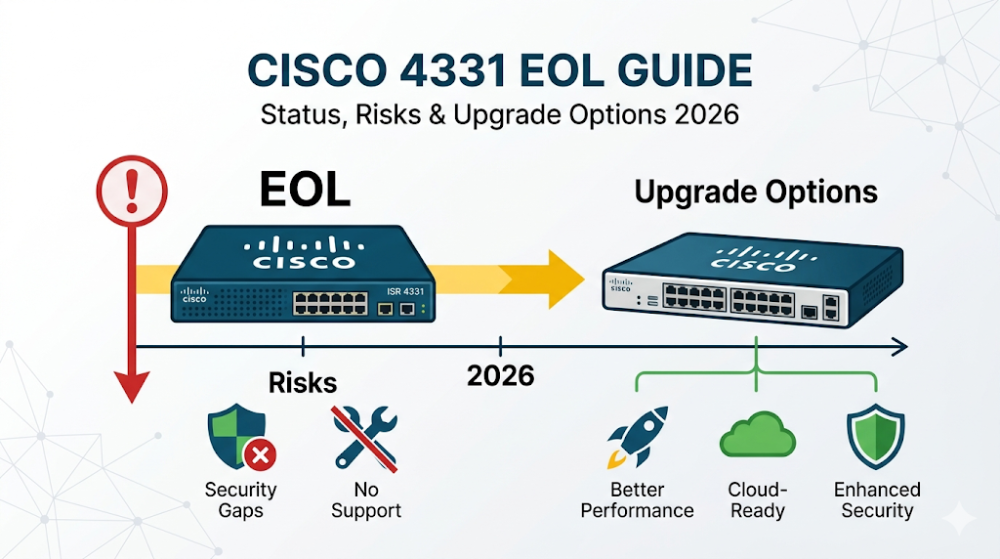
The Cisco ISR 4331 is officially in End of Life (EOL) stage and is approaching or already in End-of-Service-Life (EOSL) depending on specific hardware bundles.
In practical enterprise environments, this means:
No long-term feature development
Limited or expired TAC support coverage
Increasing operational risk for WAN edge deployments
For most organizations, Cisco 4331 should now be treated as legacy branch routing infrastructure.
Part 1: Cisco 4331 EOL Timeline (Why It Matters for Enterprises)
Cisco ISR 4331 is widely deployed in branch WAN networks, so lifecycle visibility is critical for infrastructure planning.
Key lifecycle impact:
EOL = No more development or new sales
EOSL = No more official support or hardware replacement
Increased dependency risk in distributed WAN environments
In real-world IT operations, many teams verify lifecycle status before audits or upgrade planning using tools like the Router-switch EOL/EOS Lifecycle Checker, which helps quickly identify whether ISR 4331 deployments are still within support boundaries or already exposed to risk.
This is especially useful for multi-branch WAN inventory validation before SD-WAN migration planning.
Part 2: Why Cisco 4331 Was Widely Used in WAN Edge Networks
The Cisco ISR 4331 became a standard branch router because it offered:
Integrated routing, security, and WAN services
Flexible interface expansion via NIM modules
SD-WAN readiness in hybrid deployments
Stable performance for mid-sized enterprise branches
It was commonly deployed in:
Enterprise branch offices
Retail distributed networks
MPLS + Internet hybrid WAN architectures
Early SD-WAN transition environments
However, modern WAN requirements have shifted toward higher encryption throughput, cloud-native routing, and SD-WAN-first architectures.
Part 3: Cisco 4331 EOL Risks in Production Environments
1. Security and Compliance Risk
Once a platform enters EOL/EOSL, security patches are limited or discontinued, increasing exposure to known vulnerabilities and compliance failures in audits.
2. WAN Performance Limitations
Modern enterprise traffic includes SaaS applications, encrypted SD-WAN tunnels, and cloud workloads, which can exceed ISR 4331 performance capabilities.
3. Hardware Lifecycle Risk
Aging WAN routers increase failure probability in power supplies, interfaces, and internal components, while also extending recovery time during outages.
4. Distributed Network Impact
In branch environments, a single router failure can disrupt VPN, SD-WAN, and cloud application access across an entire site.
Part 4: Cisco 4331 Replacement Options
Cisco does not provide a strict 1:1 replacement, but modern Catalyst WAN routers provide clear upgrade paths.
Cisco Catalyst 8200 Series (Standard Branch Upgrade)
Optimized for SD-WAN deployments
Cost-efficient branch modernization
Improved encryption performance
Cisco Catalyst 8300 Series (Enterprise WAN Edge)
Higher throughput for encrypted traffic
Designed for large-scale SD-WAN environments
Long-term architecture alignment
Cisco ISR 1100 Series (Small Branch / SMB)
Compact WAN edge solution
Cloud-managed deployment model
Lower cost entry for distributed sites
Part 5: Cisco 4331 vs Modern WAN Edge Platforms
Feature
Cisco 4331
Catalyst 8200/8300
Lifecycle Status
EOL / EOSL
Active
SD-WAN Support
Legacy support
Native-first design
Encryption Performance
Moderate
High-performance
Cloud Integration
Limited
Cloud-native
Architecture
ISR 4000 generation
Modern IOS-XE platform
This transition represents not just hardware replacement, but a shift toward SD-WAN-driven WAN architecture.
Part 6: Can You Still Buy Cisco 4331 in 2026?
Yes. Cisco ISR 4331 is still available through secondary and refurbished markets.
Common use cases include:
Supporting existing branch deployments
Temporary replacement for failed units
Short-term lifecycle extension strategy
However, procurement in EOL environments introduces risks such as hardware authenticity uncertainty, inconsistent revisions, and lack of standardized warranty coverage.
In enterprise procurement workflows, teams often rely on Router-switch to source enterprise networking hardware with verified authenticity, pre-shipment inspection, and stable availability for legacy Cisco models used in transitional WAN environments.
Part 7: Replace or Extend? Practical Migration Strategy
Most enterprises follow a phased WAN migration approach:
1. Short-Term Stabilization
Maintain spare ISR 4331 units
Reduce risk in high-traffic branches
2. Gradual Migration
Replace high-risk WAN nodes first
Introduce SD-WAN-ready routers gradually
3. Full WAN Modernization
Standardize on Catalyst 8200/8300
Move to SD-WAN-first architecture
Part 8: FAQ
Is Cisco 4331 still supported?
No. Cisco ISR 4331 is in End of Life status and is no longer actively supported in modern enterprise environments.
Is Cisco 4331 obsolete?
Yes. It is considered legacy WAN infrastructure and is not recommended for new deployments.
What is the best replacement for Cisco 4331?
Cisco Catalyst 8200 is the standard upgrade path, while 8300 is used for higher-performance enterprise WAN edge.
Can I still use Cisco 4331 safely?
Only in isolated or non-critical environments. It is not recommended for production WAN edges.
Is it safe to buy Cisco 4331 in 2026?
It can be used for short-term extension, but procurement risks must be carefully evaluated.
Final Insight: Cisco 4331 Is a Transition Technology
Cisco ISR 4331 is no longer a growth platform — it is a transition-era WAN device.
Organizations typically fall into three categories:
Lifecycle extension for cost control
Gradual SD-WAN migration planning
Full WAN modernization strategy
The key decision is not whether to replace it, but how quickly to reduce EOL risk while maintaining WAN continuity.
Expertise Builds Trust
20+ Years • 200+ Countries • 21500+ Customers/Projects CCIE · JNCIE · NSE7 · ACDX · HPE Master ASE · Dell Server/AI Expert