Solving Warehouse WiFi Coverage and Uptime IssuesDesign reliable warehouse WiFi coverage and uptime with warehouse wifi 6 ap, industrial wireless access points, and warehouse poe switches for racks and docks.
OLT Capacity Planning for GPON Access NetworksPlan OLT capacity for GPON OLT systems and EA5800 capacity planning, optimizing GPON split ratio and OLT uplink design for scalable fiber access.
Enterprise OLT Platform Selection for Fiber AccessDesign enterprise OLT platform strategy for GPON OLT platform, modular OLT chassis, and OLT service boards to scale passive optical LAN and XG-PON evolution.
Scale Data Center Networking Under Long Lead TimesScale data center networking faster under long lead times with data center spine switches, leaf spine data center designs and Cisco UCS fabric interconnects.
Tunnel Video Surveillance VLAN Stability over FiberDesign stable tunnel video surveillance VLANs using optical transport backbone and Arista fiber aggregation for resilient Huawei OptiX OSN CCTV networks.
Fiber vs Copper in Industrial Networks Design GuideCompare fiber vs copper in industrial ethernet, plan hybrid industrial fiber network designs, and select rugged ethernet switches and industrial SFP transceivers.
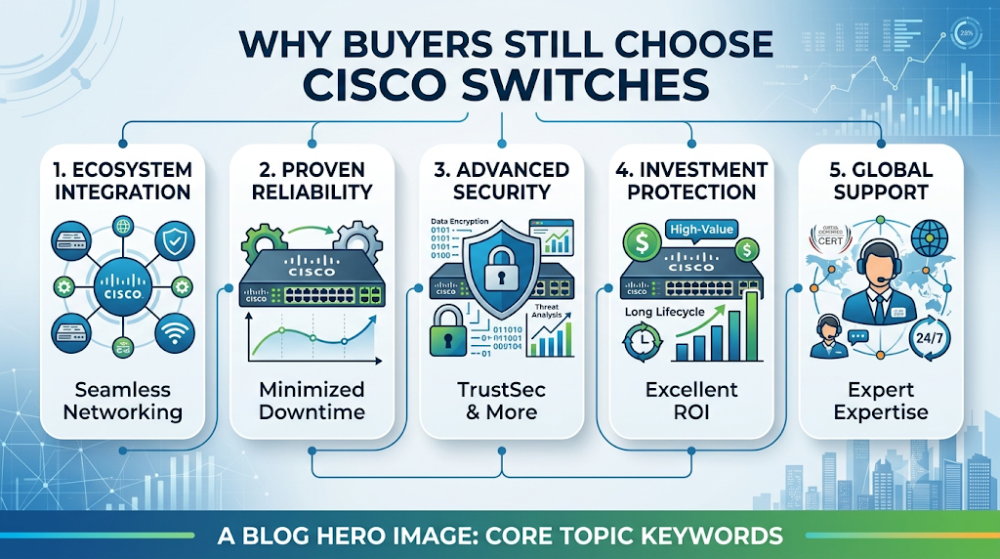
Cisco switches are not the cheapest option on the market, yet they remain the default choice for many enterprise networks. The reason is not brand loyalty alone. Buyers choose Cisco because the total package, ecosystem, support depth, and long-term predictability often justify the higher upfront cost. That does not mean Cisco is the right choice for every network. But for organizations that need scale, compliance, deep feature sets, and reliable support, the premium often pays for itself in reduced downtime, faster problem resolution, and easier expansion.
This guide is written for procurement teams, IT managers, and network leads who are evaluating whether Cisco switches are worth the premium. The goal is not to sell Cisco. It is to explain the five reasons buyers still choose Cisco even when cheaper alternatives exist, and to help you decide whether those reasons apply to your environment. If you are asking why Cisco still dominates enterprise switching, the answer is usually a combination of ecosystem, support, features, interoperability, and lifecycle management.
Cisco offers the deepest networking ecosystem, from switches and routers to security, wireless, and management platforms that integrate natively.
Support and professional services are unmatched in scale, with certified engineers, extensive documentation, and global partner networks.
Feature depth covers edge cases that cheaper switches cannot handle, including advanced QoS, security, telemetry, and automation.
Interoperability and standards leadership reduce integration risk in multi-vendor and complex environments.
Lifecycle management and investment protection mean predictable refresh cycles, clear migration paths, and residual value.
Reason
What it means for buyers
When it matters most
Ecosystem depth
Integrated wired, wireless, security, and management
Large or complex networks
Support scale
Global TAC, certified partners, extensive training
Business-critical infrastructure
Feature depth
Advanced routing, QoS, security, telemetry
Regulated or high-performance networks
Interoperability
Standards leadership, multi-vendor compatibility
Mixed environments
Lifecycle protection
Clear EOL, migration paths, trade-in programs
Long-term planning
Part 2: Ecosystem depth and integration
Cisco sells a unified network, not just switches
The biggest reason buyers choose Cisco is that the switch is not a standalone purchase. It is part of a larger ecosystem that includes routers, firewalls, wireless access points, security appliances, management platforms, and cloud services. When all of these components are designed to work together, integration becomes simpler, troubleshooting becomes faster, and the total solution is more predictable. Buyers who already use Cisco in other parts of the network often find that adding Cisco switches reduces complexity rather than increasing it.
Management platforms span the entire stack
Cisco DNA Center, Meraki, and Catalyst Center provide management views that cover wired, wireless, and WAN infrastructure. For organizations that want a single pane of glass for network operations, this integration is hard to match. Third-party and smaller vendors may offer good switches, but few can match the breadth of Cisco's management ecosystem.
Native integration reduces deployment risk
When switches, APs, routers, and security devices are all from the same vendor, configuration templates, policy enforcement, and software updates can be coordinated. This does not eliminate all problems, but it reduces the finger-pointing and compatibility testing that multi-vendor environments require.
Part 3: Support and professional services
The largest support ecosystem in networking
Cisco's Technical Assistance Center (TAC) is one of the largest and most mature support organizations in the industry. For business-critical networks, the ability to escalate complex issues to engineers who have seen the problem before is valuable. Smaller vendors may offer good products, but their support depth is usually narrower.
Certified partners and training programs
Cisco's certification program (CCNA, CCNP, CCIE) produces a large pool of engineers who understand the platform deeply. This means finding qualified consultants, integrators, and staff is easier than for most competitors. For organizations that depend on external help for design, deployment, or troubleshooting, this ecosystem is a practical advantage.
Documentation and community resources
Cisco's documentation library, design guides, and community forums are extensive. For complex deployments, having access to validated design guides, configuration examples, and troubleshooting articles reduces the risk of design errors and speeds up problem resolution.
Part 4: Feature depth and advanced capabilities
Advanced QoS and traffic management
Cisco switches offer granular QoS policies that can handle complex voice, video, and data traffic patterns. For organizations with VoIP, video conferencing, or latency-sensitive applications, this level of control is often necessary. Cheaper switches may offer basic QoS, but the depth and flexibility usually do not match Cisco's implementation.
Security features go beyond basic port security
Cisco switches support advanced security features like 802.1X, MACsec, TrustSec, DHCP snooping, dynamic ARP inspection, and private VLANs. For regulated industries or environments with strict segmentation requirements, these features are not optional. They are required by compliance frameworks.
Telemetry and automation support
Modern Cisco switches support streaming telemetry, model-driven APIs, and integration with automation tools. For organizations moving toward intent-based networking or automated operations, these capabilities matter. Older or simpler switch platforms often lack the API depth and telemetry granularity that modern network automation requires.
Part 5: Interoperability and standards leadership
Cisco leads or co-leads many networking standards
Cisco engineers participate in the development of many networking standards, which means Cisco products often implement new standards earlier and more completely than competitors. For buyers who need cutting-edge features or who want to avoid proprietary lock-in, this standards leadership is a practical advantage.
Multi-vendor interoperability is better tested
Because Cisco is the default choice in so many networks, third-party vendors usually test their interoperability with Cisco first. This means that when you need to integrate a Cisco switch with a non-Cisco firewall, load balancer, or monitoring tool, the integration is more likely to work smoothly than with a less common switch vendor.
Part 6: Lifecycle and investment protection
Clear end-of-life and migration paths
Cisco provides clear end-of-life announcements, migration guides, and trade-in programs. This predictability helps organizations plan refresh cycles, budget for replacements, and avoid unexpected support gaps. Smaller vendors may not offer the same level of lifecycle transparency.
Residual value and secondary market
Cisco equipment holds value better than most competitors in the secondary market. When it is time to refresh, organizations can often sell or trade in old Cisco gear to offset the cost of new equipment. This is harder to do with less common brands.
Software subscriptions provide continuous updates
Cisco's DNA subscription model provides access to ongoing software updates, security patches, and new features. While subscriptions add cost, they also ensure that the switch does not become a security liability due to unpatched vulnerabilities.
Part 7: When Cisco is worth the premium
Cisco is usually worth it when
The network is business-critical and downtime is expensive
The organization needs advanced security, QoS, or compliance features
The environment is complex, multi-site, or multi-vendor
Support depth and certified expertise are essential
Long-term lifecycle management and investment protection matter
Cisco may not be worth it when
The network is small, simple, and non-critical
Budget constraints are severe and the risk of failure is tolerable
The team lacks Cisco expertise and does not need advanced features
A simpler, cloud-managed solution meets all requirements
FAQ
Why are Cisco switches more expensive?
Cisco switches include deeper features, certified support, ecosystem integration, and lifecycle management. The higher price reflects these capabilities, not just the brand name.
Are Cisco switches worth the premium for small businesses?
Not always. Small businesses with simple networks may find that Cisco's feature depth and support ecosystem are more than they need. In those cases, simpler and cheaper alternatives may be sufficient.
What is the biggest advantage of Cisco switches?
The biggest advantage is usually the combination of ecosystem depth and support scale. For complex, critical networks, these factors reduce risk and operational overhead.
Can I mix Cisco switches with other brands?
Yes. Cisco switches support standard protocols and are usually well-tested for interoperability with other vendors. However, some advanced features work best within the Cisco ecosystem.
What is the best next step before buying Cisco switches?
Define your network requirements, including security, QoS, management, and growth plans. Then evaluate whether Cisco's feature depth and ecosystem justify the premium for your specific environment.
Part 8: The next practical step
If you are considering Cisco switches, the next useful step is to define which of the five reasons actually matter for your network. Not every organization needs the full Cisco ecosystem. Some need only the support depth. Others need the advanced security features. The key is to match the purchase to the real requirements rather than buying the brand by default.
Router-Switch can help compare Cisco switch families, validate configurations, check availability, and reduce the risk of overbuying or underbuying for your environment. If you are unsure whether Cisco's premium is justified for your network, the fastest path is to define your requirement set first and then compare options against it.
Expertise Builds Trust
20+ Years • 200+ Countries • 21500+ Customers/Projects CCIE · JNCIE · NSE7 · ACDX · HPE Master ASE · Dell Server/AI Expert