Solving Warehouse WiFi Coverage and Uptime IssuesDesign reliable warehouse WiFi coverage and uptime with warehouse wifi 6 ap, industrial wireless access points, and warehouse poe switches for racks and docks.
OLT Capacity Planning for GPON Access NetworksPlan OLT capacity for GPON OLT systems and EA5800 capacity planning, optimizing GPON split ratio and OLT uplink design for scalable fiber access.
Enterprise OLT Platform Selection for Fiber AccessDesign enterprise OLT platform strategy for GPON OLT platform, modular OLT chassis, and OLT service boards to scale passive optical LAN and XG-PON evolution.
Scale Data Center Networking Under Long Lead TimesScale data center networking faster under long lead times with data center spine switches, leaf spine data center designs and Cisco UCS fabric interconnects.
Tunnel Video Surveillance VLAN Stability over FiberDesign stable tunnel video surveillance VLANs using optical transport backbone and Arista fiber aggregation for resilient Huawei OptiX OSN CCTV networks.
Fiber vs Copper in Industrial Networks Design GuideCompare fiber vs copper in industrial ethernet, plan hybrid industrial fiber network designs, and select rugged ethernet switches and industrial SFP transceivers.
Firewall replacement cost is rarely just the price of the new appliance. Buyers usually start by asking how much the hardware will cost, but that only answers part of the budget question. In real projects, the final number is shaped by the firewall tier, licensing structure, support term, migration effort, site count, and how much room the business wants before the next refresh cycle. That is why firewall upgrades often feel more expensive than the first quote suggests, or cheaper than expected until hidden work appears later.
This guide is built for procurement teams, integrators, and technical leads who need a realistic budgeting framework before requesting quotes. The goal is not to fake a universal public price table. It is to help you understand what changes the cost of a firewall replacement project, where budget mistakes usually happen, and what you should clarify before asking suppliers for numbers you can actually compare.
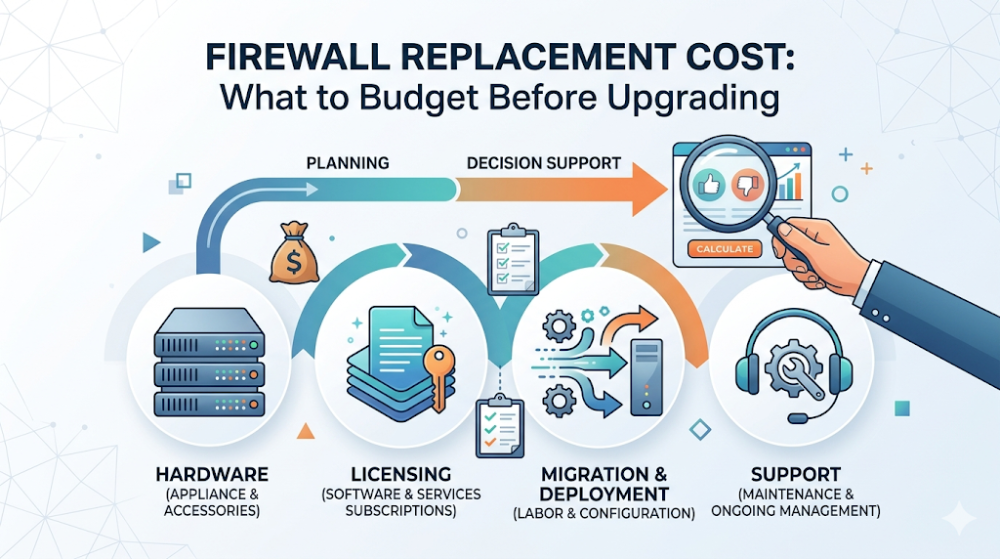
Firewall replacement cost is driven by more than the appliance. Hardware tier, licensing, support term, migration complexity, and number of sites all materially change the budget.
Smaller branch refreshes are usually dominated by hardware class and bundle choices.
Larger projects are often shaped more by migration labor, policy recreation, rollout coordination, and support expectations than by the box alone.
The most common budgeting mistake is comparing appliance-only price checks against fully structured project quotes.
The best next step is to define the replacement scope clearly enough that suppliers are answering the same cost question.
Cost driver
Why it matters
What buyers should clarify
Firewall hardware tier
Changes the base appliance cost and the performance class being purchased
Whether the project is still branch-class, mid-range, or enterprise-class
Licensing and bundles
Can change the real commercial comparison more than buyers expect
Whether quotes should be appliance-led or bundle-led
Support term
Alters both upfront budget and total ownership shape
How long support should be normalized across suppliers
Migration effort
Policy recreation, testing, and cutover work can materially affect project cost
What work is internal vs supplier-assisted
Rollout scope
Single-site and multi-site projects behave very differently commercially
Whether this is one replacement or a repeatable standardization program
Part 2: What really drives firewall replacement cost
1. The old firewall is being replaced for a reason, and that reason changes the budget
Some firewalls are replaced because they are underpowered. Others are replaced because they are aging out of support, no longer fit security policy, or have become a bottleneck in a larger network refresh. Those are not the same budget problems. A project driven by performance pressure often moves up a model band. A project driven by lifecycle pressure may only need a cleaner replacement path. A project driven by standardization may care more about repeating the same model across multiple sites than maximizing one site’s peak performance.
2. The size of the replacement is more important than the sticker price
Buyers often begin with internet price expectations, but the real budget question is whether the replacement stays in the same appliance class or moves into a different one. That shift usually matters more than the exact number in one listing. A branch firewall refresh that stays in the same class is budgeted very differently from a replacement that also adds more inspection headroom, more services, or more strategic runway.
3. Commercial structure matters as much as product choice
Two firewall quotes can look far apart even when the underlying replacement direction is similar. The difference is often not just brand. It is bundle design, support duration, acceptable alternatives, and whether the buyer asked for one model or multiple possible paths. This is where Router-Switch can add real value, especially when you need clean quote comparison, model-fit validation, stock path checks, or help deciding whether the replacement should stay close to the original tier or move up before procurement gets locked into the wrong cost assumption.
Part 3: Hardware is only one part of the budget
The appliance line item is the visible part, not the whole project
Most firewall refresh budgets start with hardware because it is the easiest figure to anchor on. But the appliance line item only tells you what class of firewall you are buying. It does not tell you how expensive it will be to replace policies, normalize licensing, schedule cutover, validate interoperability, or coordinate a multi-site rollout. In many projects, those surrounding costs decide whether the approved budget is realistic.
Why buyers over-focus on hardware
Hardware is attractive because it feels concrete. It is much harder to estimate the commercial effect of support duration, bundle assumptions, or migration effort, so teams sometimes underweight those until late in the project. That is usually when budget drift starts. A cleaner budgeting process treats hardware as the anchor, but not as the whole answer.
What this means for quote planning
If the project is still early, use hardware bands to orient the budget. If the project is nearing RFQ, start treating the appliance as only one column in a wider replacement cost model. Buyers who do that usually avoid the most frustrating outcome, which is thinking a project is affordable until the hidden non-hardware work shows up in the final commercial path.
Part 4: Licensing, support, and migration costs buyers forget
Licensing changes what “replacement cost” actually means
Many firewall refreshes are compared incorrectly because one quote represents a bare appliance direction and another includes a more realistic license structure. Without normalizing that, buyers can think they are comparing firewall replacement cost when they are actually comparing two different definitions of the project.
Support terms alter the budget shape
Support duration and support level may not feel like the main cost driver at first, but they can change how the project is approved internally. A lower upfront number can look attractive until leadership asks for a longer protection window or more predictable support coverage. Buyers should decide early whether they are optimizing for smallest entry budget or cleaner medium-term ownership planning.
Migration work is often where under-budgeting happens
Policy recreation, cutover planning, testing, rollback safety, and coordination across teams all create real cost, even when they do not appear as a simple hardware line item. This is especially true when the replacement also changes vendor, management model, or operating workflow. Router-Switch can help reduce that uncertainty by narrowing the right replacement tier, identifying practical alternatives, and helping buyers request quotes in a way that surfaces the real migration-impact differences instead of hiding them until late.
Part 5: How branch, campus, and enterprise projects budget differently
Branch replacements are usually driven by repeatability and value discipline
In smaller branch projects, firewall replacement cost is often about choosing the correct appliance class and not overbuying the site. If the replacement is being repeated across many branches, small errors in per-site budgeting multiply quickly. That makes standardization logic and acceptable alternatives unusually important.
Campus and mixed-edge projects are more sensitive to operational fit
For larger site roles, the budget question starts to include how the firewall will be managed, how it fits the rest of the environment, and whether the replacement should preserve an existing operating model or open the door to a broader platform change. Here, the migration shape can matter almost as much as the hardware itself.
Enterprise replacements are often shaped by risk and coordination cost
In enterprise refreshes, the appliance may still be expensive, but the bigger financial exposure often comes from getting the migration wrong, underestimating policy complexity, or approving a platform that creates avoidable operational friction later. That is why the most useful enterprise budget discussion is rarely “how much is the firewall?” It is “what is the full replacement cost if we do this properly?”
Part 6: A practical checklist before requesting quotes
1. Define why the firewall is being replaced
Performance, lifecycle pressure, standardization, and security redesign each create different budget logic.
2. Decide whether the project stays in the same appliance band
If the new firewall is expected to do more than the old one, do not budget it like a like-for-like swap.
3. Normalize licensing and support assumptions
Ask suppliers to respond to the same bundle and support logic, otherwise the quote comparison will mislead you.
4. Separate hardware cost from migration cost
Keep those two visible. They are both real, but they should not be mixed into one vague total too early.
5. Clarify site count and rollout rhythm
A single replacement and a 20-site refresh should never be budgeted the same way.
6. Decide whether alternatives are acceptable
If lead time, inventory, or budget pressure changes, knowing acceptable nearby options early makes the quote process much cleaner.
FAQ
What affects firewall replacement cost the most?
The biggest drivers are usually appliance tier, licensing structure, support term, migration effort, and number of sites involved in the refresh.
Is firewall replacement cost mainly about hardware price?
No. Hardware is important, but licensing, support, and migration work often reshape the project budget materially.
Why do firewall replacement quotes vary so much?
Because suppliers may be quoting different appliance classes, different bundle assumptions, different support durations, or different definitions of migration scope.
Should I ask for appliance-only quotes first?
Appliance-only visibility can help early orientation, but before approval you should compare quotes that reflect the real structure of the replacement project.
What is the best next step after reading a budget guide like this?
The best next step is to define the replacement scope clearly enough that suppliers are responding to the same question, then compare structured quotes instead of rough price impressions.
Part 7: The next practical step
If you are budgeting a firewall replacement, the next useful step is not to chase one public number. It is to define what kind of replacement this really is, same-class refresh, growth-driven upgrade, multi-site standardization, or platform change, and then request quotes that reflect that reality.
Once you are at that stage, Router-Switch can help compare replacement paths, check current availability, validate whether nearby models should be included, and make sure the quotes you receive are answering the same project question. That is usually the fastest way to turn firewall replacement cost from a vague estimate into a budget you can actually defend internally.
Expertise Builds Trust
20+ Years • 200+ Countries • 21500+ Customers/Projects CCIE · JNCIE · NSE7 · ACDX · HPE Master ASE · Dell Server/AI Expert