Solving Warehouse WiFi Coverage and Uptime IssuesDesign reliable warehouse WiFi coverage and uptime with warehouse wifi 6 ap, industrial wireless access points, and warehouse poe switches for racks and docks.
OLT Capacity Planning for GPON Access NetworksPlan OLT capacity for GPON OLT systems and EA5800 capacity planning, optimizing GPON split ratio and OLT uplink design for scalable fiber access.
Enterprise OLT Platform Selection for Fiber AccessDesign enterprise OLT platform strategy for GPON OLT platform, modular OLT chassis, and OLT service boards to scale passive optical LAN and XG-PON evolution.
Scale Data Center Networking Under Long Lead TimesScale data center networking faster under long lead times with data center spine switches, leaf spine data center designs and Cisco UCS fabric interconnects.
Tunnel Video Surveillance VLAN Stability over FiberDesign stable tunnel video surveillance VLANs using optical transport backbone and Arista fiber aggregation for resilient Huawei OptiX OSN CCTV networks.
Fiber vs Copper in Industrial Networks Design GuideCompare fiber vs copper in industrial ethernet, plan hybrid industrial fiber network designs, and select rugged ethernet switches and industrial SFP transceivers.
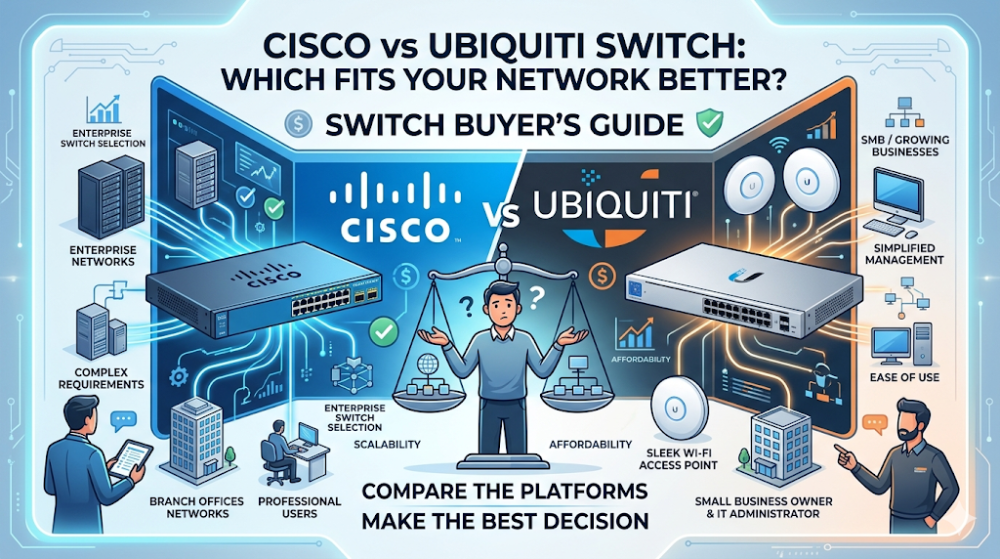
Cisco and Ubiquiti are both credible switch choices, but they fit different buyers better depending on network size, budget discipline, operational model, and how much enterprise-grade control the environment actually needs. The mistake many buyers make is treating this as a simple brand comparison. In reality, the right choice usually depends on whether the organization needs a scalable small-business stack, a cloud-managed deployment, or a full enterprise feature set with deep security and lifecycle support. This guide helps buyers decide which platform fits their real environment before requesting quotes.
This article is written for procurement teams, IT managers, integrators, and technical leads evaluating Cisco and Ubiquiti switches for branch, campus, or small data center deployments. The goal is not to declare one winner. It is to help you match the platform to your operational style, budget structure, feature requirements, and growth plan. If you are comparing Cisco vs Ubiquiti, the better question is what kind of network you are building and who will manage it over time.
Ubiquiti fits buyers who want strong value, simple cloud management, and fast deployment without deep enterprise security or advanced routing requirements.
Cisco fits buyers who need enterprise-grade security, advanced QoS, deep telemetry, long lifecycle support, and certified interoperability across a large or regulated environment.
The wrong choice is usually made when buyers pick by price alone or by brand habit without mapping the platform to operational reality.
Hybrid environments are increasingly common, with Ubiquiti at the edge and Cisco at the core, but this only works when the integration plan is clear.
The safest buying path is to define management model, security needs, growth plan, and support expectations before comparing models.
Decision factor
Ubiquiti tendency
Cisco tendency
Network size
Small to medium sites
Medium to large, multi-site
Management style
Cloud-managed, simpler UI
On-prem or cloud, deeper control
Security needs
Standard VLAN and ACL
Advanced NAC, 802.1X, TACACS+
Budget sensitivity
Lower entry cost
Higher entry, longer TCO value
Support model
Community and online
Certified TAC and partner channel
Part 2: Where each platform fits best
Ubiquiti is built for value-conscious deployments that still need managed switching
Ubiquiti switches appeal to buyers who need PoE, VLANs, and basic management at a lower price point than traditional enterprise brands. The UniFi ecosystem makes it easy to add APs, gateways, and cameras under one interface. For small offices, retail, hospitality, and light commercial environments, this can be the right balance of capability and simplicity. Buyers who choose Ubiquiti usually prioritize fast deployment, lower upfront cost, and a unified management view over deep enterprise features.
Cisco is built for environments that need scale, security, and certified support
Cisco switches are designed for organizations that require advanced routing, mature QoS, robust security policies, detailed telemetry, and long-term support through certified channels. Enterprise, healthcare, finance, government, and large campus environments often need these capabilities for compliance, interoperability, or operational stability. Buyers who choose Cisco usually prioritize feature depth, ecosystem integration, lifecycle management, and the ability to escalate through TAC and certified partners.
The gap between them is narrower at the edge, wider at the core
For basic access-layer switching, both platforms can work. The differences become more significant as the network grows in size, complexity, and security requirements. Buyers should be honest about where their network is today and where it will be in the next refresh cycle before deciding which platform is the better long-term fit.
Part 3: Feature and management comparison
Management model often decides the platform faster than any feature list
Ubiquiti's cloud-managed UniFi Controller is popular because it is easy to learn and gives a unified view of switches, APs, and gateways. Cisco offers multiple management paths, from on-prem DNA Center to cloud-based Meraki to traditional CLI, depending on the product line. Buyers should consider which management model their team can support effectively. A technically superior platform becomes a liability if the operations team cannot manage it well.
Security features separate the platforms at scale
Cisco offers deeper security integration, including advanced NAC, 802.1X, TACACS+, MACsec, and richer telemetry for threat detection. Ubiquiti covers the basics well with VLANs, ACLs, and port security, but does not match Cisco's enterprise security depth. For regulated industries or environments with strict segmentation requirements, this difference can be decisive.
QoS and routing maturity favor Cisco in complex environments
Cisco's long history in enterprise networking shows in its QoS policies, multicast handling, and Layer 3 routing features. Ubiquiti handles standard traffic well but may not offer the same granularity for latency-sensitive or highly regulated traffic. Buyers with VoIP, video, or industrial control traffic should evaluate this carefully.
Part 4: Cost, support, and lifecycle
Upfront cost is not the only cost to compare
Ubiquiti switches usually cost less upfront. Cisco switches usually cost more but include deeper support, longer lifecycle guarantees, and stronger residual value. Buyers comparing only the initial hardware price often miss the operational cost of management, troubleshooting, training, and replacement. For some environments, the lower upfront cost is the right decision. For others, the higher TCO value of Cisco's support and longevity is justified.
Support model changes who can fix problems
Ubiquiti relies heavily on community support, online documentation, and direct-to-customer sales. Cisco offers certified TAC support, partner-led professional services, and extensive training programs. Buyers with in-house networking expertise may not need Cisco's support overhead. Buyers who depend on vendor support for critical issues may find Ubiquiti's model insufficient.
Lifecycle and replacement planning differ
Cisco provides clearer end-of-life timelines, migration paths, and trade-in programs. Ubiquiti's lifecycle is often shorter and less formally announced. For buyers planning multi-year deployments, this difference matters because unexpected replacement cycles can disrupt budgets and operations.
Part 5: Matching platform to real environments
Small business and branch offices often favor Ubiquiti
For smaller sites with limited IT staff, Ubiquiti's ease of deployment, lower cost, and unified management can be the better fit. The platform handles standard office traffic, PoE for APs and cameras, and basic VLAN segmentation without requiring certified engineers.
Enterprise and regulated environments often favor Cisco
For larger organizations with compliance requirements, complex segmentation, or multi-site standardization, Cisco's feature depth and support ecosystem are usually worth the premium. The ability to integrate with existing security, routing, and management tools is often more important than upfront savings.
Integrators and service providers should match the platform to their customer base
If your customer base is mostly SMB, Ubiquiti may be the easier platform to deploy and support profitably. If your customer base is enterprise or regulated, Cisco is usually the safer standard. Some integrators support both, using Ubiquiti for edge deployments and Cisco for core infrastructure. Router-Switch can help source either platform, check current availability, and validate whether the quoted configuration matches the intended deployment.
Part 6: Common buyer mistakes
Mistake 1: Choosing by price without checking feature fit
A cheaper switch that lacks required security or management features can cost more in operational friction than the upfront savings.
Mistake 2: Choosing by brand habit without checking operational fit
A familiar brand is not automatically the right platform for the deployment. Management model and feature depth should come first.
Mistake 3: Ignoring support and lifecycle
Support model and lifecycle clarity affect long-term operational cost. Buyers should factor this into the comparison, not just the hardware price.
Mistake 4: Assuming both platforms are interchangeable
While both can handle basic switching, they are not interchangeable for complex, regulated, or high-growth environments. Buyers should match the platform to the real requirement set.
FAQ
Which is better, Cisco or Ubiquiti switches?
Neither is universally better. Ubiquiti fits value-conscious and simpler deployments. Cisco fits enterprise and regulated environments that need deeper features and certified support.
Are Ubiquiti switches good for enterprise?
Ubiquiti switches can work in smaller enterprise edge deployments, but they usually do not offer the security depth, management granularity, or certified support that large enterprise environments require.
Why are Cisco switches more expensive?
Cisco switches include deeper features, certified support, longer lifecycle guarantees, and stronger ecosystem integration. The higher price reflects these capabilities, not just the brand.
Can I mix Cisco and Ubiquiti in the same network?
Yes, but only with a clear integration plan. Many environments use Ubiquiti at the edge and Cisco at the core. Buyers should confirm interoperability and management separation before mixing.
What is the best next step before requesting quotes?
Define your network size, management model, security needs, growth plan, and support expectations. Then compare platforms against that requirement set rather than starting with brand preference.
Part 7: The next practical step
If you are comparing Cisco and Ubiquiti switches, the next useful step is to stop browsing product pages and start defining your requirement set. That means confirming network size, management preference, security needs, growth expectations, and support model. Once that is clear, platform selection becomes much faster and less noisy.
Router-Switch can help compare Cisco and Ubiquiti switch families, validate current availability, check quote alignment, and reduce the risk of buying a platform that is technically acceptable but strategically wrong for the project. If you are unsure which platform fits your environment, the fastest path is to define the requirement set first and then compare models against it.
Expertise Builds Trust
20+ Years • 200+ Countries • 21500+ Customers/Projects CCIE · JNCIE · NSE7 · ACDX · HPE Master ASE · Dell Server/AI Expert