Solving Warehouse WiFi Coverage and Uptime IssuesDesign reliable warehouse WiFi coverage and uptime with warehouse wifi 6 ap, industrial wireless access points, and warehouse poe switches for racks and docks.
OLT Capacity Planning for GPON Access NetworksPlan OLT capacity for GPON OLT systems and EA5800 capacity planning, optimizing GPON split ratio and OLT uplink design for scalable fiber access.
Enterprise OLT Platform Selection for Fiber AccessDesign enterprise OLT platform strategy for GPON OLT platform, modular OLT chassis, and OLT service boards to scale passive optical LAN and XG-PON evolution.
Scale Data Center Networking Under Long Lead TimesScale data center networking faster under long lead times with data center spine switches, leaf spine data center designs and Cisco UCS fabric interconnects.
Tunnel Video Surveillance VLAN Stability over FiberDesign stable tunnel video surveillance VLANs using optical transport backbone and Arista fiber aggregation for resilient Huawei OptiX OSN CCTV networks.
Fiber vs Copper in Industrial Networks Design GuideCompare fiber vs copper in industrial ethernet, plan hybrid industrial fiber network designs, and select rugged ethernet switches and industrial SFP transceivers.
TL;DR: Cisco IE switches combine industrial-grade resilience with enterprise-level networking features. Many IE series are compatible with Cisco SDA as Extended Nodes (EN), Policy Extended Nodes (PEN), or non-fabric devices managed via Catalyst Center. SDA leverages VXLAN/LISP for scalable, automated segmentation in industrial networks.
In today's rapidly evolving industrial landscape, the convergence of Information Technology (IT) and Operational Technology (OT) networks is paramount for enhancing efficiency, security, and real-time data analysis. Cisco Software-Defined Access (SDA) offers a transformative approach to network management, extending the benefits of intent-based networking to industrial environments.
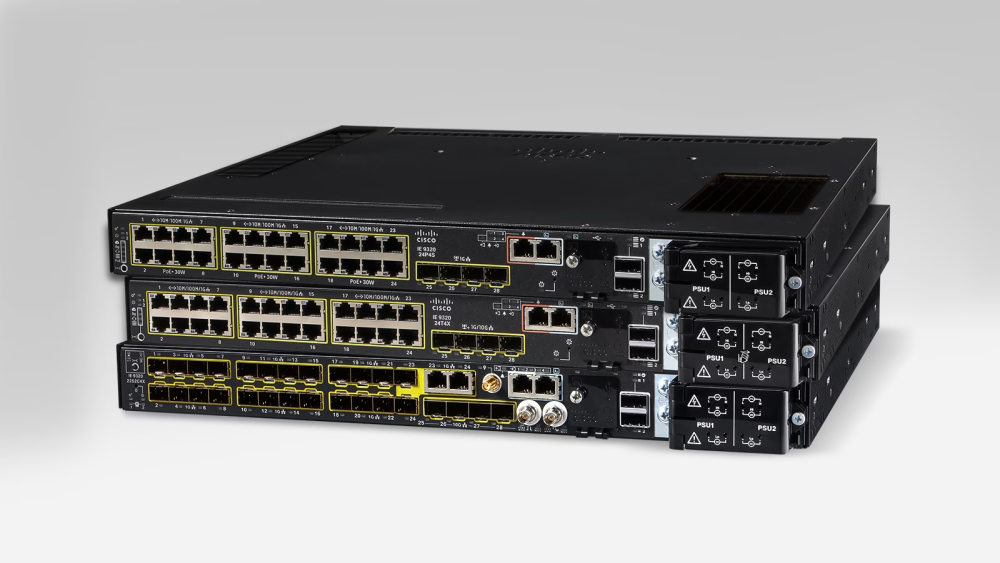
Cisco Industrial Ethernet (IE) switches are purpose-built networking devices designed to operate reliably in harsh industrial environments such as manufacturing plants, oil and gas facilities, wind farms, and transportation infrastructure. They feature extended temperature ranges, resistance to vibration, shock, and electromagnetic interference, and support specific industrial protocols. The compatibility between IE switches and SDA is crucial for extending modern IT management and security capabilities to the industrial edge, ensuring a robust, secure, and future-ready operational network.
Part 1: Overview of Cisco IE Switches and SDA
Industrial networks face unique challenges including extreme temperatures, vibration, electromagnetic interference, and specialized industrial protocols. Cisco Industrial Ethernet (IE) switches address these challenges with rugged hardware and enterprise-grade networking capabilities. Integrating IE switches with Cisco SDA allows IT teams to extend advanced networking features—macro and micro segmentation, centralized management, and automation—into OT environments. This combination enables unified IT/OT management while maintaining industrial reliability. In this section, we provide an overview of IE switch series and introduce their role in SDA deployments.
Part 2: Cisco IE Switch Series and SDA Compatibility
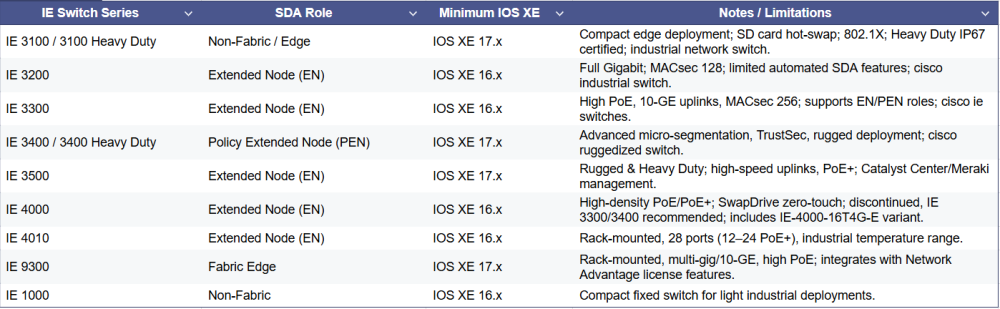
The following IE series are compatible with SDA, either as Extended Nodes (EN), Policy Extended Nodes (PEN), or managed non-fabric devices. Each series offers different capabilities depending on the deployment role and environment.
Part 3: Deployment Models for IE Switches with SDA
Deploying IE switches in SDA fabrics can follow several models, each suited to specific industrial scenarios. Understanding these models helps maintain both network reliability and automation benefits.
Choosing the right deployment model ensures IT/OT integration, security, and operational efficiency.
PEN/EN Fabric Integration
IE switches such as IE 3300, 3400, 4000, and 4010 can serve as PEN or EN devices within the SDA fabric. This allows full macro/micro segmentation, centralized monitoring, and automated provisioning via Catalyst Center. Considerations include REP-only topologies and possible limitations with SD card zero-touch replacement.
Non-Fabric / Catalyst Center Managed
Edge or brownfield industrial networks can operate as non-fabric devices managed centrally via Catalyst Center. This method speeds deployment, reduces errors, and preserves existing OT network designs. Some SDA automation features may be limited.
Fabric Edge / Rack-Mount Nodes
Devices like IE 9300 can act as fabric edge nodes, extending the SDA fabric to distribution or core layers. This setup integrates industrial devices with enterprise SDA features while leveraging centralized automation and security controls.
Part 4: Technical Features, Benefits, and Considerations
Integrating IE switches with SDA provides operational, security, and management advantages, though some challenges must be addressed.
Understanding the technical features and limitations of each IE series ensures optimal network design and IT/OT convergence.
Key Benefits
IT/OT Convergence: Unified management across industrial and enterprise networks.
Segmentation: Macro and micro segmentation improves security and isolates network traffic.
VLAN Extension: Devices remain in the same VLAN regardless of physical location.
QoS and Industrial Protocol Support: Prioritize mission-critical traffic (e.g., PROFINET).
L2NAT for IP Duplication: Integrates pre-configured devices with overlapping IP addresses.
Silent Hosts & Multicast Handling: IP Directed Broadcast and LISP detection for silent endpoints; Layer 2 flooding for multicast.
Security: MACsec, 802.1X, TrustSec, VXLAN, and LISP features support industrial OT security.
Challenges and Workarounds
Resiliency Protocols: REP supported; PRP/HSR may require dual-fabric or manual configuration.
Zero-Touch Replacement: Some EN/PEN devices do not support SD card swap; workaround: use as non-fabric.
Loop Prevention: SDA Fabric relies on BPDU Guard or Flexlink for redundancy.
Extreme Environment Constraints: Heavy Duty models needed for temperature extremes; ensures ruggedized industrial network switch reliability.
Part 5: People Also Ask (PAA)
Q1: Can IE 3100 switches be used in SDA fabric?
Yes, as non-fabric or edge devices; supports SD card hot-swap and 802.1X.
Q2: Which IE switches support Policy Extended Node (PEN) role?
IE 3400 and IE 3400 Heavy Duty series.
Q3: Does Cisco SDA use VXLAN?
Yes, SDA leverages VXLAN and LISP to enable scalable, automated segmentation and micro-segmentation across enterprise and industrial networks.
Q4: How does Catalyst Center manage IE switches in SDA?
Provides centralized configuration, automation, monitoring, API access, and RBAC.
Q5: What are limitations when integrating industrial protocols with SDA?
PRP, HSR, and precise multicast may require manual configuration or workarounds.
Q6: How do I check which IE switches are compatible with SDA?
Review Cisco official documentation or your trusted distributor to verify compatibility.
Q7: What is IE-4000-16T4G-E?
A specific variant of the IE 4000 series, offering 16 Gigabit and 4 10-GE uplink ports, supporting SDA as an Extended Node (EN).
Q8: What is an industrial grade switch?
Industrial-grade switches are ruggedized devices capable of operating in extreme temperatures, high vibration, shock, and EMI environments, supporting industrial protocols like PROFINET and EtherNet/IP.
Part 6: Conclusion
Cisco IE switches that work with SDA provide industrial-grade reliability combined with enterprise-level networking capabilities. Selecting the appropriate IE series, understanding deployment roles (EN, PEN, Fabric Edge, Non-Fabric), and accounting for technical considerations—including VXLAN, LISP, TrustSec, MACsec, and industrial protocol support—are critical to a successful IT/OT integrated SDA deployment.