Solving Warehouse WiFi Coverage and Uptime IssuesDesign reliable warehouse WiFi coverage and uptime with warehouse wifi 6 ap, industrial wireless access points, and warehouse poe switches for racks and docks.
OLT Capacity Planning for GPON Access NetworksPlan OLT capacity for GPON OLT systems and EA5800 capacity planning, optimizing GPON split ratio and OLT uplink design for scalable fiber access.
Enterprise OLT Platform Selection for Fiber AccessDesign enterprise OLT platform strategy for GPON OLT platform, modular OLT chassis, and OLT service boards to scale passive optical LAN and XG-PON evolution.
Scale Data Center Networking Under Long Lead TimesScale data center networking faster under long lead times with data center spine switches, leaf spine data center designs and Cisco UCS fabric interconnects.
Tunnel Video Surveillance VLAN Stability over FiberDesign stable tunnel video surveillance VLANs using optical transport backbone and Arista fiber aggregation for resilient Huawei OptiX OSN CCTV networks.
Fiber vs Copper in Industrial Networks Design GuideCompare fiber vs copper in industrial ethernet, plan hybrid industrial fiber network designs, and select rugged ethernet switches and industrial SFP transceivers.
Fiber optic cabling is the backbone of modern enterprise networks, data centers, and campus infrastructures. Choosing the right fiber type is crucial for ensuring high performance, future scalability, and cost-effective deployment. This guide covers everything about single-mode fiber vs multimode fiber, including technical differences, applications, cost, and upgrade considerations.
Part 1: What's the Difference Between Multimode and Singlemode Fiber?
When planning an enterprise network or data center, understanding the differences between multimode and single-mode fiber is essential. These two fiber types vary in core diameter, light propagation, distance support, and cost, which directly impact network performance and scalability. For an in-depth guide on 1300nm vs 1310nm and SFP compatibility, see our detailed guide here.
Overview:
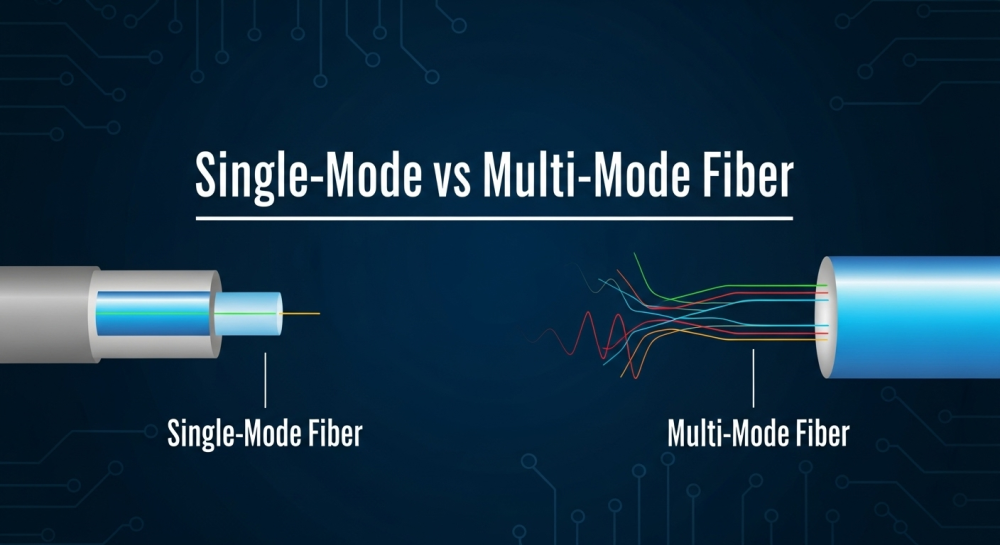
Single-Mode Fiber (SMF): Narrow core (8–10 µm) allows only one light mode, minimizing signal loss and enabling long-distance, high-bandwidth transmission.
Multi-Mode Fiber (MMF): Wider core (50 or 62.5 µm) allows multiple light modes, suitable for short-distance links, with lower transceiver costs.
Typical Applications by Distance:
Scenario
Recommended Fiber Type
Typical Application
Notes
Long Distance (>10 km)
SMF
Metropolitan Area Networks, backbone, long-haul, inter-data-center
Laser or DFB modules
Medium-Short Distance (<550 m)
MMF
Building internal networks, campus LAN
LED or VCSEL modules
Data Center (300–400 m)
MMF (OM3/OM4)
Server, storage, and switch interconnects
VCSEL optimized
Long-Haul / Carrier
SMF
DWDM, high-bandwidth services
Laser modules
Part 2:Technical Parameters and Performance of Fiber Types
Different fiber types support varying bandwidths, data rates, and distances. Choosing the correct fiber optic type ensures efficient data transmission and future-proofing.
Multi-Mode Fiber (MMF)
OM1 (62.5/125 µm): 100 Mbps up to 2 km; 1 Gbps up to 275 m; 10 Gbps up to 33 m. LED light source.
OM2 (50/125 µm): 1 Gbps up to 550 m; 10 Gbps up to 82 m. LED light source.
OM3 (50/125 µm): Laser-optimized for 10G up to 300 m; 40/100G up to 100 m. VCSEL source.
OM4 (50/125 µm): Enhanced OM3; 10G up to 550 m; 40/100G up to 150 m. Fully backward compatible.
OM5 (50/125 µm): Wideband MMF for SWDM, 10G up to 550 m, 40/100G up to 150 m.
MMF: Easier to terminate, tolerant to minor connector imperfections, bend-insensitive options (BIF) available.
Compatibility Caution: SMF and MMF cannot be directly mixed; mode-conditioning cables or media converters are needed for interoperability.
Part 7: Application Scenarios in Enterprise Networks
Enterprise LAN: MMF is common for intra-building links; SMF is recommended for new builds for future-proofing.
Data Center: MMF (OM3/OM4) for intra-rack; SMF for inter-data center and high-speed backbones.
Telecom Backbone: SMF is standard for MAN/WAN networks.
Campus / Healthcare / Finance: SMF preferred for high reliability, long-distance, and future scalability.
Upgrade Scenarios: Existing MMF may need OM4/OM5 upgrade or migration to SMF for 100G+ links.
Part 8: Future-Proofing and Upgrade Recommendations
Choosing SMF today ensures:
Choosing SMF today ensures support for 100G, 400G, 800G without replacing fiber.
Compatibility with DWDM, BiDi, and emerging high-speed transceivers.
Minimal future upgrade costs, maximizing total cost of ownership (TCO).
Part 9: Frequently Asked Questions (FAQ)
Q1: Can single-mode and multi-mode fiber be mixed? A: Not directly. Core size and propagation modes differ. Use mode-conditioning patch cables or fiber media converters for interoperability.
Q2: How to identify my existing fiber type? SMF: yellow sheath, 1310/1550 nm, 8–10 µm core. MMF: orange (OM1/OM2), aqua (OM3/OM4), lime green (OM5), 50–62.5 µm core.
Q3: If upgrading from 10G to 100G, which fiber is recommended? SMF is strongly recommended. MMF may require OM4/OM5 with MPO connectors, and distances are limited.
Q4: Which fiber is better for future 400G/800G networks? SMF is preferred for ultra-high bandwidth and long-distance applications.
Q5: Is 1310 single-mode or multimode? 1310 nm is typically used with single-mode fiber, though some older or specific MMF applications may use 1310 nm. Modern deployments almost always use 1310 nm for SMF.
Q6: Is single-mode fiber compatible with multimode? Not natively compatible. A mode-conditioning patch cable or media converter is required to connect SMF to MMF devices.
Q7: What are the disadvantages of single-mode fiber? Higher initial cost for transceivers, more precise installation required, laser safety precautions, and slightly more complex termination.
Part 10: Comparison Table of SMF vs MMF
Feature
Single-Mode Fiber (SMF)
Multi-Mode Fiber (MMF)
Core Diameter
8–10 µm
50 / 62.5 µm
Light Source
Laser (FP, DFB)
LED / VCSEL
Modes
Single
Multiple
Bandwidth
Virtually unlimited
Limited by modal dispersion
Max Distance
Long (km–hundreds km)
Short (<2 km)
Attenuation
Low (0.22–0.36 dB/km)
High (1–3 dB/km)
Dispersion
Minimal
Modal & chromatic
Cost
Fiber cheaper; transceivers higher
Fiber slightly higher; transceivers lower
Installation
Precision required
Easier, tolerant
Future Proofing
Excellent (supports 400G/800G)
Limited; may require upgrade
Sheath Color
Yellow
Orange (OM1/OM2), Aqua (OM3/OM4), Lime (OM5)
Typical Applications
Long-haul, MAN, backbone, data center interconnect
LAN, intra-rack, short campus links
Conclusion
For enterprise networks, single-mode fiber provides maximum bandwidth, long-distance capability, and future-proofing, making it the preferred choice for new deployments and high-speed upgrades. Multi-mode fiber remains cost-effective for short-distance links and existing infrastructures.