Solving Warehouse WiFi Coverage and Uptime IssuesDesign reliable warehouse WiFi coverage and uptime with warehouse wifi 6 ap, industrial wireless access points, and warehouse poe switches for racks and docks.
OLT Capacity Planning for GPON Access NetworksPlan OLT capacity for GPON OLT systems and EA5800 capacity planning, optimizing GPON split ratio and OLT uplink design for scalable fiber access.
Enterprise OLT Platform Selection for Fiber AccessDesign enterprise OLT platform strategy for GPON OLT platform, modular OLT chassis, and OLT service boards to scale passive optical LAN and XG-PON evolution.
Scale Data Center Networking Under Long Lead TimesScale data center networking faster under long lead times with data center spine switches, leaf spine data center designs and Cisco UCS fabric interconnects.
Tunnel Video Surveillance VLAN Stability over FiberDesign stable tunnel video surveillance VLANs using optical transport backbone and Arista fiber aggregation for resilient Huawei OptiX OSN CCTV networks.
Fiber vs Copper in Industrial Networks Design GuideCompare fiber vs copper in industrial ethernet, plan hybrid industrial fiber network designs, and select rugged ethernet switches and industrial SFP transceivers.
When you are performing a midnight migration to transition your core routing to a new security boundary, nothing is more frustrating than watching a critical 100G link refuse to come up between your core switch and your new security appliance. You run diagnostic commands only to find that the transceiver power readings return "N/A" on all lanes, or a Forward Error Correction (FEC) mismatch silently drops packets at the physical layer. As network architects planning a security budget in 2026, these physical-layer headaches are compounded by a much larger commercial challenge: balancing raw hardware performance against escalating multi-year subscription licensing costs.
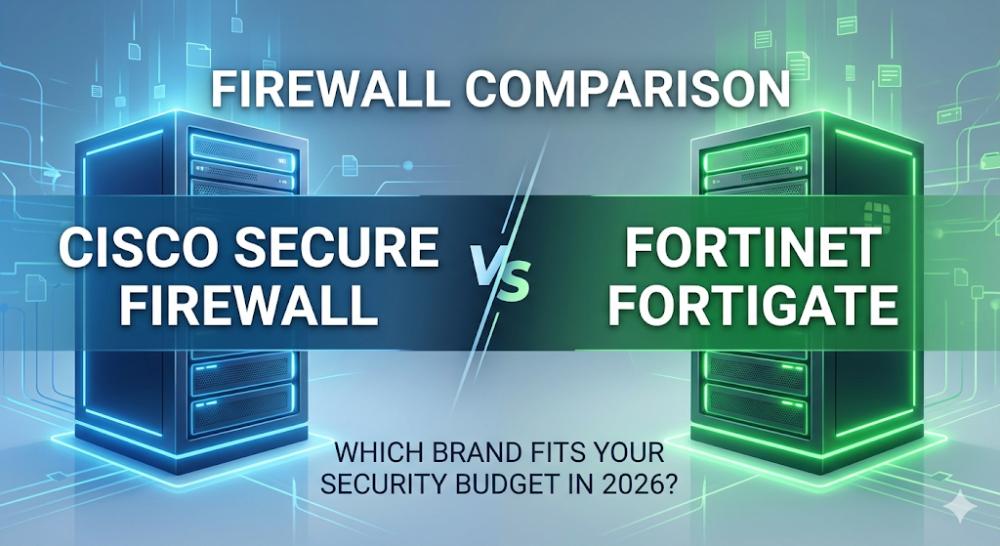
Choosing between a Cisco vs Fortinet Firewall is no longer just a question of brand loyalty; it is a complex engineering and financial calculation. This guide breaks down the architectural differences, hardware specifications, and total cost of ownership (TCO) dynamics between Cisco Secure Firewall and Fortinet FortiGate systems to help you optimize your infrastructure and budget.
The fundamental difference between Cisco vs Fortinet Firewall platforms lies in how they process packets. This architectural divergence impacts port-to-port latency, microburst handling, and how the system behaves under heavy SSL/TLS decryption loads.
Fortinet FortiGate: ASIC-Driven Acceleration
Fortinet's engineering philosophy centers on proprietary Application-Specific Integrated Circuits (ASICs). Rather than relying solely on general-purpose x86 CPUs to inspect every packet, a Fortinet FortiGate offloads specific tasks to dedicated silicon:
Network Processors (NP7): Handle IPv4/IPv6 routing, NAT, multicast traffic, and IPsec VPN encapsulation/decryption directly at the hardware layer. This bypasses the main CPU, keeping port-to-port latency in the microsecond range and preventing packet buffer serialization bottlenecks during microbursts.
Content Processors (CP9/CP10): Act as co-processors to accelerate compute-intensive tasks like pattern matching, SSL/TLS decryption, and antivirus scanning.
This hardware-centric architecture allows Fortinet to deliver exceptionally high raw throughput and low latency at a lower hardware cost, making it a highly efficient option for high-throughput, low-latency environments.
Cisco Secure Firewall: Multi-Core x86 with Hardware Offload
Cisco has historically favored a software-defined approach, running its Snort-based inspection engine on high-performance multi-core Intel Xeon processors. However, to address the performance overhead of deep packet inspection, modern Cisco Secure Firewall appliances (such as the 3100 and 4200 series) incorporate specialized hardware acceleration:
Field Programmable Gate Arrays (FPGAs): Used for flow offloading and packet classification. Trusted flows can bypass the deep inspection engine entirely, reducing CPU utilization.
Intel QuickAssist Technology (QAT): Integrated directly into the processing pipeline to accelerate cryptographic operations and compress/decompress data without exhausting x86 CPU cycles.
While Cisco's architecture offers immense flexibility for complex policy rules and deep integration with Cisco's broader security ecosystem, it relies more heavily on general-purpose compute resources, which historically resulted in a larger physical footprint and higher power consumption per gigabit of inspected traffic.
Real-World Engineering Pain: Transceiver and FEC Mismatches
A common issue when deploying high-speed interfaces (25G, 40G, or 100G) between Cisco switches and Fortinet firewalls is link negotiation failure. If your transceiver diagnostics show "N/A" for RX/TX power, or if the link remains down despite correct cabling, you are likely facing an unsupported transceiver block or a FEC mismatch.
Below is a copy-paste-ready CLI diagnostic and configuration block to resolve these physical-layer mismatches between a Cisco Nexus switch and a Fortinet FortiGate firewall:
# =================================================================
# DIAGNOSING AND FIXING LINK ISSUES ON CISCO NEXUS (SWITCH SIDE)
# =================================================================

# 1. Check if the transceiver is recognized and read DOM values
show interface ethernet 1/1 transceiver details

# 2. If RX/TX power shows "N/A" or the port is error-disabled due to third-party optics:
configure terminal
  service unsupported-transceiver

# 3. Manually configure the interface speed and force FEC to match the firewall
interface ethernet 1/1
  description Uplink_to_FortiGate_Port1
  speed 100000
  fec rs
  no shutdown
  exit
write memory

# =================================================================
# CONFIGURING THE MATCHING INTERFACE ON FORTINET FORTIGATE (CLI)
# =================================================================

# 1. Access the FortiGate CLI to configure the physical port properties
config system interface
    edit "port1"
        set speed 100000full
        # Ensure FEC matches the Cisco side (cl91/rs-fec)
        set fec cl91
    next
end

# 2. Verify physical link status and transceiver diagnostics on FortiGate
get system interface physical port1
diagnose sys physical-interface transceiver show port1
Part 2: Hardware Specifications and Performance Sizing Guide
When sizing a Next-Generation Firewall (NGFW), looking at "raw firewall throughput" can be highly misleading. Real-world performance drops significantly once you enable Intrusion Prevention Systems (IPS), Application Control, Antivirus, and SSL/TLS decryption.
To help you plan your security budget in 2026, let us compare two highly popular mid-range appliances: the Cisco Secure Firewall 3120 and the Fortinet FortiGate 400F.
Specification / Metric
Cisco Secure Firewall 3120
Fortinet FortiGate 400F
ASIC / Hardware Acceleration
Intel Xeon + FPGA + Intel QAT
Fortinet SP5 (Security Processing Unit) + CP9
Firewall Throughput (Raw)
15 Gbps
80 Gbps
IPS Throughput
15 Gbps
10 Gbps
NGFW Throughput (App + IPS)
15 Gbps
8 Gbps
Threat Protection Throughput
15 Gbps
6 Gbps
IPsec VPN Throughput
8 Gbps
55 Gbps
Interfaces
8 x RJ45, 8 x 1/10/25G SFP28
18 x GE RJ45, 8 x 10G SFP+, 4 x 25G SFP28
Performance Analysis
The Throughput Paradox: On paper, the FortiGate 400F boasts a massive 80 Gbps raw firewall throughput compared to Cisco's 15 Gbps. This is because Fortinet's ASICs can route basic stateful packets at wire speed with almost zero CPU overhead.
Deep Inspection Parity: When you enable full Threat Protection (IPS, Antivirus, Application Control, and SSL inspection), the performance gap narrows significantly. Cisco's architecture maintains a flat 15 Gbps across all inspection tiers due to its unified software pipeline and FPGA-based flow offloading. Fortinet's throughput drops from 80 Gbps to 6 Gbps under full threat inspection.
SSL/TLS Decryption: If your traffic profile consists of more than 80% encrypted traffic (which is standard in 2026), Fortinet's CP9 co-processors handle SSL inspection with minimal latency penalties. Cisco relies on Intel QAT, which is highly efficient but requires careful sizing to avoid CPU starvation under peak loads.
Part 3: Sourcing, BOM Optimization, and Risk Mitigation
When designing a security architecture, the hardware purchase price is only one part of the equation. Licensing models, subscription renewals, and supply chain lead times can make or break your project's timeline and budget.
Licensing Models and Hidden Costs
Cisco's Licensing Structure: Cisco utilizes a subscription-based model (Essentials, Advantage, and Premier) managed via Cisco Smart Licensing. While highly flexible for enterprise-wide agreements (EA), managing Smart Accounts can introduce administrative overhead. Additionally, letting a subscription lapse on a Cisco Secure Firewall can restrict access to critical security updates and management features via Cisco Secure Firewall Management Center (FMC).
Fortinet's Licensing Structure: Fortinet packages its services into FortiGuard bundles (such as Advanced Threat Protection or Unified Threat Protection). While generally more cost-effective upfront, Fortinet enforces strict licensing policies. If a license expires, the firewall may stop updating signatures entirely, and renewing a lapsed license often incurs backdated penalties.
Optimizing Your Procurement with Router-switch
Navigating the complex supply chains of major network vendors can lead to project delays. Traditional distribution channels often quote lead times of 6 to 8 weeks for high-end security appliances, risking project delay penalties and security gaps.
Router-switch mitigates these risks through its robust physical supply chain and value-added services:
Immediate Availability: With over $20 million in multi-warehouse, on-shelf inventory, Router-switch bypasses traditional lead times to offer same-week dispatch on critical security hardware.
BOM Optimization: By utilizing a flat supply chain that bypasses multiple layers of regional middleman markups, Router-switch allows System Integrators (SIs) and SMEs to secure direct bulk-purchase discounts, maximizing their security budget in 2026.
Risk Mitigation & RS Care: To protect against post-deployment hardware failures without the high cost of vendor-specific support contracts, Router-switch offers free 1-on-1 CCIE consultancy and a complimentary 3-Year RS Care extended warranty. This includes a Rapid RMA standby replacement service, shipping replacement hardware first to minimize your Mean Time to Repair (MTTR).
Guaranteed Authenticity: Every appliance shipped comes with a 100% original genuine guarantee, with serial numbers (S/N) fully verifiable in official vendor databases prior to dispatch.
Part 4: Frequently Asked Questions (FAQ)
Q1: Can I manage Fortinet firewalls using Cisco management tools?
No. Fortinet firewalls are managed via FortiManager or the local FortiOS GUI/CLI. Cisco Secure Firewalls are managed via Cisco Secure Firewall Management Center (FMC) or Cisco Defense Orchestrator (CDO). While third-party security policy management tools (like Algosec or Tufin) can orchestrate policies across both brands, native cross-vendor management is not supported.
Q2: Why does my 25G/100G link between a Cisco switch and a FortiGate show "N/A" for transceiver power?
This typically occurs when using third-party transceivers that do not fully support Digital Optical Monitoring (DOM) or when there is a mismatch in Forward Error Correction (FEC). Ensure that service unsupported-transceiver is enabled on the Cisco switch, and manually hardcode the FEC settings (e.g., set fec cl91 on FortiGate and fec rs on Cisco) to force link synchronization.
Q3: Which brand is better suited for a highly distributed branch network?
For highly distributed environments (such as retail or branch offices), Fortinet FortiGate is often preferred due to its integrated Secure SD-WAN capabilities and lower hardware cost per site. However, if your organization already relies on a Cisco-centric core (such as Cisco Catalyst SD-WAN or Cisco ISE), deploying Cisco Secure Firewall provides tighter policy integration and unified threat intelligence via Cisco Talos.
Q4: How do the licensing renewal costs compare between Cisco and Fortinet over a 5-year lifecycle?
Generally, Fortinet offers a lower initial capital expenditure (CapEx) and lower initial subscription costs. However, over a 5-year lifecycle, the total cost of ownership (TCO) can converge. Cisco's Enterprise Agreements (EA) often provide significant volume discounts for large-scale deployments, whereas Fortinet's renewal costs can rise if you require advanced security modules outside of standard bundles.
Q5: How does Router-switch handle warranty replacements compared to traditional vendor support?
While traditional vendor support contracts can be costly and complex to manage, Router-switch provides a complimentary 3-Year RS Care warranty with Rapid RMA. If a hardware failure occurs, Router-switch ships a replacement unit first, ensuring your network remains operational while the faulty unit is returned.