Solving Warehouse WiFi Coverage and Uptime IssuesDesign reliable warehouse WiFi coverage and uptime with warehouse wifi 6 ap, industrial wireless access points, and warehouse poe switches for racks and docks.
OLT Capacity Planning for GPON Access NetworksPlan OLT capacity for GPON OLT systems and EA5800 capacity planning, optimizing GPON split ratio and OLT uplink design for scalable fiber access.
Enterprise OLT Platform Selection for Fiber AccessDesign enterprise OLT platform strategy for GPON OLT platform, modular OLT chassis, and OLT service boards to scale passive optical LAN and XG-PON evolution.
Scale Data Center Networking Under Long Lead TimesScale data center networking faster under long lead times with data center spine switches, leaf spine data center designs and Cisco UCS fabric interconnects.
Tunnel Video Surveillance VLAN Stability over FiberDesign stable tunnel video surveillance VLANs using optical transport backbone and Arista fiber aggregation for resilient Huawei OptiX OSN CCTV networks.
Fiber vs Copper in Industrial Networks Design GuideCompare fiber vs copper in industrial ethernet, plan hybrid industrial fiber network designs, and select rugged ethernet switches and industrial SFP transceivers.
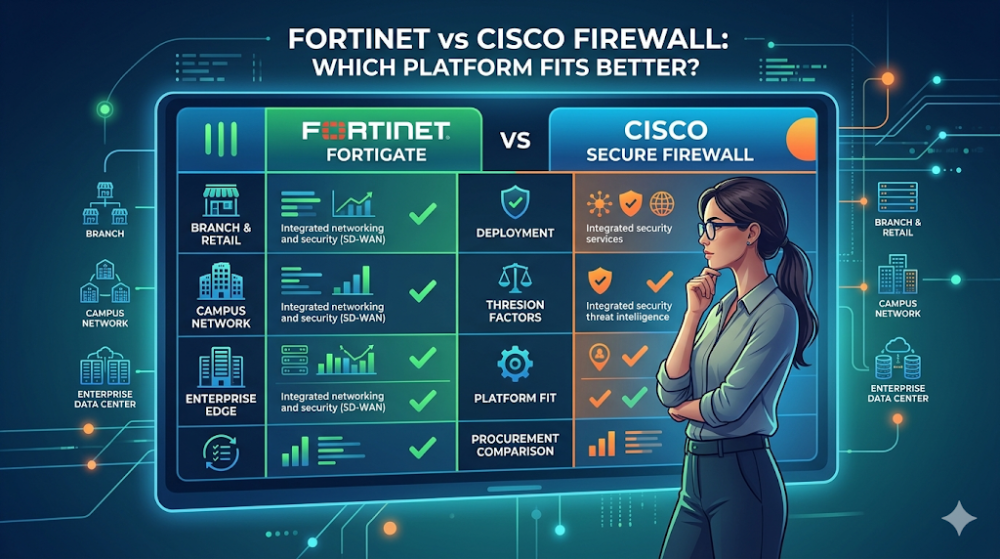
Fortinet and Cisco are both credible firewall choices, but buyers rarely struggle because one platform is obviously good and the other is obviously bad. The real difficulty is that they fit different organizations better depending on branch scale, operational model, and how tightly security has to align with the rest of the network stack. That is why the most useful comparison is not a feature checklist. It is a procurement decision: which platform is easier to approve for your real environment without creating unnecessary cost, rollout friction, or long-term management drag.
This guide is written for buyers, integrators, and technical decision-makers who are already beyond generic NGFW awareness and need a clearer answer to a practical question. If you are comparing FortiGate against Cisco Secure Firewall, you are usually deciding between faster value-to-deployment on one side and deeper Cisco-stack alignment on the other. The right answer depends on what kind of site you are protecting, how your team operates security today, and whether this is a single project or a repeatable multi-site standard.
Fortinet usually fits better when the buyer wants strong price-to-performance, straightforward branch or distributed-site rollout, and a firewall-led security decision that does not depend on a broader Cisco architecture commitment.
Cisco usually fits better when the firewall decision is tightly connected to an existing Cisco-heavy network and security operating model, especially when centralized policy consistency and broader Cisco platform alignment matter more than lowest-cost expansion.
For branch rollouts, Fortinet often wins when buyers want a cleaner scale-out path across many sites with disciplined BOM control.
For Cisco-centered enterprises, Cisco Secure Firewall can be easier to justify if the organization already runs Cisco networking and wants firewall policy and operations to stay inside that ecosystem.
The wrong way to buy is to compare only raw throughput or headline pricing. The right comparison is platform fit, operational fit, and rollout fit together.
Decision factor
Fortinet often looks stronger when
Cisco often looks stronger when
Branch rollout economics
Per-site value and faster standardization matter
Sites must stay tightly aligned with Cisco architecture standards
Operations model
Team wants a firewall-first platform with strong standalone logic
Team already operates heavily inside Cisco networking and security tooling
Buying motion
Need practical shortlist, quick quote path, and acceptable alternatives
Need ecosystem continuity more than lowest expansion cost
Enterprise preference
Security platform is selected independently from switching vendor
Firewall choice is part of a broader Cisco-wide operating model
Part 2: Where Fortinet usually fits better
Fortinet often wins when the buyer wants faster value from the firewall layer itself
Fortinet is often easier to justify when the firewall project is being evaluated as its own security and edge decision, not as a downstream consequence of an all-Cisco infrastructure strategy. In practice, that usually means the buyer is looking for strong branch and distributed-site fit, a broad model ladder, and a platform that is commercially easier to scale across multiple locations without making every site absorb enterprise-stack overhead.
Why Fortinet is often attractive for branch and distributed deployments
Fortinet’s model structure and market positioning make it especially comfortable in branch-heavy buying motions. Buyers often shortlist it when they need to protect many sites, keep BOM logic disciplined, and avoid turning every branch firewall into a larger architecture debate. This is where FortiGate can feel easier to operationalize, especially when the organization wants one vendor to cover compact branch, stronger branch, and mid-range edge tiers without dramatically changing the commercial rhythm of the rollout. Router-Switch can support that motion with practical model-by-model shortlist review, bundle clarification, stock checks, and alternative-SKU guidance before the quote path gets noisy.
When Fortinet is the safer approval path
Fortinet is often the safer approval path when the project is price-sensitive, branch-heavy, or still needs flexibility around exact model selection. Buyers in this situation usually care about whether the platform delivers enough security and operational consistency without making the project more expensive or harder to scale than it needs to be.
If your team is already narrowing specific FortiGate tiers, Router-Switch’s FortiGate model sizing guide is the better next stop after this broader brand-level comparison.
Part 3: Where Cisco usually fits better
Cisco often wins when firewall choice is part of a larger Cisco operating model
Cisco Secure Firewall becomes more attractive when the buyer is not really making a firewall-only choice. Instead, the firewall is being evaluated inside an existing Cisco-centric environment across campus, branch, data center, and security operations. In those cases, Cisco’s value is less about being the cheapest standalone firewall decision and more about preserving architectural consistency, management alignment, and internal familiarity.
Why Cisco can be easier to defend in Cisco-heavy environments
For organizations already standardized on Cisco networking, Cisco Secure Firewall may reduce political and operational friction even if the raw appliance comparison is not the only thing in its favor. Security teams may prefer to stay inside Cisco threat intelligence, policy language, and hybrid-mesh direction rather than introduce another major platform. That does not automatically make Cisco better, but it does make Cisco easier to approve in environments where vendor alignment is already a real selection criterion.
When Cisco is the safer approval path
Cisco is often the safer approval path when the enterprise wants tighter cross-domain consistency, when internal teams are already trained around Cisco workflows, or when the firewall decision will be judged partly on how well it fits a broader Cisco roadmap. In those environments, choosing another vendor can create extra operational debate even if the alternative is technically credible. If the project is already close to exact Cisco firewall selection, Router-Switch can help validate current model availability, quote positioning, and whether nearby Cisco alternatives should be considered before the RFQ is finalized.
Part 4: Branch, campus, and enterprise decision logic
Branch projects usually reward simplicity and repeatability
In branch and distributed-site projects, the best firewall is often the one that scales cleanly across many locations without forcing unnecessary complexity into each site. That is why Fortinet is frequently attractive in this part of the market. Buyers often prioritize per-site value, repeatable deployment, and easier standardization over deep architecture purity. Cisco can still make sense here, especially in Cisco-heavy organizations, but it usually needs to be justified as part of that broader standard, not just as a one-box comparison win.
Campus and mixed-edge environments depend more on operating model
Once the environment becomes more campus-like or mixed between branch edge and broader enterprise operations, the decision becomes less about raw branch economics and more about how the security platform fits day-to-day administration. This is the point where some teams prefer Fortinet because it keeps the firewall choice commercially flexible, while others prefer Cisco because the firewall is expected to live inside a larger Cisco-managed environment. The right answer here is rarely “which vendor has more features.” It is “which platform creates less operating friction for this team over the next three years.”
Enterprise selection should focus on platform fit, not brand prestige
In enterprise projects, both Fortinet and Cisco can be justified. The question is whether the security platform is being chosen primarily for firewall value and deployment flexibility, or whether it must reinforce a bigger architecture strategy. If the project needs strong standalone economics and a practical route from branch through stronger edge tiers, Fortinet may be easier to defend. If the project needs policy consistency and ecosystem alignment across a Cisco-centered estate, Cisco may be easier to defend. Buyers should be honest about which of those two pressures is real, because that usually determines the better answer faster than a long spec sheet ever will.
Part 5: What buyers should compare before RFQ
1. Compare platform fit, not just throughput tables
Throughput still matters, but it is rarely the deciding factor by itself. Compare how each platform fits the actual site profile, traffic pattern, and rollout objective.
2. Compare operational fit
Ask which platform is easier for your existing team to deploy, manage, and justify internally. That answer often matters more than one benchmark delta.
3. Compare rollout economics
If the project is multi-site, compare what the platform does to the total rollout budget, not just one site’s appliance line item.
4. Compare quote structure and acceptable alternatives
Many firewall buying errors happen because one quote is appliance-led, another is bundle-led, and the buyer has not decided whether nearby alternatives are acceptable if stock or lead time shifts. Router-Switch can reduce that friction by checking current availability, validating whether the shortlisted model is really the right commercial fit, and comparing alternative model paths before procurement locks the wrong assumption into the PO.
5. Compare strategic dependence
If choosing Cisco only makes sense because the organization is already deep in Cisco, say that clearly. If choosing Fortinet only makes sense because the project values rollout efficiency and platform independence, say that clearly too. Hidden assumptions are what make brand comparisons drift into bad buying decisions.
Part 6: Common mistakes in Fortinet vs Cisco firewall selection
Mistake 1: Treating this as a generic brand battle
This is not really a “which brand is better?” question. It is a project-fit question. Buyers who turn it into a broad brand fight usually lose sight of the actual deployment constraints.
Mistake 2: Buying only for today’s smallest requirement
Especially in branch rollouts, buyers sometimes choose the platform that looks cheapest or simplest at the first site without checking whether it still works cleanly across the larger rollout or over the next refresh cycle.
Mistake 3: Ignoring internal operating reality
A technically acceptable platform can still be the wrong answer if the internal team is structured around another operating model. This matters a lot in Cisco-heavy enterprises.
Mistake 4: Waiting too long to normalize quote logic
By the time quotes arrive, buyers should already know what model class they are comparing, what bundle assumptions are acceptable, and whether nearby alternatives can be considered if availability changes. If not, the comparison becomes noisy and political very quickly.
FAQ
Is Fortinet better than Cisco for branch firewalls?
Often it is easier to justify for branch-heavy and distributed-site projects, especially when buyers prioritize price-to-performance and repeatable rollout logic. But Cisco can still be the better answer if the branch project must stay tightly aligned with a Cisco-wide architecture.
Is Cisco better than Fortinet for enterprise firewalls?
Not automatically. Cisco is often stronger when enterprise security operations are already closely tied to Cisco platforms. Fortinet is often stronger when the enterprise wants more firewall-platform independence and cleaner rollout economics.
What matters more, security features or operating fit?
Both matter, but in real procurement, operating fit is often what separates a good shortlist from a bad one. Most buyers at this stage are choosing between credible platforms, not between a strong one and a weak one.
Should I compare pricing directly between Fortinet and Cisco?
Yes, but only after you normalize the deployment tier, bundle assumptions, support expectations, and project scope. Otherwise you may think you are comparing price when you are actually comparing different buying structures.
What is the best next step after this comparison?
The best next step is to narrow the project to a realistic platform direction, then compare exact model shortlists and quote structures instead of staying at brand-general level.
Part 7: The next practical step
If your team is actively deciding between Fortinet and Cisco, the next useful step is not another generic brand article. It is a shortlist exercise: identify the likely deployment tier, confirm whether branch economics or ecosystem alignment is the stronger selection pressure, and then compare the exact models that fit that logic.
That is usually where buying decisions get unstuck. Router-Switch can help review the shortlist, compare Fortinet and Cisco quote structures, check current availability, and flag nearby alternatives before the final approval path hardens around the wrong model. For most real projects, that practical step is worth more than another round of abstract feature debate.
Expertise Builds Trust
20+ Years • 200+ Countries • 21500+ Customers/Projects CCIE · JNCIE · NSE7 · ACDX · HPE Master ASE · Dell Server/AI Expert