Solving Warehouse WiFi Coverage and Uptime IssuesDesign reliable warehouse WiFi coverage and uptime with warehouse wifi 6 ap, industrial wireless access points, and warehouse poe switches for racks and docks.
OLT Capacity Planning for GPON Access NetworksPlan OLT capacity for GPON OLT systems and EA5800 capacity planning, optimizing GPON split ratio and OLT uplink design for scalable fiber access.
Enterprise OLT Platform Selection for Fiber AccessDesign enterprise OLT platform strategy for GPON OLT platform, modular OLT chassis, and OLT service boards to scale passive optical LAN and XG-PON evolution.
Scale Data Center Networking Under Long Lead TimesScale data center networking faster under long lead times with data center spine switches, leaf spine data center designs and Cisco UCS fabric interconnects.
Tunnel Video Surveillance VLAN Stability over FiberDesign stable tunnel video surveillance VLANs using optical transport backbone and Arista fiber aggregation for resilient Huawei OptiX OSN CCTV networks.
Fiber vs Copper in Industrial Networks Design GuideCompare fiber vs copper in industrial ethernet, plan hybrid industrial fiber network designs, and select rugged ethernet switches and industrial SFP transceivers.
When executing a rolling storage node replacement in a high-density Ceph cluster or resolving latency spikes on legacy hyperconverged infrastructure (HCI) backplanes, the choice of SATA boot and read-intensive drives directly dictates your IOPS-per-watt efficiency. Many systems engineers face a critical decision point when upgrading older hypervisors: do they stick with the field-proven Samsung PM883, or transition to the newer Samsung PM893? While both drives utilize the legacy SATA III (6 Gbps) interface, treating them as drop-in equivalents overlooks fundamental shifts in NAND cell architecture, controller processing pipelines, and long-term write endurance profiles. Understanding these differences is key to avoiding premature drive failures, controller queue bottlenecks, and unexpected storage array rebuilds.
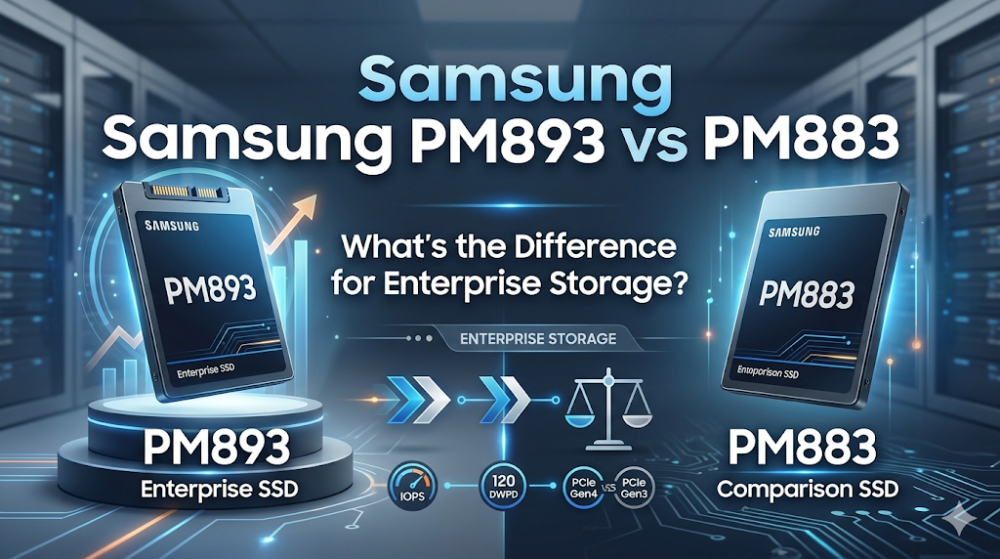
The core distinction in the Samsung PM893 vs PM883 comparison lies in the generational leap of Samsung's proprietary silicon and vertical NAND (V-NAND) fabrication. While the PM883 relies on Samsung's 5th-generation (V5) 96-layer 3D TLC V-NAND paired with the legacy "Maru" controller, the Samsung PM893 Enterprise SSD leverages 6th-generation (V6) 128-layer 3D TLC V-NAND managed by the advanced "Metis" controller.
V6 vs. V5 V-NAND Cell Physics
The transition from 96-layer to 128-layer V-NAND is not merely a vertical stacking exercise. Samsung's V6 architecture utilizes a channel hole etching process that reduces cell-to-cell interference and lowers operating voltages.
Write Latency Reduction: The V6 NAND features a write-loop time reduction of approximately 10% compared to V5, directly translating to lower write amplification factors (WAF) during sustained random write workloads.
Power Efficiency: By shrinking the physical footprint of the memory cells and optimizing the word-line pitch, V6 NAND achieves up to a 15% reduction in active power consumption per bit transferred.
Controller Evolution: Maru vs. Metis
The controller acts as the traffic cop for the SSD, managing the Flash Translation Layer (FTL), garbage collection (GC) scheduling, and Low-Density Parity-Check (LDPC) error correction.
Queue Depth and Command Processing: The Metis controller in the PM893 features enhanced hardware-accelerated FTL mapping. Under heavy Native Command Queuing (NCQ) depth (up to 32 commands), the Metis controller exhibits significantly tighter latency distribution curves (QoS) than the older Maru controller.
Error Correction Code (ECC) Engine: As NAND cells shrink, raw bit error rates (RBER) naturally increase. The PM893's Metis controller integrates an upgraded LDPC engine capable of executing multi-stage soft-decision decoding with minimal latency penalties, preventing read-retry operations that cause sudden latency spikes in legacy PM883 arrays.
Part 2: Hardware Specifications and Performance Sizing Guide
When designing an enterprise SATA SSD performance sizing matrix, raw sequential speeds are rarely the bottleneck; the SATA III bus caps theoretical throughput at 600 MB/s. Instead, engineers must evaluate sustained random IOPS, write endurance (Drive Writes Per Day - DWPD), and power-loss protection (PLP) reliability.
The following table outlines the critical hardware differences between these two enterprise drives:
Specification Parameter
Samsung PM883 (V5 NAND / Maru)
Samsung PM893 (V6 NAND / Metis)
Interface
SATA III 6.0 Gbps
SATA III 6.0 Gbps
Capacity Range
240GB, 480GB, 960GB, 1.92TB, 3.84TB, 7.68TB
240GB, 480GB, 960GB, 1.92TB, 3.84TB, 7.68TB
Sequential Read / Write
Up to 550 / 520 MB/s
Up to 550 / 520 MB/s
Random Read IOPS (4KB)
Up to 98,000 IOPS
Up to 98,000 IOPS
Random Write IOPS (4KB)
Up to 28,000 IOPS (Capacity dependent)
Up to 32,000 IOPS (Capacity dependent)
Endurance (DWPD over 5 Years)
1.3 DWPD
1.3 DWPD
Mean Time Between Failures (MTBF)
2.0 Million Hours
2.0 Million Hours
Power Loss Protection (PLP)
Hardware Tantalum Capacitors
Enhanced Hardware PLP Circuitry
Analyzing the SATA SSD DWPD Endurance Comparison
While both drives are rated at 1.3 DWPD (Drive Writes Per Day) over a 5-year warranty period, the underlying wear-leveling efficiency differs. The PM893's Metis controller utilizes an optimized garbage collection algorithm that reduces write amplification during mixed random workloads. In real-world deployments, this means the PM893 will maintain its rated endurance with a higher safety margin under sustained 70:30 read/write database workloads compared to the PM883.
Diagnostic CLI: Verifying Drive Health and Link Speed
To verify that your newly installed drives are negotiating at full SATA III speeds and to monitor their remaining wear life, you can use the standard Linux smartctl utility. Below is a diagnostic command block to query the drive's internal telemetry:
# Identify the drive path (e.g., /dev/sda) and run a detailed SMART query
sudo smartctl -x /dev/sda

# Expected output highlights for Samsung PM893:
# Device Model:     SAMSUNG MZ7L31T9HBLT-00A07 (PM893 1.92TB)
# SATA Version is:  SATA 3.3, 6.0 Gb/s (current: 6.0 Gb/s)
# LU WWN Device Id: 5 002538 f11a2b3c4
#
# Monitor wear-out indicator (Attribute 177 - Wear Range Delta or 233 - Media Wearout Indicator):
# ID# ATTRIBUTE_NAME          FLAGS    VALUE WORST THRESH TYPE      UPDATED  WHEN_FAILED RAW_VALUE
# 177 Wear_Leveling_Count     0x0013   099   099   000    Pre-fail  Always       -       12
# 233 Media_Wearout_Indicator 0x0032   099   099   000    Old_age   Always       -       1
If the current speed shows 3.0 Gb/s or 1.5 Gb/s, check your SAS/SATA HBA configuration or backplane integrity, as this indicates a negotiation bottleneck that will throttle your Samsung PM883 SSD comparison benchmarks.
Part 3: Sourcing, BOM Optimization, and Risk Mitigation
When managing large-scale datacenter refreshes, technical superiority is only half the battle; supply chain predictability and total cost of ownership (TCO) are equally critical. Transitioning your Bill of Materials (BOM) from legacy PM883 drives to the modern PM893 requires a strategic sourcing partner who can mitigate lead-time risks and guarantee hardware authenticity.
Overcoming Lead-Time Bottlenecks
Traditional IT distribution channels often quote 6 to 8-week lead times for enterprise-grade SSDs, which can stall critical virtualization projects and incur costly project delay fines. To optimize your procurement timeline, you can explore the Samsung PM893 Enterprise SSD Pricing and Availability on Router-switch. By maintaining over $20 million in physical, on-shelf inventory across global multi-warehouse locations, Router-switch bypasses traditional distribution delays to offer same-week dispatch on bulk orders.
Direct Supply Chain Savings
By utilizing a flat supply chain that bypasses multiple layers of regional middlemen, Router-switch enables system integrators and enterprise IT departments to secure direct bulk-purchase discounts. This cost optimization allows you to transition your legacy storage nodes to the PM893 platform without exceeding your allocated capital expenditure (CAPEX) budget.
Risk Mitigation and Engineering Support
Deploying storage hardware in mission-critical environments requires absolute assurance of product authenticity and post-sales support:
100% Original Genuine Guarantee: Every Samsung SSD sourced through Router-switch features fully verifiable serial numbers (S/N) that can be validated directly in official manufacturer databases prior to deployment.
Complimentary 3-Year RS Care Warranty: To safeguard your investment against premature hardware failures, Router-switch provides a complimentary 3-Year RS Care extended warranty, backed by a Rapid RMA standby replacement program that ships replacement drives first to minimize your Mean Time to Repair (MTTR).
CCIE-Level Technical Consultancy: Navigating compatibility issues between legacy SAS/SATA RAID controllers (such as Broadcom/LSI MegaRAID or HPE Smart Array) and modern V6 NAND drives can be complex. Router-switch offers free 1-on-1 technical consultancy with certified CCIE and storage systems engineers to validate your BOM before you purchase.
Part 4: Frequently Asked Questions (FAQ)
Q1: Can I mix Samsung PM893 and PM883 drives within the same RAID 5 or RAID 6 array?
A: While it is technically possible because both drives share the same SATA III interface and sector formatting (512e/4Kn compatibility), it is not recommended for production environments. The PM893 utilizes the newer Metis controller and V6 NAND, which exhibits different write latency profiles and garbage collection behaviors than the PM883's Maru controller. Mixing them can cause the RAID controller to experience minor latency jitter, potentially degrading the overall performance of the array to the speed of the slowest drive.
Q2: How does the power consumption of the PM893 compare to the PM883 under full write workloads?
A: Thanks to the 128-layer V6 V-NAND architecture, the PM893 is more power-efficient. It achieves up to a 10-15% reduction in active write power consumption compared to the PM883 at equivalent capacities. This reduction lowers the thermal footprint of high-density 1U or 2U storage servers, leading to indirect savings on datacenter cooling costs.
Q3: Does the PM893 support hardware-based encryption, and is it compatible with older servers?
A: Yes, the Samsung PM893 supports AES 256-bit hardware encryption and conforms to TCG Enterprise standards. It is fully backward compatible with legacy SATA II (3 Gbps) and SATA I (1.5 Gbps) backplanes, though running the drive on these legacy interfaces will severely bottleneck its sequential throughput.
Q4: Why should I choose the PM893 over consumer-grade Samsung EVO/PRO drives for my server?
A: Consumer drives lack the dedicated hardware-based Power-Loss Protection (PLP) capacitors found in the PM893. In the event of a sudden datacenter power failure, consumer drives risk losing data still residing in the volatile DRAM cache, which can lead to silent data corruption. Furthermore, the PM893 features enterprise-grade firmware optimized for sustained 24/7 write workloads and tight Quality of Service (QoS) latency bounds, whereas consumer drives are optimized for bursty, single-user workloads.
Q5: How can I verify the remaining lifespan of my PM893 drives in a VMware ESXi environment?
A: You can query the drive's health directly through the ESXi command-line interface using the esxcli storage core device smart get command. Look for the "Media Wearout Indicator" or "Percentage Used" parameter to determine how much of the drive's rated 1.3 DWPD write endurance has been consumed.
Expertise Builds Trust
20+ Years • 200+ Countries • 21500+ Customers/Projects CCIE · JNCIE · NSE7 · ACDX · HPE Master ASE · Dell Server/AI Expert