OLT Capacity Planning for GPON Access NetworksPlan OLT capacity for GPON OLT systems and EA5800 capacity planning, optimizing GPON split ratio and OLT uplink design for scalable fiber access.
Enterprise OLT Platform Selection for Fiber AccessDesign enterprise OLT platform strategy for GPON OLT platform, modular OLT chassis, and OLT service boards to scale passive optical LAN and XG-PON evolution.
Tunnel Video Surveillance VLAN Stability over FiberDesign stable tunnel video surveillance VLANs using optical transport backbone and Arista fiber aggregation for resilient Huawei OptiX OSN CCTV networks.
Fiber vs Copper in Industrial Networks Design GuideCompare fiber vs copper in industrial ethernet, plan hybrid industrial fiber network designs, and select rugged ethernet switches and industrial SFP transceivers.
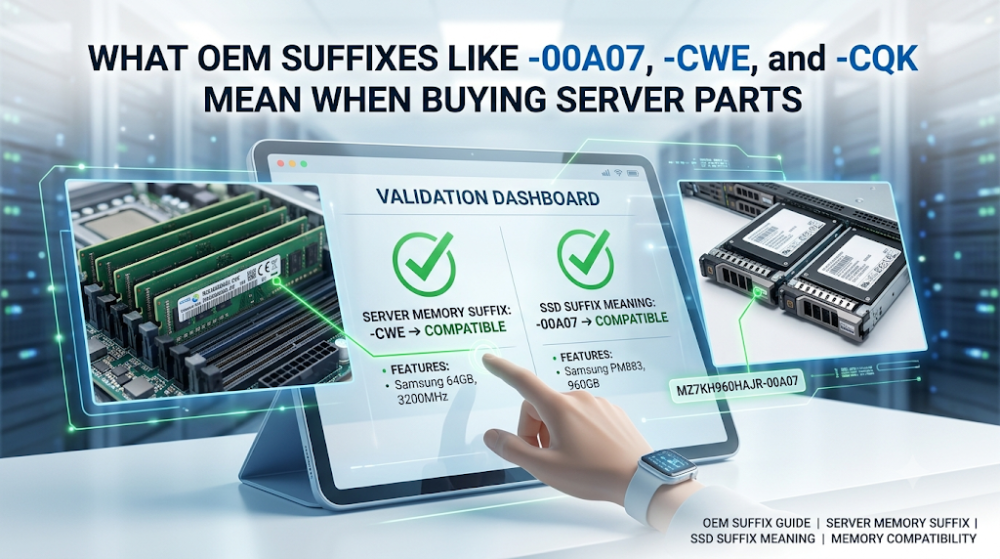
Enterprise buyers and technical procurement teams often run into the same problem: two memory modules or SSDs look identical in capacity and form factor, but the part numbers are slightly different. One ends in -00A07, another in -CWE, and another in -CQP. In some cases, these suffixes change nothing. In others, they determine whether the part will work in the target server at all.
This is why OEM suffixes matter in enterprise procurement. They are not random manufacturer codes. They typically carry information about packaging, revision, firmware version, temperature grade, voltage, regulator design, or OEM-specific qualification. A buyer who ignores the suffix risks receiving a module that is electrically correct but logically incompatible with the server platform.
This article explains what common OEM suffixes mean, why they affect compatibility, and what buyers should check before approving a replacement or substitution order.
OEM suffixes carry configuration, revision, and qualification data. They are not decorative. They indicate differences in firmware, voltage, temperature range, PCB revision, or OEM approval status.
Some suffixes change compatibility. A server may accept one revision and reject another even if the capacity and speed are the same.
Not every suffix difference is a dealbreaker. Packaging codes, batch identifiers, and region markers often do not affect functionality.
Buyers should validate suffixes against the server platform's memory or storage qualification list. The safest path is not to assume interchangeability.
Substitution without suffix validation is a common cause of failed memory and SSD orders. Procurement teams who treat all same-capacity parts as interchangeable often learn the hard way that the server will not boot.
Suffix type
What it often means
Does it affect compatibility?
Revision code (-00A07, -00B01)
Firmware or PCB revision update
Sometimes. Newer revisions may fix bugs or change timing.
Temperature grade (-CWE, -CQP)
Operating temperature range
Yes, if the server requires extended temperature support.
Voltage or regulator suffix
1.2V vs 1.35V, buffered vs unbuffered
Yes, especially in servers with strict SPD requirements.
OEM qualification code
Dell, HPE, or Cisco validated variant
Often yes. Some servers reject non-qualified modules.
Packaging or region code
Tray vs retail, region distribution
Usually no, if the part itself is functionally identical.
Part 2: Why OEM suffixes exist
Memory and SSD manufacturers use suffixes to track product variants
A base part number like M393A4K40DB3 refers to a Samsung DDR4 RDIMM module. But the full part number often includes additional characters that describe the exact configuration. Manufacturers need this granularity because enterprise servers are sensitive to timing, voltage, temperature, and firmware behavior. A module that works in one generation of PowerEdge may not be accepted by the next generation even if the headline specs match.
OEMs add their own qualification layers
Major server vendors like Dell, HPE, and Cisco validate memory and storage for their platforms. When a manufacturer produces a qualified variant, it may receive an OEM-specific suffix or firmware revision. That means two modules from the same manufacturer can have different suffixes simply because one was qualified for HPE and another was not. A server that enforces qualified-part validation may refuse to boot with the non-qualified version.
Procurement teams often see suffixes only at the quote stage
Buyers frequently compare quotes based on capacity, speed, and brand, without realizing that the suffix difference between two quoted parts could change whether the module works. This is especially common when a supplier quotes a generic variant while the original BOM specified an OEM-qualified variant.
Part 3: Common suffix categories and what they mean
Revision and firmware codes
Codes like -00A07 or -00B01 often indicate a firmware or PCB revision change. In some cases, the revision fixes a known timing issue, improves signal integrity, or updates the SPD (serial presence detect) data that the server reads during boot. If the server platform requires a specific revision, an older or newer suffix may cause compatibility warnings or prevent the system from initializing the module.
Temperature grade codes
Codes like -CWE, -CQP, or -CTD sometimes relate to temperature specifications. Enterprise memory is typically rated for standard commercial temperature, but some deployments in challenging environments may require extended temperature support. A suffix that changes the temperature grade is relevant if the server operates outside standard data center conditions.
Voltage and buffer type indicators
Some suffixes reflect differences between registered DIMMs, load-reduced DIMMs, or unbuffered DIMMs. Others distinguish between standard voltage and low-voltage variants. Server platforms often enforce voltage consistency across all installed modules, so mixing standard and low-voltage DIMMs, or registered and unbuffered types, can cause boot failures even when the physical slots accept both formats.
OEM-specific qualification codes
When a server vendor qualifies a module, the manufacturer may assign a variant-specific suffix or firmware revision. This is not always visible to the buyer, but it shows up in qualification lists and compatibility matrices. If a server requires qualified parts, substituting a generic variant with the same base part number may still fail validation.
Part 4: Suffixes that change compatibility
Any suffix that changes firmware or SPD data
If the server reads the module's SPD to determine configuration, timing, or voltage, any suffix that changes the SPD can alter compatibility. This is especially common when a manufacturer releases a newer revision that the server platform has not yet validated.
Temperature grade changes in non-standard environments
Standard data center conditions rarely stress temperature limits, but edge deployments, industrial environments, or poorly ventilated closets may. If the project involves non-standard conditions, a suffix that changes the temperature grade becomes a real compatibility factor.
OEM qualification in managed environments
Servers with strict qualified-part enforcement, including some Dell and HPE platforms with active support contracts, may log warnings or refuse to initialize non-qualified memory. In those cases, even a technically identical module with the wrong suffix is functionally incompatible.
Part 5: Suffixes that usually do not matter
Packaging codes
Some suffixes simply indicate tray packaging versus retail packaging, or bulk versus individual box. If the module itself is functionally identical, the packaging code usually does not affect compatibility.
Region or distribution codes
Manufacturers sometimes append codes that indicate the region where the part was distributed. These typically do not change the module's electrical or logical behavior, assuming the part itself is the same revision and configuration.
Batch identifiers
Batch or date codes that appear in the full part string are usually irrelevant to compatibility unless they coincide with a known manufacturing change that affects firmware or timing.
Part 6: How to validate a suffix before ordering
Check the server vendor's memory or storage qualification list
The most reliable source is the platform vendor's published compatibility matrix. Dell, HPE, Cisco, and others maintain lists of tested and validated part numbers for each server generation. If the part number with its full suffix appears on the list, it is qualified.
Cross-reference with the manufacturer's product change notice
If a suffix appears to indicate a revision change, check whether the manufacturer has published a product change notice or revision history. This often explains whether the change affects timing, voltage, firmware, or compatibility.
Ask the supplier for the exact revision and compatibility confirmation
Suppliers should be able to confirm which revision they are shipping and whether it matches the original BOM requirement. If the supplier cannot confirm, that is a signal that the part may not be the correct variant.
Test before approving large substitutions
If the project involves a large memory or SSD refresh, validating one module in the target server before approving the full order is the safest approach. One failed test is far less expensive than a full batch of incompatible parts.
Part 7: Common buyer mistakes
Mistake 1: Treating same-capacity parts as interchangeable
Capacity is only one variable. Timing, voltage, revision, and qualification status all matter in enterprise servers.
Mistake 2: Ignoring the full part number during quote comparison
Buyers who compare quotes on base part numbers only may approve a substitution that changes a critical suffix.
Mistake 3: Assuming newer revisions are always better
A newer revision may not yet be validated for the target server. In some cases, the older revision is the only one the platform supports.
Mistake 4: Ordering generic variants for platforms that require qualified parts
Some servers enforce qualified-part validation. A generic module with the same base specs may still fail to initialize.
FAQ
What does the -00A07 suffix mean on Samsung server memory?
The -00A07 suffix typically indicates a specific revision, packaging, or OEM qualification variant. The exact meaning depends on the product family, but it often relates to firmware revision or OEM-specific configuration. Buyers should cross-reference the full part number with the server vendor's qualification list.
Are -CWE and -CQP interchangeable?
Not always. These codes may indicate different temperature grades, PCB revisions, or OEM qualifications. Whether they are interchangeable depends on the server platform's validation status for each specific suffix.
Can I substitute a generic memory module for an OEM-qualified module?
Sometimes, but not safely without validation. Some servers enforce qualified-part checks and will reject generic variants even if the electrical specs match. Always check the platform's qualification list before substituting.
Where can I check if a part number is qualified for my server?
Start with the server vendor's published memory or storage compatibility matrix. Dell, HPE, Cisco, and other vendors maintain qualification lists by server generation and platform. Cross-reference the full part number including suffix.
What is the best way to avoid ordering the wrong server memory or SSD?
Validate the full part number including suffix against the server vendor's qualification list. Ask the supplier for confirmation of the exact revision. For large orders, test one module before approving the full batch.
Part 8: How to turn this into a buying decision
OEM suffixes are not random characters. They carry real information about revision, qualification, voltage, temperature, and packaging. Buyers who treat them as meaningless often end up with parts that fail validation, cause boot errors, or void support coverage.
The safest approach is to treat the full part number as the unit of compatibility, not just the base number. Before approving any substitution, check the server vendor's qualification list, ask the supplier for revision confirmation, and test when possible. This reduces the risk of ordering a module that looks right but does not work in the target platform.
If your project involves memory or SSD procurement and you are comparing part numbers with different suffixes, Router-Switch can help validate compatibility and availability. For teams that need to match exact qualified parts, confirming the full part number including suffix is the first step before placing the order.
Expertise Builds Trust
20+ Years • 200+ Countries • 21500+ Customers/Projects
CCIE · JNCIE · NSE7 · ACDX · HPE Master ASE · Dell Server/AI Expert