Solving Warehouse WiFi Coverage and Uptime IssuesDesign reliable warehouse WiFi coverage and uptime with warehouse wifi 6 ap, industrial wireless access points, and warehouse poe switches for racks and docks.
OLT Capacity Planning for GPON Access NetworksPlan OLT capacity for GPON OLT systems and EA5800 capacity planning, optimizing GPON split ratio and OLT uplink design for scalable fiber access.
Enterprise OLT Platform Selection for Fiber AccessDesign enterprise OLT platform strategy for GPON OLT platform, modular OLT chassis, and OLT service boards to scale passive optical LAN and XG-PON evolution.
Scale Data Center Networking Under Long Lead TimesScale data center networking faster under long lead times with data center spine switches, leaf spine data center designs and Cisco UCS fabric interconnects.
Tunnel Video Surveillance VLAN Stability over FiberDesign stable tunnel video surveillance VLANs using optical transport backbone and Arista fiber aggregation for resilient Huawei OptiX OSN CCTV networks.
Fiber vs Copper in Industrial Networks Design GuideCompare fiber vs copper in industrial ethernet, plan hybrid industrial fiber network designs, and select rugged ethernet switches and industrial SFP transceivers.
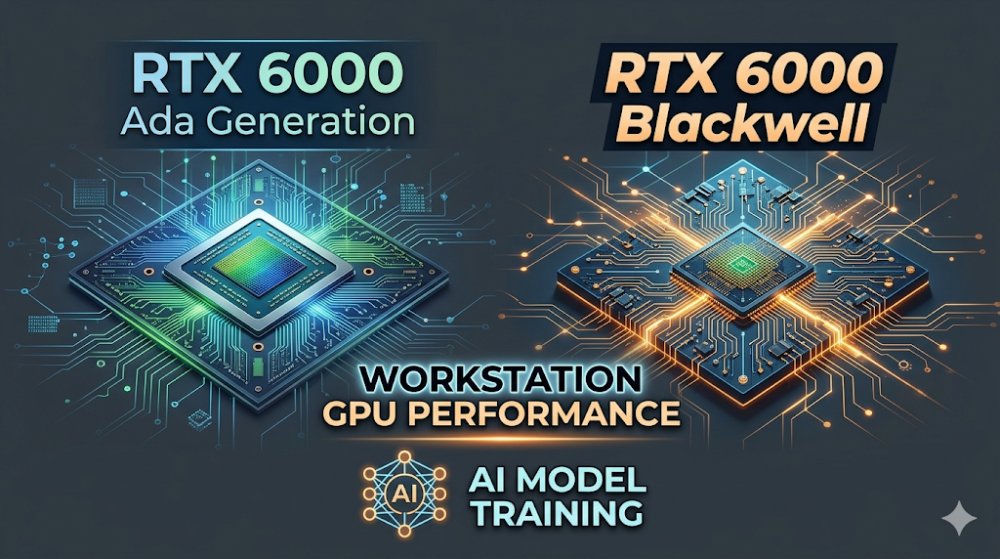
When your engineering team is running local LLM fine-tuning, complex CAD assemblies, or real-time photorealistic rendering pipelines, and you start seeing CUDA out-of-memory (OOM) errors or PCIe Gen 4 bus saturation during multi-GPU synchronization, the hardware bottleneck is no longer a theoretical problem—it is a direct hit to your deployment timeline. Selecting the right workstation GPU is a critical architectural decision. The transition from the Ada Lovelace architecture to the highly anticipated Blackwell architecture represents one of the most significant generational leaps in NVIDIA's history. This deep-dive technical review compares the NVIDIA RTX 6000 Blackwell against the established RTX 6000 Ada Generation, analyzing ASIC pipelines, memory subsystems, and real-world performance sizing to guide your next infrastructure upgrade.
To understand the performance delta between the NVIDIA RTX 6000 Blackwell and the RTX 6000 Ada Generation, we must look directly at the silicon. The Ada Lovelace architecture (built on the custom TSMC 4N process) optimized the graphics and compute pipeline through 4th Generation Tensor Cores and 3rd Generation RT Cores. However, as enterprise workloads shifted heavily toward generative AI and large language models (LLMs), the demand for lower-precision compute and higher interconnect bandwidth exposed the physical limitations of the Ada architecture.
The Blackwell ASIC Evolution: TSMC 4NP and the Dual-Die Era
The Blackwell architecture transition introduces a refined TSMC 4NP process node, allowing for a massive increase in transistor density and power efficiency. While high-end data center Blackwell GPUs (like the B200) utilize a dual-die design connected by a high-bandwidth silicon interconnect, the workstation-class NVIDIA RTX 6000 Blackwell leverages these architectural efficiencies within a highly optimized monolithic or dual-die package tailored for standard workstation thermal envelopes.
Tensor Core and Transformer Engine Upgrades
The core differentiator in workstation GPU performance for AI workloads lies in the Tensor Core architecture:
RTX 6000 Ada Generation: Features 4th Generation Tensor Cores with a FP8 Transformer Engine. It excels at FP16 and FP8 precision, but lacks native support for lower-precision formats without quantization loss.
NVIDIA RTX 6000 Blackwell: Introduces 5th Generation Tensor Cores paired with a 2nd Generation Transformer Engine. Crucially, Blackwell adds native support for FP4 and FP6 precision. This allows engineers to run massive LLMs locally at a fraction of the memory footprint, effectively doubling the token-generation throughput compared to Ada without sacrificing model accuracy.
Ray Tracing (RT) Cores and Rendering Pipelines
For rendering and simulation, the RT Core evolution is equally significant. The RTX 6000 Ada's 3rd Gen RT Cores introduced Opacity Micromap (OMM) and Displaced Micro-Mesh (DMM) engines to accelerate ray tracing of complex geometries. Blackwell's 4th Gen RT Cores build on this with enhanced ray-triangle intersection testing and improved hardware-assisted motion blur acceleration, making it the premier AI model training GPU and rendering powerhouse for real-time photorealistic simulations.
PCIe Gen 5 vs. PCIe Gen 4 Bus Dynamics
A common bottleneck in multi-GPU workstation configurations is host-to-device transfer speeds. The RTX 6000 Ada is limited to PCIe Gen 4 x16, capping theoretical bi-directional bandwidth at 64 GB/s. The NVIDIA RTX 6000 Blackwell upgrades the interface to PCIe Gen 5 x16, doubling the bi-directional bandwidth to 128 GB/s. This is critical for loading massive datasets into VRAM and preventing CPU-to-GPU bottlenecks during complex simulation runs.
Part 2: Hardware Specifications and Performance Sizing Guide
When sizing your workstation cluster, raw specifications must be mapped directly to your workload requirements. Below is a detailed technical comparison of the two flagship GPUs.
Specification
NVIDIA RTX 6000 Ada Generation
NVIDIA RTX 6000 Blackwell (Workstation)
Architecture
Ada Lovelace (AD102)
Blackwell (GB102/Workstation Variant)
Process Node
TSMC 4N (Custom)
TSMC 4NP (Custom)
CUDA Cores
18,176
Up to 19,200+ (Architectural Target)
Tensor Cores
568 (4th Gen)
600+ (5th Gen)
VRAM Capacity & Type
48GB GDDR6 with ECC
48GB GDDR7 with ECC
Memory Bandwidth
960 GB/s
Up to 1,500+ GB/s (GDDR7 Advantage)
PCIe Interface
PCIe Gen 4.0 x16
PCIe Gen 5.0 x16
FP32 Compute Performance
~91.1 TFLOPS
~120+ TFLOPS
FP8 Tensor Compute
~1,457 TFLOPS (with Sparsity)
~2,200+ TFLOPS (with Sparsity)
FP4 Tensor Compute
Not Supported Natively
~4,400+ TFLOPS (with Sparsity)
TDP (Power Consumption)
300W
300W - 350W (Configurable)
Diagnostic and Performance Monitoring CLI
To verify that your workstation is utilizing the full bandwidth of the PCIe bus and to monitor for thermal throttling or ECC memory errors, engineers can use the following nvidia-smi diagnostic commands. This is highly useful when troubleshooting multi-GPU setups under heavy AI training loads.
# Query GPU details, active PCIe generation, link width, and ECC error counts
nvidia-smi --query-gpu=index,name,pcie.link.gen.current,pcie.link.gen.max,pcie.link.width.current,ecc.errors.uncorrected.aggregate.total,temperature.gpu,power.draw --format=csv

# Expected Output Example for RTX 6000 Ada (PCIe Gen 4):
# index, name, pcie.link.gen.current, pcie.link.gen.max, pcie.link.width.current, ecc.errors.uncorrected.aggregate.total, temperature.gpu, power.draw [W]
# 0, NVIDIA RTX 6000 Ada Generation, 4, 4, 16, 0, 72, 285.40 W

# Expected Output Example for RTX 6000 Blackwell (PCIe Gen 5):
# 0, NVIDIA RTX 6000 Blackwell, 5, 5, 16, 0, 68, 310.20 W
Performance Sizing Recommendations
Local LLM Fine-Tuning (7B to 70B Parameters): The RTX 6000 Blackwell is the clear winner here. Thanks to native FP4 support, a single Blackwell GPU can hold and run models that previously required dual RTX 6000 Ada cards, drastically reducing hardware acquisition costs.
High-Fidelity CAD and CAE Simulations: If your workload is bound by memory bandwidth, the transition to GDDR7 in the Blackwell GPU provides a ~50% increase in memory throughput, preventing the GPU execution pipelines from stalling while waiting for data.
Multi-GPU Scaling: Because neither card supports physical NVLink bridges in standard workstation form factors, multi-GPU scaling relies entirely on the PCIe bus. The PCIe Gen 5 interface on the Blackwell GPU mitigates this bottleneck, offering twice the inter-GPU communication speed over the Ada generation.
Part 3: Sourcing, BOM Optimization, and Risk Mitigation
Deploying high-end enterprise GPUs involves navigating complex supply chains, long lead times, and significant capital expenditure. For systems integrators and enterprise IT departments, sourcing these components efficiently is just as important as their raw compute performance.
Overcoming Distributor Lead Times
Traditional distribution channels for enterprise-grade GPUs like the RTX 6000 series often suffer from lead times of 8 to 12 weeks, which can stall critical AI research and development projects. Router-switch addresses this bottleneck by maintaining over $20 million in multi-warehouse on-shelf stock, enabling same-week dispatch for critical hardware upgrades. This ensures your engineering teams can begin deployment immediately rather than waiting months for allocation.
Flat Supply Chain and BOM Optimization
By bypassing multiple layers of regional middlemen, Router-switch's flat supply chain allows system integrators and enterprise buyers to secure direct bulk-purchase discounts. This optimization is crucial when building out multi-node GPU clusters where hardware costs scale exponentially. To optimize your enterprise AI infrastructure procurement, you can explore the NVIDIA RTX 6000 Blackwell pricing and availability to secure allocation for your next-generation compute clusters.
Mitigating Post-Deployment Risks
High-performance GPUs operating under continuous compute loads are susceptible to thermal stress and hardware degradation. While traditional vendor warranties can involve complex, slow RMA processes that increase your Mean Time to Repair (MTTR), Router-switch provides robust risk mitigation:
Free 1-on-1 CCIE & Systems Engineer Consultancy: Ensure your power delivery, thermal design, and PCIe lane allocation are fully optimized before deployment.
Complimentary 3-Year RS Care Extended Warranty: Extends your hardware protection well beyond standard terms.
Rapid RMA Standby Replacement: In the event of a hardware anomaly, Router-switch ships a replacement unit first, minimizing downtime for your critical development pipelines.
100% Original Genuine Guarantee: Every GPU shipped features a fully verifiable serial number (S/N) that can be validated directly in the manufacturer's official database, ensuring absolute authenticity and peace of mind.
Part 4: Frequently Asked Questions (FAQ)
Q1: Can I mix NVIDIA RTX 6000 Blackwell and RTX 6000 Ada in the same multi-GPU workstation?
While you can physically install both cards in a system with sufficient PCIe slots and power supply capacity, mixing architectures for distributed workloads (like PyTorch model training or SLI-like rendering) is not recommended. CUDA will treat them as separate devices with different compute capabilities (9.0 for Blackwell vs. 8.9 for Ada), leading to synchronization bottlenecks and load-balancing inefficiencies.
Q2: How does the transition to PCIe Gen 5 in the RTX 6000 Blackwell impact deep learning workloads?
PCIe Gen 5 doubles the bandwidth to 128 GB/s bi-directional. In deep learning, this significantly reduces the time spent loading model weights from system RAM to GPU VRAM and accelerates gradient synchronization in multi-GPU training setups that do not utilize NVLink.
Q3: What are the power supply (PSU) and thermal requirements when upgrading from Ada to Blackwell?
The RTX 6000 Ada has a TDP of 300W and utilizes a standard 16-pin (12VHPWR) PCIe power connector. The RTX 6000 Blackwell workstation variant is expected to have a slightly higher or comparable TDP (300W–350W). However, due to higher transient power spikes common in next-gen architectures, it is highly recommended to use an ATX 3.0-compliant power supply with a native 12VHPWR or 12V-2x6 cable rated for at least 1000W for single-GPU setups, and 1600W+ for dual-GPU configurations.
Q4: Does the RTX 6000 Blackwell support physical NVLink for workstation configurations?
NVIDIA has phased out physical NVLink connectors on workstation-class GPUs to segment them from high-end data center platforms (like the H100/B200). Multi-GPU scaling on both the RTX 6000 Ada and RTX 6000 Blackwell relies on high-speed PCIe communication, making the Blackwell GPU's PCIe Gen 5 support critical for mitigating the lack of a dedicated NVLink bridge.
Q5: How does the new FP4 precision in Blackwell benefit local LLM deployment?
Native FP4 support allows the 2nd Generation Transformer Engine to compress model weights to 4-bit precision with minimal loss in accuracy. This effectively doubles the capacity of the 48GB VRAM, allowing a single RTX 6000 Blackwell to run models that would otherwise require 96GB of VRAM on older architectures, drastically lowering the entry barrier for local enterprise AI inference.
Expertise Builds Trust
20+ Years • 200+ Countries • 21500+ Customers/Projects CCIE · JNCIE · NSE7 · ACDX · HPE Master ASE · Dell Server/AI Expert