Solving Warehouse WiFi Coverage and Uptime IssuesDesign reliable warehouse WiFi coverage and uptime with warehouse wifi 6 ap, industrial wireless access points, and warehouse poe switches for racks and docks.
OLT Capacity Planning for GPON Access NetworksPlan OLT capacity for GPON OLT systems and EA5800 capacity planning, optimizing GPON split ratio and OLT uplink design for scalable fiber access.
Enterprise OLT Platform Selection for Fiber AccessDesign enterprise OLT platform strategy for GPON OLT platform, modular OLT chassis, and OLT service boards to scale passive optical LAN and XG-PON evolution.
Scale Data Center Networking Under Long Lead TimesScale data center networking faster under long lead times with data center spine switches, leaf spine data center designs and Cisco UCS fabric interconnects.
Tunnel Video Surveillance VLAN Stability over FiberDesign stable tunnel video surveillance VLANs using optical transport backbone and Arista fiber aggregation for resilient Huawei OptiX OSN CCTV networks.
Fiber vs Copper in Industrial Networks Design GuideCompare fiber vs copper in industrial ethernet, plan hybrid industrial fiber network designs, and select rugged ethernet switches and industrial SFP transceivers.
When you are performing a midnight NVMe-over-Fabrics (NVMe-oF) migration or scaling out an RDMA-enabled AI compute cluster and start noticing silent packet drops and TCP retransmissions across your legacy leaf switches, the culprit is rarely the physical fiber. In high-throughput, low-latency storage environments, microbursts easily overwhelm static packet buffers, leading to packet buffer serialization bottlenecks. For years, the Mellanox Spectrum SN2700 served as the workhorse of the 100GbE data center leaf/spine fabric. However, as workloads transition to distributed machine learning and high-density flash storage, the limitations of first-generation silicon become apparent.
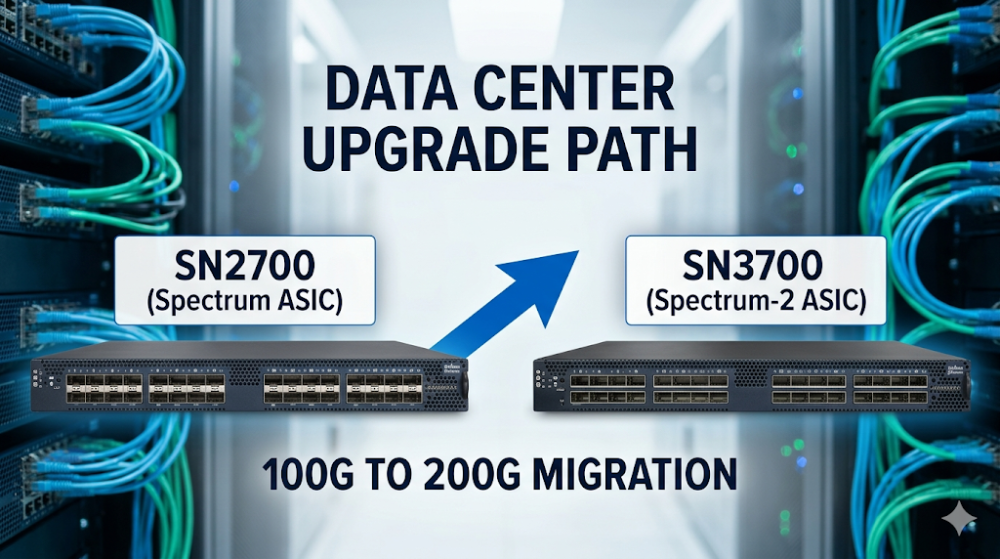
Upgrading from the Mellanox Spectrum SN2700 (Spectrum-1 ASIC) to the SN3700 (Spectrum-2 ASIC) is not merely a transition from 100GbE to 200GbE; it is a fundamental architectural shift in packet buffer allocation, telemetry capabilities, and congestion management. This deep-dive technical analysis evaluates the silicon pipelines, performance metrics, and real-world deployment strategies required to execute a seamless data center 100G to 200G migration.
Silicon Pipeline Evolution: Spectrum-1 vs. Spectrum-2 ASIC Architecture
The architectural divergence between the Mellanox Spectrum SN2700 vs SN3700 begins at the silicon level. The SN2700 is powered by the first-generation Spectrum-1 ASIC, fabricated on a 28nm process node. The SN3700 utilizes the Spectrum-2 ASIC, built on a highly efficient 16nm FinFET process. This die shrink allowed Mellanox to double the switching capacity while introducing sophisticated packet processing pipelines.
Packet Buffer Serialization and Microburst Mitigation
The most critical upgrade in the Spectrum-2 ASIC architecture is the packet buffer allocation model:
Spectrum-1 (SN2700): Features a 16MB fully shared packet buffer. While superior to the carved/segmented buffers of contemporary Broadcom Tomahawk chips, 16MB can quickly saturate under heavy incast patterns (e.g., many-to-one storage writes).
Spectrum-2 (SN3700): Boasts a massive 42MB dynamically shared packet buffer. This buffer is not statically partitioned per port; instead, a dynamic allocation algorithm assigns buffer space on-demand to ports experiencing transient congestion. This significantly alters the microburst drop profile, allowing the SN3700 to absorb bursts up to 2.6 times larger than the SN2700 before initiating tail drops or triggering Priority Flow Control (PFC).
Latency Profiles
In high-frequency trading (HFT) and ultra-low-latency clustering, port-to-port latency is a key metric. The SN2700 delivers an ultra-low cut-through latency of 300ns for 100GbE packets. Interestingly, the SN3700 exhibits a slightly higher latency profile of approximately 425ns. This minor increase is the trade-off for the Spectrum-2's enhanced pipeline depth, larger buffer lookup tables, and advanced packet parsing capabilities. For 99% of enterprise data centers and AI workloads, the massive buffer capacity and congestion avoidance mechanisms of the SN3700 far outweigh the 125ns latency delta.
Hardware-Telemetry: What-Just-Happened (WJH)
The Spectrum-1 ASIC relies on traditional sFlow and SNMP polling, which often miss transient microbursts occurring in the millisecond range. The Spectrum-2 ASIC introduces hardware-embedded What-Just-Happened (WJH) telemetry. WJH inspects packets dropped at the ASIC level and streams detailed diagnostic metadata (including the exact drop reason, such as VLAN mismatch, ACL drop, or buffer tail drop) directly to monitoring tools in real-time. This eliminates the guesswork during complex network troubleshooting.
Hardware Specifications and Real-World Performance Sizing
When planning a Mellanox SN2700 upgrade path, network architects must evaluate the physical and logical scaling limits of both platforms. The SN2700 is strictly a 100GbE platform, whereas the SN3700 family offers multiple SKU variations, including the SN3700C (a 32-port 100G switch designed as a direct drop-in replacement for the SN2700 but with Spectrum-2 advantages) and the standard SN3700 (which supports 32 ports of 200GbE via QSFP56 interfaces).
The following table outlines the technical specifications of the SN2700, SN3700C, and SN3700:
Specification Parameter
Mellanox Spectrum SN2700
Mellanox Spectrum SN3700C
Mellanox Spectrum SN3700
ASIC Generation
Spectrum-1 (28nm)
Spectrum-2 (16nm)
Spectrum-2 (16nm)
Switching Capacity
3.2 Tbps
6.4 Tbps
6.4 Tbps
Forwarding Rate
4.76 Bpps
8.33 Bpps
9.52 Bpps
Packet Buffer
16MB (Fully Shared)
42MB (Dynamically Shared)
42MB (Dynamically Shared)
Max Port Density
32x 100GbE (QSFP28)
32x 100GbE (QSFP28)
32x 200GbE (QSFP56)
Breakout Capabilities
64x 50G, 64x 25G, 128x 10G
64x 50G, 128x 25G, 128x 10G
64x 100G, 128x 50G, 128x 25G
Port-to-Port Latency
300ns
425ns
425ns
L3 Routing Scale (IPv4)
Up to 256K Routes
Up to 512K Routes
Up to 512K Routes
Mitigating Port Flapping and FEC Mismatches in 100G/200G Deployments
A common real-world engineering struggle during a data center 100G to 200G migration involves Forward Error Correction (FEC) mismatches. When connecting a legacy 100G NIC (such as a ConnectX-4 or ConnectX-5) to a newer Spectrum-2 switch port, or when utilizing third-party transceivers, the link often fails to come up or experiences continuous port flapping.
This occurs because the default FEC mode on the SN3700 (typically Reed-Solomon FEC, or rs) may not automatically negotiate with the legacy NIC, which might expect no-fec or Firecode FEC (fc).
To resolve this, network engineers must manually configure the port speed, breakout options, and FEC modes. Below is a copy-paste-ready configuration script for Mellanox Onyx (MLNX-OS) to split a 200G port on an SN3700 into two 100G interfaces, manually set the FEC mode to rs to prevent flapping, and verify the packet buffer drop counters.
# Enter global configuration mode
enable
configure terminal

# Step 1: Configure port breakout on interface 1/1 (Split 200G QSFP56 to 2x 100G)
interface ethernet 1/1 module-type qsfp-split-2

# Step 2: Navigate to the newly created sub-interfaces and configure FEC
interface ethernet 1/1/1
  description Uplink_To_Legacy_100G_Leaf
  speed 100G
  fec rs
  no shutdown
exit

interface ethernet 1/1/2
  description Storage_Node_Connection
  speed 100G
  fec rs
  no shutdown
exit

# Step 3: Configure RoCEv2 Congestion Control (Explicit Congestion Notification - ECN)
interface ethernet 1/1/1 traffic-class 3 congestion-control ecn minimum-threshold 150kb maximum-threshold 1500kb mark-probability 10

# Step 4: Verification and Diagnostics
show interfaces ethernet 1/1/1 status
show interfaces ethernet 1/1/1 counters drop
show system wjh-records
Strategic Migration and Procurement: Optimizing Data Center CapEx
Migrating an active data center fabric from the SN2700 to the SN3700 requires careful planning to avoid network downtime and budget overruns. Traditional distribution channels often quote lead times of 6 to 8 weeks for high-density switches, which can stall critical infrastructure expansions and result in project delay penalties.
Router-switch addresses these supply chain bottlenecks by maintaining over $20 million in multi-warehouse on-shelf stock, enabling same-week dispatch to global destinations, including the US market. This rapid availability is critical for enterprise customers executing phased migrations where hardware must arrive precisely when maintenance windows open.
Furthermore, Router-switch's flat supply chain bypasses multiple layers of regional distributor markups, allowing system integrators and enterprise IT departments to secure direct bulk-purchase discounts on both the legacy SN2700 (for sparing or expanding existing legacy pods) and the newer SN3700 series.
To mitigate post-deployment risks, every switch shipped is backed by a 100% original genuine guarantee, with serial numbers fully verifiable in the manufacturer's official database prior to shipment. Instead of relying on expensive, rigid vendor support contracts, deployments are supported by Router-switch's free 1-on-1 CCIE/CCDE-level engineering consultancy and a complimentary 3-Year RS Care extended warranty, which includes a Rapid RMA standby replacement service to minimize Mean Time to Repair (MTTR).
Expert Troubleshooting and Community Q&A
Q1: Can I mix SN2700 and SN3700 switches in the same EVPN-VXLAN fabric?
Yes. Both the Spectrum-1 (SN2700) and Spectrum-2 (SN3700) ASICs fully support EVPN-VXLAN control planes. However, you must design your fabric around the lowest common denominator regarding scale. The SN2700 has smaller ARP/ND and MAC tables compared to the SN3700. If you use SN2700 switches as leaf nodes and SN3700 switches as spines, ensure that the leaf nodes do not exceed their 256K L3 routing and host table limits.
Q2: Why does my SN3700 show packet drops even though the average bandwidth utilization is under 40%?
This is a classic symptom of microbursting. Average bandwidth is typically calculated over 1-minute or 5-minute intervals by SNMP. A microburst occurs in microseconds, where multiple server ports simultaneously send traffic to a single uplink port. If the burst exceeds the transient buffer capacity, the switch drops the packets. While the SN3700's 42MB buffer mitigates this significantly compared to the SN2700's 16MB buffer, you may still need to enable Explicit Congestion Notification (ECN) and Priority Flow Control (PFC) to allow RoCEv2 to throttle the sending NICs before drops occur.
Q3: Can I run Cumulus Linux or SONiC on both the SN2700 and SN3700?
Yes. Both switches are built on an open platform architecture. They support Mellanox Onyx (MLNX-OS), Cumulus Linux, and SONiC (Software for Open Networking in the Cloud). When migrating, ensure that your network automation scripts (Ansible/Terraform) are updated, as interface naming conventions and hardware-specific buffer profiles differ between the Spectrum-1 and Spectrum-2 ASICs under open operating systems.
Q4: How does the port breakout capability differ when migrating from the SN2700 to the SN3700?
The SN2700 (QSFP28) supports breaking out a single 100G port into 4x 25G or 4x 10G interfaces. The SN3700 (QSFP56) allows you to break out a single 200G port into 2x 100G, 4x 50G, or 4x 25G interfaces. This provides double the density of 25G/50G connections per rack unit, making the SN3700 an exceptionally dense leaf switch for high-performance compute nodes.
Expertise Builds Trust
20+ Years • 200+ Countries • 21500+ Customers/Projects CCIE · JNCIE · NSE7 · ACDX · HPE Master ASE · Dell Server/AI Expert