Solving Warehouse WiFi Coverage and Uptime IssuesDesign reliable warehouse WiFi coverage and uptime with warehouse wifi 6 ap, industrial wireless access points, and warehouse poe switches for racks and docks.
OLT Capacity Planning for GPON Access NetworksPlan OLT capacity for GPON OLT systems and EA5800 capacity planning, optimizing GPON split ratio and OLT uplink design for scalable fiber access.
Enterprise OLT Platform Selection for Fiber AccessDesign enterprise OLT platform strategy for GPON OLT platform, modular OLT chassis, and OLT service boards to scale passive optical LAN and XG-PON evolution.
Scale Data Center Networking Under Long Lead TimesScale data center networking faster under long lead times with data center spine switches, leaf spine data center designs and Cisco UCS fabric interconnects.
Tunnel Video Surveillance VLAN Stability over FiberDesign stable tunnel video surveillance VLANs using optical transport backbone and Arista fiber aggregation for resilient Huawei OptiX OSN CCTV networks.
Fiber vs Copper in Industrial Networks Design GuideCompare fiber vs copper in industrial ethernet, plan hybrid industrial fiber network designs, and select rugged ethernet switches and industrial SFP transceivers.
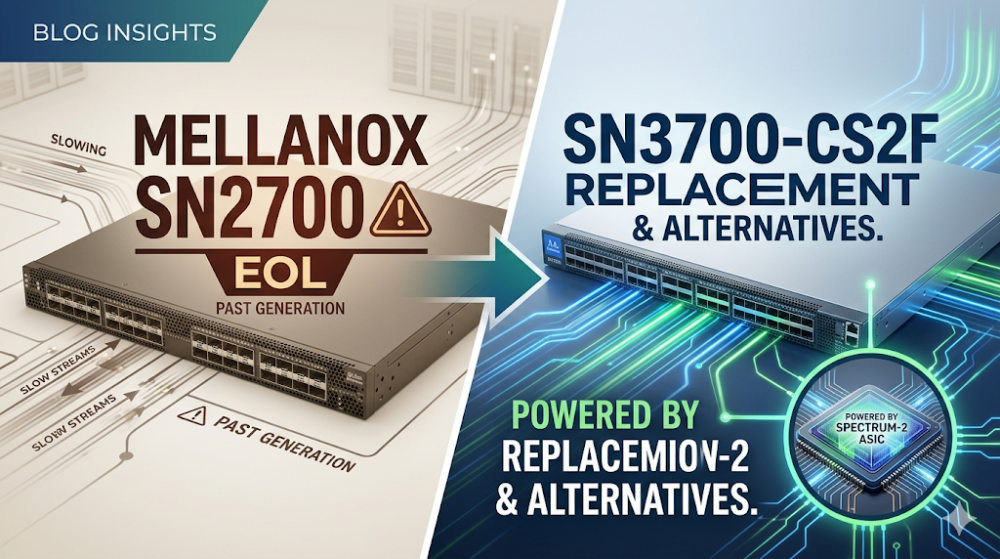
When you are performing a midnight vSAN migration or scaling out an NVMe-over-Fabrics (NVMe-oF) storage cluster, the last thing you want to see is silent packet drops or port flapping across your legacy leaf switches. For years, the Mellanox SN2700 served as the backbone of high-performance, low-latency 100GbE networks. However, with the Mellanox SN2700 EOL (End-of-Life) milestones now passed, network architects face a critical decision: how to transition their aging Spectrum-1 infrastructure to modern, supported hardware without risking packet loss, configuration mismatches, or costly downtime.
The logical successor is the NVIDIA Mellanox SN3700-CS2F, powered by the Spectrum-2 ASIC. This transition is not merely a simple hardware swap; it represents a fundamental shift in packet buffer serialization, telemetry capabilities, and Forward Error Correction (FEC) handling. This guide provides a deep technical blueprint for migrating from the SN2700 to the SN3700-CS2F, analyzing ASIC pipeline differences, addressing real-world configuration bottlenecks, and outlining strategic procurement paths to minimize lead times.
Silicon Evolution: Spectrum-1 vs. Spectrum-2 ASIC Pipeline Architecture
The architectural leap from the Spectrum-1 ASIC (powering the SN2700) to the Spectrum-2 ASIC (powering the SN3700-CS2F) fundamentally changes how high-frequency trading (HFT) platforms, AI workloads, and storage area networks (SANs) process packets.
Packet Buffer Allocation and Microburst Mitigation
The SN2700 utilizes a 16MB fully shared, dynamic packet buffer. While highly efficient for its time, modern RoCEv2 (RDMA over Converged Ethernet) workloads can easily saturate this buffer during incast scenarios—where multiple 25G/100G leaf nodes burst traffic simultaneously to a single storage target. The SN3700-CS2F replacement upgrades this to a massive 42MB fully shared packet buffer. More importantly, the Spectrum-2 ASIC introduces dynamic buffer allocation algorithms that dynamically carve buffer space based on real-time port congestion, virtually eliminating microburst-induced packet drops that trigger TCP slow-start or PFC (Priority Flow Control) storms.
Pipeline Flexibility and VXLAN/EVPN Scale
While the Spectrum-1 pipeline is relatively rigid, the Spectrum-2 ASIC features a fully programmable pipeline. This allows the SN3700-CS2F to support double the ARP/neighbor table sizes and significantly larger ACL rule sets. For multi-tenant cloud environments, the Spectrum-2 ASIC processes VXLAN encapsulation and decapsulation in a single pass, maintaining a deterministic port-to-port latency of 425ns, even when routing across VXLAN tunnels.
What Just Happened (WJH) Telemetry
One of the most significant operational upgrades in the Spectrum-2 platform is hardware-level telemetry. While the SN2700 relied on traditional sFlow and SNMP (which often miss transient microbursts), the SN3700-CS2F features "What Just Happened" (WJH) telemetry. WJH inspects packets at the ASIC pipeline level and instantly alerts administrators if a packet is dropped, providing the exact reason (e.g., VLAN mismatch, ACL drop, MTU violation, or buffer congestion) and the packet header details, reducing Mean Time to Resolution (MTTR) from hours to seconds.
Hardware Specifications and Real-World Performance Sizing
When planning your migration path, reviewing the Mellanox SN2700 Switch Specifications and EOL Status is the critical first step to mapping out port-density requirements and power budgets. The SN3700-CS2F is designed to fit into the exact same 1U rack space while offering double the switching capacity and significantly enhanced port flexibility.
The following table highlights the key hardware differences between the legacy SN2700 and the modern SN3700-CS2F:
Specification
Mellanox SN2700 (Legacy)
NVIDIA Mellanox SN3700-CS2F (Replacement)
ASIC Generation
Spectrum-1
Spectrum-2
Switching Capacity
3.2 Tbps
6.4 Tbps
Packet Forwarding Rate
4.76 Bpps
8.33 Bpps
Packet Buffer
16 MB (Fully Shared)
42 MB (Fully Shared)
Port Configuration
32x QSFP28 (100GbE)
32x QSFP28 (100GbE / Splittable to 128x 10G/25G)
Latency
300 ns (Port-to-Port)
425 ns (Port-to-Port)
Telemetry
sFlow, Standard Mirroring
What Just Happened (WJH) Hardware Telemetry
Typical Power Consumption
150 W
171 W
Resolving Port Breakout, FEC Mismatches, and RoCEv2 Buffers in Production
A common issue engineers face when replacing an SN2700 with an SN3700-CS2F is port flapping or link failure due to Forward Error Correction (FEC) mismatches and incorrect port breakout configurations. On the SN2700, 100G ports connected to older 25G NICs often defaulted to specific FEC modes (like no-fec or Firecode CL74). The SN3700-CS2F, running newer Onyx (MLNX-OS) or Cumulus Linux releases, defaults to RS-FEC CL91 for 100G and Reed-Solomon (RS) for 25G/50G. If the connected transceiver or NIC does not match this setting, the link will remain down.
Below is a copy-paste-ready configuration script for NVIDIA Onyx (MLNX-OS) to split a 100G QSFP28 port into 4x25G channels, manually override the FEC settings to prevent port flapping, and configure RoCEv2 Priority Flow Control (PFC) to optimize the packet buffer for storage traffic.
enable
configure terminal

# Step 1: Split QSFP28 Port 1/1 into four 25G interfaces
interface ethernet 1/1 module-type qsfp-split-4

# Step 2: Configure the split interfaces (1/1/1 through 1/1/4)
interface ethernet 1/1/1-1/1/4
  no speed auto-negotiation
  speed 25000
  fec override rs
  mtu 9216
  no shutdown
exit

# Step 3: Configure RoCEv2 Priority Flow Control (PFC) on Priority 3
dcb priority-flow-control enable

interface ethernet 1/1/1-1/1/4
  dcb priority-flow-control mode on
  priority-flow-control priority 3 force
exit

# Step 4: Verify the configuration and link status
show interfaces ethernet 1/1/1 status
show interfaces ethernet 1/1/1 transceiver
show priority-flow-control
Strategic Lifecycle Migration and Supply Chain Optimization
Migrating away from EOL hardware like the SN2700 is not just a technical challenge; it is a logistical one. Traditional distribution channels often quote lead times of 8 to 12 weeks for enterprise-grade switches, which can stall critical data center expansions and trigger project delay penalties.
Router-switch addresses these supply chain bottlenecks directly. By maintaining a $20M+ multi-warehouse on-shelf stock, Router-switch ensures same-week dispatch for critical networking hardware, including the SN3700-CS2F. This flat supply chain model bypasses multiple layers of regional distributor markups, allowing system integrators and enterprise IT departments to secure direct bulk-purchase discounts and optimize their Bill of Materials (BOM).
Furthermore, migrating to new hardware introduces post-deployment operational risks. While traditional vendor support contracts can be prohibitively expensive, Router-switch mitigates this by offering free 1-on-1 CCIE/CCDE level engineering consultancy to assist with configuration translation, a complimentary 3-Year RS Care extended warranty, and rapid RMA standby replacement which ships replacement hardware first to minimize Mean Time to Repair (MTTR). All hardware comes with a 100% original genuine guarantee, with serial numbers fully verifiable in official vendor databases prior to shipping.
Q1: Can I run Cumulus Linux on the SN3700-CS2F just like I did on the SN2700?
Yes. The SN3700-CS2F is an ONIE (Open Network Install Environment) compliant switch. While NVIDIA has transitioned its primary operating system focus toward NVIDIA User Experience (Onyx) and SONiC, Cumulus Linux is fully supported on the Spectrum-2 ASIC. However, ensure you are using Cumulus Linux version 4.x or later, as older 3.x releases do not contain the necessary ASIC drivers for Spectrum-2.
Q2: Why does my 100G link fail to come up when connecting the SN3700-CS2F to an older SN2700 switch?
This is almost always caused by a FEC mismatch. The SN2700 defaults to no-fec or CL74 on older firmware, while the SN3700-CS2F defaults to RS-FEC (CL91) for 100G links. You must manually configure both ends of the link to use the same FEC mode. Use the fec override command in Onyx or edit /etc/network/interfaces in Cumulus to align the FEC settings.
Q3: How does the Spectrum-2 ASIC handle RoCEv2 congestion control differently than Spectrum-1?
The Spectrum-1 ASIC (SN2700) relies primarily on static ECN (Explicit Congestion Notification) marking thresholds. The Spectrum-2 ASIC (SN3700-CS2F) introduces hardware-accelerated, dynamic ECN marking based on queue growth rates rather than static queue depths. This allows the switch to signal congestion to end-hosts much faster, preventing buffer overflow and reducing the need to trigger disruptive PFC pause frames.
Q4: Are the transceivers and DAC cables used on the SN2700 compatible with the SN3700-CS2F?
Yes, both switches utilize standard QSFP28 ports. Standard 100G SR4, LR4, AOCs, and passive copper DACs are fully backward compatible. However, because the SN3700-CS2F supports higher port densities and tighter tolerances, it is highly recommended to verify that your transceivers are coded correctly and that their serial numbers are officially recognized to avoid "unsupported transceiver" port-lock errors.
Expertise Builds Trust
20+ Years • 200+ Countries • 21500+ Customers/Projects
CCIE · JNCIE · NSE7 · ACDX · HPE Master ASE · Dell Server/AI Expert