Solving Warehouse WiFi Coverage and Uptime IssuesDesign reliable warehouse WiFi coverage and uptime with warehouse wifi 6 ap, industrial wireless access points, and warehouse poe switches for racks and docks.
OLT Capacity Planning for GPON Access NetworksPlan OLT capacity for GPON OLT systems and EA5800 capacity planning, optimizing GPON split ratio and OLT uplink design for scalable fiber access.
Enterprise OLT Platform Selection for Fiber AccessDesign enterprise OLT platform strategy for GPON OLT platform, modular OLT chassis, and OLT service boards to scale passive optical LAN and XG-PON evolution.
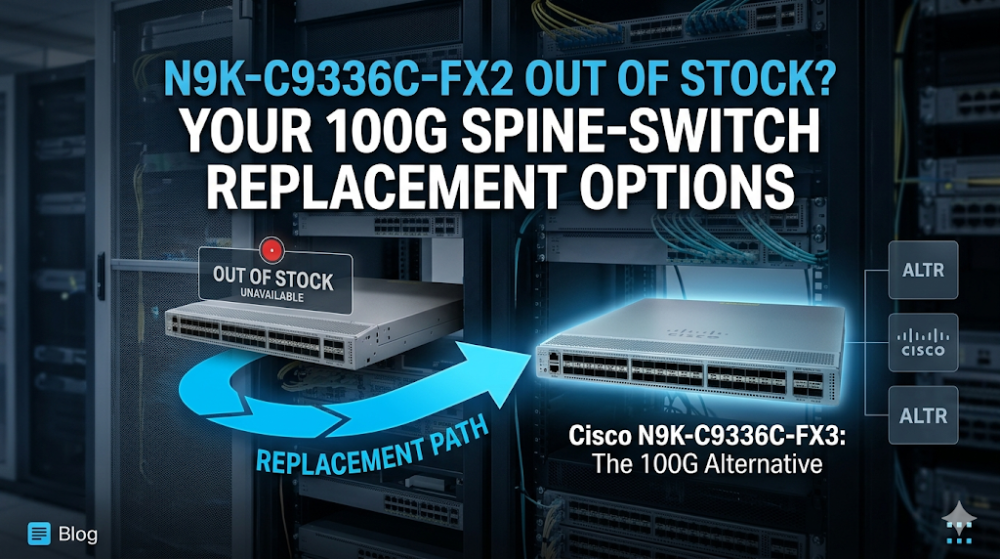
Scale Data Center Networking Under Long Lead TimesScale data center networking faster under long lead times with data center spine switches, leaf spine data center designs and Cisco UCS fabric interconnects.
Tunnel Video Surveillance VLAN Stability over FiberDesign stable tunnel video surveillance VLANs using optical transport backbone and Arista fiber aggregation for resilient Huawei OptiX OSN CCTV networks.
Fiber vs Copper in Industrial Networks Design GuideCompare fiber vs copper in industrial ethernet, plan hybrid industrial fiber network designs, and select rugged ethernet switches and industrial SFP transceivers.
Cisco ISR 4331 and ISR 4431 reached end-of-sale on November 7, 2023. For organizations still running these routers, the clock is ticking: while Cisco TAC support continues for holders of active service contracts, the inability to purchase new units or expansion modules creates a hard stop for growth and replacement scenarios. This guide explains the two migration paths available — a short-term upgrade within the ISR family or a direct jump to the Catalyst 8000 series — and how to choose based on your timeline, budget, and operational constraints.
Cisco announced the end-of-sale for the ISR 4200, 4300, and select 4400 series platforms on November 7, 2023. This affects the ISR 4331 and ISR 4431 directly. The end-of-life milestones follow Cisco's standard timeline:
Milestone
Date
What It Means
End-of-Sale (EoS)
November 7, 2023
No new orders can be placed for affected SKUs
Last Ship Date
~May 2024
Final units shipped to fulfill existing orders
End-of-Software Maintenance
~November 2025
No new software releases or bug fixes
End-of-Support (EoL)
~November 2028
Cisco TAC support ends; no replacement parts
For buyers with active service contracts, TAC support continues through November 2028. But the practical constraint is earlier: once existing inventory and refurbished stock dry up, finding replacement hardware for failed units becomes difficult and expensive.
Part 2: Replacement Options at a Glance
Cisco offers two replacement paths: staying within the ISR family for a short-term bridge, or migrating to the Catalyst 8000 series for a longer-term platform.
Original Model
Short-Term Replacement
Long-Term Replacement
Performance Gain
ISR 4331
ISR 4351 / ISR 4451
Catalyst 8200-1N-4T
C8200: up to 3.8 Gbps CEF, 1 Gbps IPsec
ISR 4431
ISR 4451 / ISR 4461
Catalyst 8300-1N1S-6T / 8300-1N1S-4T2X
C8300: up to 12 Gbps CEF, 5 Gbps IPsec
Short-Term: ISR 4451
The ISR 4451 is the highest-performance router still available in the ISR 4400 sub-series. It provides a direct chassis upgrade with familiar IOS-XE management and full NIM/SM-X compatibility. For teams that need to replace a failed 4331 or 4431 quickly without retraining staff or rewriting automation, the 4451 is the lowest-friction option.
However, the 4451 is also on a delayed EoS track. While it was not part of the November 2023 announcement, Cisco has signaled that the entire ISR 4000 family will eventually transition to Catalyst 8000. Buying a 4451 today buys time — typically 2–4 years — but does not eliminate the eventual migration.
Long-Term: Catalyst 8200 and 8300
The Catalyst 8200-1N-4T and Catalyst 8300-1N1S-6T are Cisco's designated replacements for the ISR 4000 series. They run the same IOS-XE software but on newer hardware with higher throughput, better power efficiency, and native SD-WAN optimization.
Part 3: Short-Term vs. Long-Term Migration Strategy
The choice between ISR 4451 and Catalyst 8000 usually comes down to three factors: timeline, operational readiness, and budget structure.
Choose ISR 4451 If...
You need to replace a failed unit within days, not weeks
Your team is not yet trained on Catalyst 8000 differences
You have existing NIM modules you want to reuse
Your automation and monitoring tools are hardcoded to ISR 4000 OIDs
You plan a full network refresh in 2–3 years anyway
Choose Catalyst 8000 If...
You are planning a 5-year deployment and want to avoid a second migration
You need higher throughput than the 4451 can provide
You are adopting or expanding Cisco SD-WAN
You want to consolidate management under Cisco DNA Center or vManage
You have the operational bandwidth to handle a platform change
The Hybrid Approach
Some organizations split the difference: they buy ISR 4451 units for immediate replacement needs while piloting Catalyst 8300 in one or two sites. This lets them validate configuration migration and staff training before committing to a full fleet transition. The risk is operational complexity — running two router platforms in parallel requires separate sparing, documentation, and troubleshooting knowledge.
Part 4: Configuration and Compatibility Checklist
Before ordering replacements, verify these compatibility points. Misalignment here is the most common cause of migration delays.
1. NIM Module Compatibility
ISR 4000 NIMs are not physically compatible with Catalyst 8000 slots. If your 4331 or 4431 relies on NIM-based WAN interfaces (T1/E1, LTE, DSL, or additional Ethernet), those modules cannot transfer to the new platform. Catalyst 8000 uses different interface modules, and the available options differ from the ISR 4000 catalog.
Action: Inventory all NIMs in your current routers and confirm whether Catalyst 8000 offers equivalent interfaces.
2. SM-X Service Modules
Service modules for compute, storage, or security acceleration are also platform-specific. SM-X modules from ISR 4000 do not fit Catalyst 8000. If you use SM-X for local UCS-E compute or WAAS acceleration, the Catalyst 8000 equivalent is the UCS-E M2/M3 series or containerized services on the host CPU.
3. Configuration Syntax
IOS-XE syntax is largely consistent between ISR 4000 and Catalyst 8000, but there are differences in:
Interface naming (Catalyst 8000 uses different port numbering)
SD-WAN configuration mode (Catalyst 8000 is optimized for vManage-managed SD-WAN)
Feature availability (some legacy features may not be supported on Catalyst 8000)
Action: Run a configuration diff using Cisco's configuration migration tools or validate feature parity before cutover.
4. Power and Rack Space
Catalyst 8000 routers have different power requirements and form factors. The C8200-1N-4T is a 1RU unit similar to the ISR 4331, but the C8300-1N1S-6T is deeper and may not fit in shallow wall-mount racks commonly used in branch offices.
Action: Verify rack depth and power outlet type (C13 vs. C15) before ordering.
Part 5: License and Support Considerations
License Transfer
Cisco DNA licenses for ISR 4000 are not transferable to Catalyst 8000. If you purchased DNA Essentials or DNA Advantage for your 4331/4431, those licenses are tied to the chassis and cannot be moved. New Catalyst 8000 units require new DNA licenses.
Exception: If you have a Cisco Enterprise Agreement (EA) that covers router platforms, the license pool may be fungible across ISR and Catalyst families. Check with your Cisco partner or account team.
SmartNet Support
SmartNet contracts for ISR 4000 remain valid through the EoL date (November 2028). If you buy a refurbished ISR 4451 as a replacement, ensure it comes with transferable SmartNet eligibility. Some gray-market units do not qualify for Cisco support, which creates a support gap if the unit fails.
For Catalyst 8000, new units come with standard warranty and can be covered under new SmartNet contracts. If you are buying through a distributor, confirm whether they offer advance replacement (NBD or 4-hour) in your region.
Software Version Alignment
Catalyst 8000 requires IOS XE 17.15.1a or later for full feature parity. If your ISR 4331/4431 is running an older IOS XE version, the configuration syntax and feature set may differ more than expected. Plan for a lab validation phase before production cutover.
FAQ
Can I still buy ISR 4331 or ISR 4431 new?
No. Cisco stopped accepting new orders on November 7, 2023. The only way to acquire these models today is through refurbished or secondary-market inventory. For production deployments, current-model replacements are strongly recommended.
Is the ISR 4451 also end-of-sale?
The ISR 4451 was not part of the November 2023 EoS announcement, but Cisco has indicated that the entire ISR 4000 family will eventually transition to Catalyst 8000. The 4451 is available today but should be treated as a short-term bridge, not a long-term platform.
Will my ISR 4000 configuration work on Catalyst 8000?
Most IOS-XE configurations transfer directly, but interface names, module references, and some feature syntax differ. A configuration audit is recommended before migration. Cisco offers migration tools, but manual review is usually necessary for complex deployments.
What happens to my DNA licenses?
DNA licenses are chassis-bound and do not transfer to Catalyst 8000. You will need new DNA licenses for the replacement units. If you have an Enterprise Agreement, consult your Cisco partner about license pooling options.
Can I run SD-WAN on both ISR 4451 and Catalyst 8000?
Yes, but Catalyst 8000 is Cisco's preferred SD-WAN platform going forward. The SD-WAN image and vManage integration are more mature on Catalyst 8000 than on ISR 4000. If SD-WAN is a strategic direction, migrating to Catalyst 8000 aligns with Cisco's roadmap.
Should I migrate all sites at once or site by site?
For organizations with more than 10 branch sites, a phased migration is usually lower risk. Pilot 2–3 sites first, validate WAN connectivity, VPN tunnels, and monitoring integration, then roll out to the remaining sites. This approach also spreads the license and labor costs over multiple quarters.
If you are running Cisco ISR 4331 or ISR 4431 routers and need to plan your migration — whether choosing ISR 4451 as a short-term bridge or moving directly to Catalyst 8200/8300 — send your current inventory and timeline to Router-Switch for a migration path review. We will confirm model fit, stock availability, lead times, and any configuration considerations before you commit to the replacement order.
Expertise Builds Trust
20+ Years • 200+ Countries • 21500+ Customers/Projects CCIE · JNCIE · NSE7 · ACDX · HPE Master ASE · Dell Server/AI Expert