Solving Warehouse WiFi Coverage and Uptime IssuesDesign reliable warehouse WiFi coverage and uptime with warehouse wifi 6 ap, industrial wireless access points, and warehouse poe switches for racks and docks.
OLT Capacity Planning for GPON Access NetworksPlan OLT capacity for GPON OLT systems and EA5800 capacity planning, optimizing GPON split ratio and OLT uplink design for scalable fiber access.
Enterprise OLT Platform Selection for Fiber AccessDesign enterprise OLT platform strategy for GPON OLT platform, modular OLT chassis, and OLT service boards to scale passive optical LAN and XG-PON evolution.
Scale Data Center Networking Under Long Lead TimesScale data center networking faster under long lead times with data center spine switches, leaf spine data center designs and Cisco UCS fabric interconnects.
Tunnel Video Surveillance VLAN Stability over FiberDesign stable tunnel video surveillance VLANs using optical transport backbone and Arista fiber aggregation for resilient Huawei OptiX OSN CCTV networks.
Fiber vs Copper in Industrial Networks Design GuideCompare fiber vs copper in industrial ethernet, plan hybrid industrial fiber network designs, and select rugged ethernet switches and industrial SFP transceivers.
During a midnight maintenance window, a network engineer initiates a critical core switch upgrade. Upon rebooting, the console floods with cryptographic validation failures: %SMART_LIC-3-AUTH_FAIL and %COMMON_FIB-4-FIB_WARN. The newly installed transceivers begin flapping continuously, throwing %GBIC_SECURITY_CRYPT_ERR errors. The culprit? Non-genuine hardware components that lack the necessary cryptographic signatures to pass the strict integrity checks of modern Cisco IOS-XE.
In high-density enterprise environments, deploying unverified hardware is a ticking time bomb. Beyond immediate operational failures, counterfeit or altered hardware introduces severe security vulnerabilities, lack of official TAC support, and unpredictable MTBF (Mean Time Between Failures). This guide provides a deep-dive technical blueprint for verifying Cisco product authenticity using cryptographic trust anchors, CLI diagnostics, and physical forensic analysis.
Cryptographic Trust Anchors and ASIC-Level Integrity in Cisco Hardware
Modern Cisco hardware architecture relies on a multi-layered security paradigm designed to prevent hardware tampering and counterfeiting. At the core of this defense is the Trust Anchor module (TAm), a proprietary, tamper-resistant silicon chip embedded directly into the motherboard of Cisco switches, routers, and firewalls.
The TAm acts as a hardware-based root of trust. During manufacturing, Cisco programs a Secure Unique Device Identifier (SUDI) into this chip. The SUDI consists of the Product Identifier (PID), the Version Identifier (VID), and the Serial Number (S/N). This identity is cryptographically bound to an asymmetric key pair (RSA or ECDSA) generated inside the secure boundary of the TAm. The private key never leaves the silicon, while the public key is contained within an X.509 certificate signed by the Cisco Root Certificate Authority (CA).
When a switch boots, the bootloader queries the TAm to verify the cryptographic signature of the operating system image. If the hardware is counterfeit or has been altered, the cryptographic handshake fails, preventing the execution of unauthorized code. When designing high-density enterprise networks, sourcing authentic Cisco Switches Solutions is paramount to maintaining this cryptographic trust chain and ensuring seamless integration with Cisco Smart Licensing.
CLI-Based Verification: Extracting SUDI, IDPROM, and Serial Numbers
To verify the authenticity of a Cisco device in the field, network engineers must bypass physical labels—which can be easily forged—and query the internal EEPROM and Trust Anchor silicon directly via the Command Line Interface (CLI).
1. Validating the Secure Unique Device Identifier (SUDI)
On modern IOS-XE platforms (such as the Catalyst 9000 series), you can extract the SUDI certificate details to verify that the hardware-bound serial number matches the chassis label.
Counterfeit transceivers are highly prevalent and frequently cause port flapping or high bit-error rates (BER). Cisco switches use an internal IDPROM validation mechanism to check the cryptographic signature of the transceiver's EEPROM.
show idprom interface GigabitEthernet1/0/1
If the transceiver is non-genuine, the switch will log a security violation and may disable the port:
%GBIC_SECURITY_CHK-4-NON_CISCO_GBIC: Non-Cisco transceiver detected in port Gi1/0/1
%PM-4-ERR_DISABLE: gbic-invalid error detected on Gi1/0/1, putting Gi1/0/1 in err-disable state
Workaround for emergency deployments (Note: This bypasses security checks and should only be used temporarily):
configure terminal
 service unsupported-transceiver
 no errdisable detect cause gbic-invalid
end
Physical Security Features and Packaging Forensic Analysis
While CLI diagnostics provide absolute cryptographic certainty, physical inspection remains the first line of defense during the receiving process. Cisco employs sophisticated physical security measures on both packaging and hardware chassis.
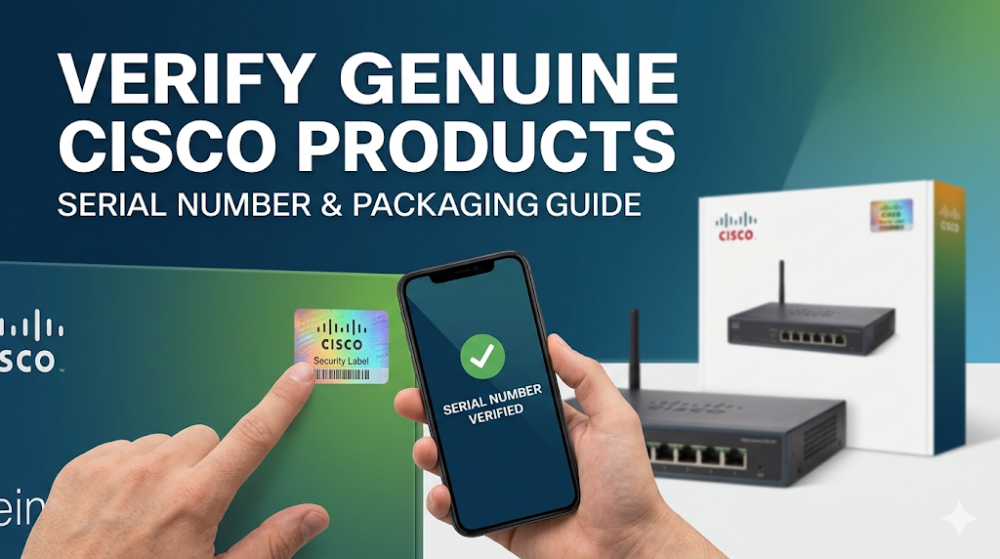
1. The Cisco Security Hologram
Every genuine Cisco product, including transceivers, memory modules, and chassis, features a high-security holographic label.
Color-Shifting Properties: When tilted, the hologram transitions smoothly between green, gold, and blue.
Micro-Text: Under magnification, genuine holograms contain crisp, legible micro-text reading "CISCO SYSTEMS" or "SECURE". Counterfeit holograms often display blurry, merged lettering.
Unique Serial Number: Each hologram contains a unique serial number that is independent of the product serial number but registered in Cisco's manufacturing database.
2. Packaging and Carton Labels
Cisco packaging is designed to withstand transit while clearly displaying product information.
The Carton Label: Genuine Cisco carton labels feature high-resolution, thermal-printed text. The barcodes must be sharp and scan instantly. Counterfeit boxes often use low-quality inkjet printing, resulting in jagged barcode edges.
Security Tape: Cisco shipping cartons are sealed with heavy-duty, reinforced security tape featuring the Cisco logo. If the tape has been cut and resealed with clear tape, the shipment's chain of custody has been broken.
2D Barcodes: Modern Cisco labels include a 2D DataMatrix barcode containing the PID, VID, and Serial Number. Scanning this barcode with a standard scanner must yield data that matches the printed text exactly.
Hardware Sizing and Verification Matrix
The following matrix outlines the critical differences between genuine Cisco hardware and counterfeit or altered alternatives:
Verification Vector
Genuine Cisco Hardware
Counterfeit / Altered Hardware
Trust Anchor Module (TAm)
Present and active; cryptographically signs the bootloader.
Absent or bypassed via modified bootloader code.
SUDI Certificate
Valid X.509 certificate signed by Cisco Root CA.
Invalid, self-signed, or missing entirely.
Smart Licensing
Registers seamlessly with Cisco CSSM.
Fails registration due to duplicate or blacklisted UDI.
Transceiver IDPROM
Cryptographically signed; accepted natively by IOS-XE.
Triggers %GBIC_SECURITY_CHK; requires CLI bypass.
Physical Hologram
Crisp micro-text; smooth green-to-blue color shift.
Dull, static colors; blurry or missing micro-text.
Mitigating Supply Chain Risks: The Strategic Procurement Framework
Verifying hardware after it arrives is a reactive approach. To truly secure your network infrastructure, organizations must adopt a proactive, strategic procurement framework.
Traditional distribution channels often suffer from severe lead-time bottlenecks, with delivery schedules stretching to 6-8 weeks or longer. These delays can jeopardize critical project timelines, tempting procurement teams to source from unverified, high-risk channels.
Router-switch addresses these supply chain challenges directly. By maintaining over $20M+ in multi-warehouse on-shelf stock, Router-switch ensures same-week dispatch for critical enterprise hardware, eliminating project delays without compromising on security. Furthermore, Router-switch's flat supply chain bypasses multiple layers of regional middleman markups, allowing System Integrators (SIs) and SMEs to secure direct bulk-purchase discounts.
To guarantee absolute peace of mind, Router-switch provides:
100% Original Genuine Guarantee: Every piece of hardware shipped features fully verifiable serial numbers (S/N) that can be validated directly in Cisco's official databases.
Complimentary 3-Year RS Care Extended Warranty: Providing robust protection that rivals traditional SmartNet contracts.
Rapid RMA Standby Replacement: In the rare event of a hardware anomaly, Router-switch dispatches a replacement unit first, minimizing your Mean Time to Repair (MTTR).
Free 1-on-1 CCIE Consultancy: Access to elite network architects to assist with design, configuration, and verification.
Q1: Why does my Cisco switch show "unauthorized transceiver" or "GBIC_SECURITY_CRYPT_ERR" error?
This error occurs when the switch's IOS-XE operating system queries the transceiver's IDPROM and fails to validate the cryptographic signature. Cisco switches use this mechanism to ensure that only certified transceivers—which meet strict thermal and electrical specifications—are deployed. If you receive this error on a transceiver labeled as genuine Cisco, the transceiver is likely counterfeit or has a corrupted EEPROM.
Q2: How can I verify if a Cisco serial number is valid if the physical sticker is missing or damaged?
You can retrieve the internal, immutable serial number directly from the hardware's EEPROM via the CLI. Connect to the device console and run the show inventory or show license udi command. The serial number returned by these commands is read directly from the Trust Anchor module (TAm) or system IDPROM and cannot be easily altered by counterfeiters. Compare this internal serial number with your purchase invoice and Cisco's official support database.
Q3: What is the Cisco SUDI, and how does it prevent counterfeit hardware from running modern IOS-XE?
The Secure Unique Device Identifier (SUDI) is an X.509 certificate burned into the tamper-resistant Trust Anchor module (TAm) chip during manufacturing. It contains the product's PID, VID, and unique serial number, cryptographically signed by Cisco's Root CA. Modern IOS-XE uses this certificate during the boot process to verify hardware integrity. If the operating system detects an invalid or missing SUDI certificate, it will restrict functionality, block Smart Licensing registration, or refuse to boot.
Q4: Can counterfeit Cisco memory or flash cards cause system instability during IOS-XE upgrades?
Yes. Counterfeit or third-party memory modules often lack the precise timing profiles and high-quality silicon required by Cisco's custom ASICs. While they may appear to work under light loads, they frequently cause kernel panics, memory leaks, or silent packet corruption when the system is subjected to high traffic loads or during the intensive read/write cycles of an IOS-XE upgrade.
Q5: How does Router-switch guarantee that the serial numbers of shipped products are 100% genuine and verifiable?
Router-switch enforces a rigorous quality control and verification process. Every Cisco product received into our warehouses undergoes physical inspection, holographic validation, and CLI-based diagnostic testing by our certified engineering team. We guarantee that all serial numbers are 100% original, unaltered, and fully verifiable in Cisco's official databases prior to dispatch.
Expertise Builds Trust
20+ Years • 200+ Countries • 21500+ Customers/Projects CCIE · JNCIE · NSE7 · ACDX · HPE Master ASE · Dell Server/AI Expert