Solving Warehouse WiFi Coverage and Uptime IssuesDesign reliable warehouse WiFi coverage and uptime with warehouse wifi 6 ap, industrial wireless access points, and warehouse poe switches for racks and docks.
OLT Capacity Planning for GPON Access NetworksPlan OLT capacity for GPON OLT systems and EA5800 capacity planning, optimizing GPON split ratio and OLT uplink design for scalable fiber access.
Enterprise OLT Platform Selection for Fiber AccessDesign enterprise OLT platform strategy for GPON OLT platform, modular OLT chassis, and OLT service boards to scale passive optical LAN and XG-PON evolution.
Scale Data Center Networking Under Long Lead TimesScale data center networking faster under long lead times with data center spine switches, leaf spine data center designs and Cisco UCS fabric interconnects.
Tunnel Video Surveillance VLAN Stability over FiberDesign stable tunnel video surveillance VLANs using optical transport backbone and Arista fiber aggregation for resilient Huawei OptiX OSN CCTV networks.
Fiber vs Copper in Industrial Networks Design GuideCompare fiber vs copper in industrial ethernet, plan hybrid industrial fiber network designs, and select rugged ethernet switches and industrial SFP transceivers.
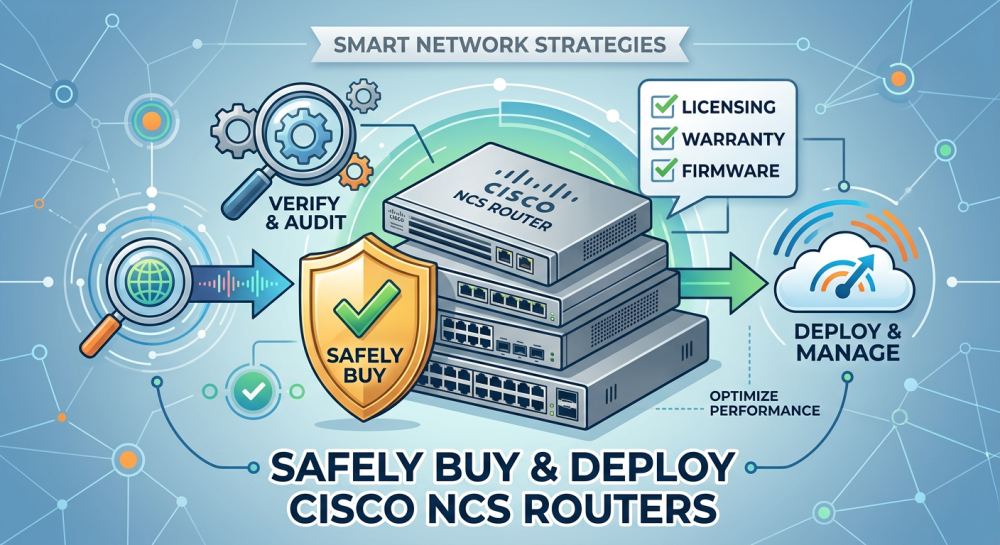
Enterprise network infrastructure procurement is no longer evaluated solely based on hardware performance. Modern networking teams must balance throughput performance, procurement risk management, supply chain reliability, and long-term operational sustainability. High-performance service provider routing platforms such as Cisco NCS 5500 Series Router are widely deployed in enterprise WAN aggregation and carrier-grade transport environments. However, global supply chain constraints and capital expenditure pressures have driven many enterprises to evaluate secondary market procurement options. The real challenge is not whether grey-market hardware works. The real challenge is whether it can remain secure, supportable, and operationally sustainable across its lifecycle.
Part 1: Why Enterprises Purchase Grey-Market Routing Hardware
Enterprises rarely purchase grey-market hardware as a primary strategy. It is usually a risk-managed business decision driven by three operational pressures.
Capital Expenditure Optimization
High-end service provider routing platforms require significant infrastructure investment. Secondary market procurement can reduce upfront financial barriers while extending network lifecycle utilization. However, enterprises should always evaluate total cost of ownership, support lifecycle risk, and security compliance exposure. Hardware cost savings should never compromise network stability.
Supply Chain Availability Challenges
OEM delivery cycles for SP-grade routers can exceed 12 weeks. Organizations facing network outages, end-of-life hardware replacement, or unexpected traffic growth may not have the flexibility to wait for manufacturer production cycles.
Operational Business Flexibility
Service providers and large enterprises often require rapid network capacity expansion. Secondary markets provide procurement agility for temporary or emergency infrastructure deployment.
Part 2: Licensing, Software Entitlement, and Support Risk
Modern Cisco infrastructure operates under identity-driven licensing models. Cisco Smart Licensing systems control feature activation, security patch availability, and TAC technical support eligibility.
Cisco official site provides licensing validation tools and support contract verification resources.
Smart Licensing Compliance Risks
Grey-market devices may remain tied to previous Smart Accounts. This can result in feature activation failure, software upgrade restrictions, and support contract rejection. Enterprise IT teams must verify license transferability before procurement.
Part 3: Hardware Security Trust Architecture
Enterprise routing platforms are designed with hardware-level cryptographic validation. Cisco NCS platforms implement Secure Unique Device Identifier (SUDI) and Trust Anchor security modules to verify hardware identity and software boot integrity.
Secure Boot Verification
If unauthorized hardware modifications are detected, secure boot validation may prevent system startup. This is a security protection mechanism designed to protect enterprise infrastructure from tampering and supply chain compromise risks.
router# show version
router# show inventory
Example CLI command to verify hardware identity and software version.
Part 4: Safe Deployment Governance for Secondary Market Hardware
Pre-Shipment Validation
Always request exact serial numbers and hardware revision documentation before purchase. Validate device history using official Cisco verification portals.
Laboratory Testing Strategy
Never deploy secondary market core routing hardware directly into production. Use isolated test environments and verify hardware integrity using CLI validation commands.
router# show inventory
router# show version
Confirm chassis identity matches physical labeling before network deployment.
Support Strategy Planning
Since OEM support may be restricted, enterprises should evaluate third-party maintenance ecosystems. Third-party maintenance providers can provide next business day hardware replacement and emergency repair SLA services.
Part 5: When Enterprises Should Replace Instead of Refurbish
Hardware refresh becomes necessary when security compliance requirements change, performance capacity limits are reached, or new network architecture models are introduced.
Next-Generation Routing Platforms
Recommended platforms include Cisco NCS 5700 Series Router and Cisco ASR 9000 Series Router for modern service provider backbone and edge routing environments.
Segment routing support
Cloud connectivity optimization
Advanced encryption workload acceleration
Part 6: Enterprise Procurement Strategy and Supply Chain Protection
Enterprise procurement should not be driven purely by hardware price optimization. Organizations should prioritize suppliers that provide serial-level hardware verification, global logistics coverage, and full lifecycle technical support protection.
Platforms such as Router-Switch support enterprise procurement workflows through multi-brand global inventory availability, fast global delivery capabilities, and RS Care technical protection programs.
When network infrastructure becomes business-critical, procurement speed, hardware authenticity verification, and long-term support sustainability are often more important than initial hardware price differences. At the same time, Router-Switch.com also maintains competitive pricing models to help enterprises optimize total cost of ownership without sacrificing reliability.
Procurement Dimension
Evaluation Focus
Cost
Total lifecycle ownership cost
Risk
Security and compliance exposure
Support
Technical sustainability
Network infrastructure should be treated as a business continuity asset rather than commodity hardware.
Part 7: Conclusion
Grey-market networking hardware can be safely deployed in enterprise environments when governed by strict engineering and procurement controls. Successful organizations prioritize hardware authenticity validation, licensing compliance verification, and long-term support ecosystem planning. Enterprise networking is no longer only about performance. It is about building predictable, secure, and supportable infrastructure platforms that sustain business operations.
FAQ: Enterprise Procurement Questions
Q1.Is grey-market hardware always risky?
No. Risk depends on supply chain verification, licensing status, and support availability.
Q2.How to verify Cisco hardware legitimacy?
Verify serial numbers through official vendor validation portals and inspect hardware inventory details using CLI commands.
Q3.Can grey-market routers be used in production?
Yes, but only after strict lab validation, licensing verification, and support strategy planning.
Q4.Where can enterprises purchase reliable networking hardware?
Enterprise buyers can evaluate multi-brand distributors offering global inventory and lifecycle support services.
Expertise Builds Trust
20+ Years • 200+ Countries • 21500+ Customers/Projects CCIE · JNCIE · NSE7 · ACDX · HPE Master ASE · Dell Server/AI Expert