Solving Warehouse WiFi Coverage and Uptime IssuesDesign reliable warehouse WiFi coverage and uptime with warehouse wifi 6 ap, industrial wireless access points, and warehouse poe switches for racks and docks.
OLT Capacity Planning for GPON Access NetworksPlan OLT capacity for GPON OLT systems and EA5800 capacity planning, optimizing GPON split ratio and OLT uplink design for scalable fiber access.
Enterprise OLT Platform Selection for Fiber AccessDesign enterprise OLT platform strategy for GPON OLT platform, modular OLT chassis, and OLT service boards to scale passive optical LAN and XG-PON evolution.
Scale Data Center Networking Under Long Lead TimesScale data center networking faster under long lead times with data center spine switches, leaf spine data center designs and Cisco UCS fabric interconnects.
Tunnel Video Surveillance VLAN Stability over FiberDesign stable tunnel video surveillance VLANs using optical transport backbone and Arista fiber aggregation for resilient Huawei OptiX OSN CCTV networks.
Fiber vs Copper in Industrial Networks Design GuideCompare fiber vs copper in industrial ethernet, plan hybrid industrial fiber network designs, and select rugged ethernet switches and industrial SFP transceivers.
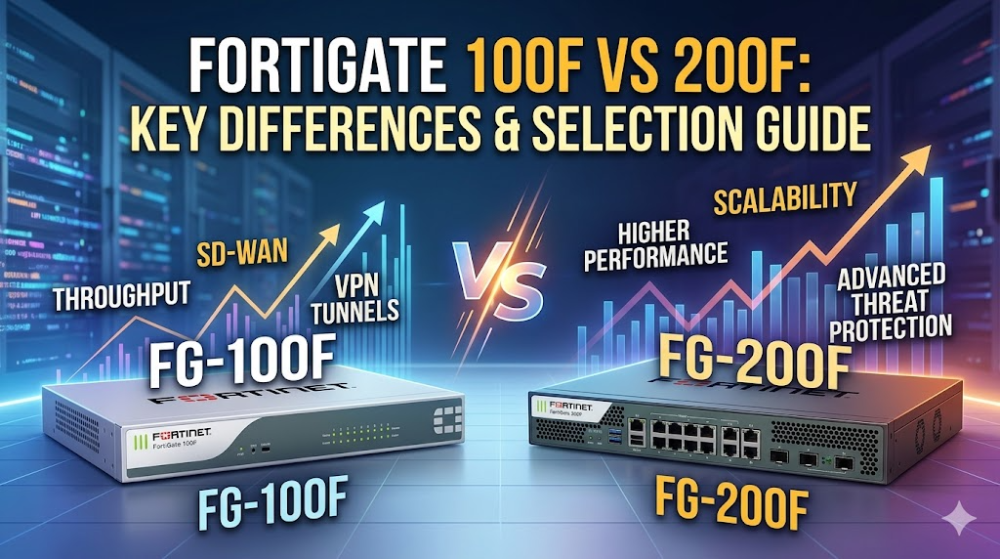
When you are performing a midnight maintenance window to cut over a school district or a mid-sized enterprise core to a new Next-Generation Firewall (NGFW), the last thing you want to see is your console flooding with "conserve mode" memory alerts. This exact scenario frequently plays out when engineers underestimate the memory footprint of full BGP routing tables or the processing overhead of deep SSL/TLS inspection. Choosing between the FortiGate 100F vs 200F is not merely a matter of comparing raw firewall throughput; it requires a deep understanding of ASIC pipeline architectures, memory allocation limits, and port density constraints.
In this architectural deep dive, we will dissect the hardware differences between the FG-100F vs FG-200F, analyze how their respective System-on-a-Chip (SOC4) and discrete Network Processor (NP6XLite) architectures handle heavy traffic loads, and provide a concrete selection guide to optimize your network security posture and procurement budget.
The fundamental differentiator between the Fortinet FortiGate 100F and the FortiGate 200F lies in their silicon architecture. Fortinet's proprietary Application-Specific Integrated Circuits (ASICs) offload resource-intensive security processing from the main CPU, but they do so differently in these two models.
FortiGate 100F: The System-on-a-Chip (SOC4) Architecture
The Fortinet FortiGate 100F is powered by Fortinet's SOC4 (System-on-a-Chip 4). The SOC4 integrates a RISC-based CPU with a Content Processor 9 (CP9) and a Network Processor 6 Direct (NP6Lite) onto a single silicon die.
The Advantage: This consolidated architecture reduces manufacturing costs, power consumption, and physical space, making the FG-100F an incredibly cost-effective 1U appliance.
The Bottleneck: Because the CPU, CP9, and NP6Lite share the same memory bus and physical RAM (4GB), high-concurrency environments can experience memory bus contention. Under heavy SSL inspection or when processing large routing tables, the shared memory architecture can limit the maximum concurrent session capacity.
FortiGate 200F: Discrete CP9 and NP6XLite Architecture
In contrast, the FortiGate 200F utilizes a discrete architecture. It separates the main CPU from the acceleration coprocessors, featuring a dedicated CP9 and a discrete NP6XLite ASIC.
NP6XLite Capabilities: The NP6XLite is a specialized version of Fortinet's line-rate network processor. It handles IPv4/IPv6 traffic, IPsec VPN encryption/decryption, and CAPWAP tunnel offloading at the hardware level, completely bypassing the main CPU for accelerated paths.
Dedicated Memory Bus: With 8GB of system RAM and a dedicated memory bus for the discrete ASICs, the FortiGate 200F performance profile remains stable under extreme multi-gigabit threat protection loads.
The BGP Memory Struggle: 4GB vs. 8GB RAM
A common pain point discussed across network engineering communities (such as Reddit's r/networking) is the memory footprint of BGP routing tables on mid-range firewalls.
The FG-200F features 8GB of RAM, whereas the FG-100F is limited to 4GB. A single full IPv4/IPv6 routing table takes approximately 580MB of RAM for the FortiOS bgpd process. If you attempt to pull dual full tables from two upstream ISPs on an FG-100F, the device will rapidly exhaust its physical memory and enter conserve mode (which triggers when memory usage exceeds 80%). In conserve mode, the firewall begins dropping new sessions and disabling security profiles to protect the kernel.
Even on the FG-200F with 8GB of RAM, running dual full BGP tables is highly discouraged without strict prefix filtering. To prevent control-plane instability, engineers must implement route-maps to filter incoming prefixes down to default routes and partial tables.
The following CLI configuration demonstrates how to apply a prefix-list and route-map on FortiOS to limit incoming BGP prefixes, protecting your firewall's control plane from memory exhaustion:
# Define a prefix-list to allow only the default route
config router prefix-list
    edit "ONLY-DEFAULT"
        config rule
            edit 1
                set prefix 0.0.0.0/0
                set action permit
            next
        end
    next
end

# Create a route-map referencing the prefix-list
config router route-map
    edit "ISP-IN-FILTER"
        config rule
            edit 1
                set match-ip-address "ONLY-DEFAULT"
            next
            edit 2
                set action deny
            next
        end
    next
end

# Apply the route-map to the BGP neighbor
config router bgp
    set as 65001
    config neighbor
        edit "192.0.2.1"
            set remote-as 64496
            set route-map-in "ISP-IN-FILTER"
        next
    end
end
Part 2: Hardware Specifications and Performance Sizing Guide
When comparing FortiGate 100F vs 200F performance, we must look beyond the "marketing" firewall throughput (which measures stateless UDP traffic) and focus on Next-Generation Firewall (NGFW), Intrusion Prevention System (IPS), and Threat Protection throughput. These metrics represent real-world scenarios where SSL inspection, application control, and antivirus scanning are active.
Interface Density and 10G SFP+ Constraints
A critical physical limitation of the Fortinet FortiGate 100F is its 10G port density. It features only two 10 GE SFP+ ports, which are designated as FortiLink ports by default. If you use these two ports to connect a redundant pair of downstream FortiSwitches, you have zero remaining 10G ports for high-speed uplinks to your core network or WAN providers.
The FortiGate 200F solves this bottleneck by providing four 10 GE SFP+ ports (two default FortiLink ports and two generic 10 GE SFP+ slots). This allows for a fully redundant 10G uplink to the core switch fabric while maintaining a high-speed 10G FortiLink connection to the access layer.
Here is a detailed, side-by-side hardware and performance comparison:
Specification / Metric
FortiGate 100F (FG-100F)
FortiGate 200F (FG-200F)
ASIC Architecture
System-on-a-Chip 4 (SOC4)
Discrete CP9 + NP6XLite
System Memory (RAM)
4 GB
8 GB
10 GE SFP+ Ports
2 (Shared FortiLink)
4 (2x FortiLink, 2x Generic SFP+)
1 GE RJ45 Ports
12 (LAN) + 2 (WAN) + 2 (MGMT/HA)
16 (LAN) + 2 (MGMT/HA)
1 GE SFP Slots
4
8
Firewall Throughput (1518B)
20 Gbps
27 Gbps
IPS Throughput
2.6 Gbps
5 Gbps
NGFW Throughput
1.6 Gbps
3.5 Gbps
Threat Protection Throughput
1 Gbps
3 Gbps
SSL Inspection Throughput
1 Gbps
4 Gbps
Concurrent TCP Sessions
1.5 Million
3 Million
New Sessions/Second (TCP)
56,000
280,000
Sizing Scenarios: When to Choose Which?
The K-12 School District / Medium Enterprise (300–800 Users): If you are deploying in an environment with heavy web browsing, active directory integration, and strict content filtering, SSL inspection is mandatory. The FortiGate 200F performance shines here, offering 4 Gbps of SSL inspection throughput compared to the 1 Gbps limit of the FG-100F. If your aggregate internet bandwidth exceeds 1 Gbps and you plan to decrypt HTTPS traffic, the FG-100F will quickly bottleneck, making the FG-200F the architecturally sound choice.
The Distributed Branch / SD-WAN Hub (100–300 Users): For branch offices requiring secure SD-WAN, local breakout, and site-to-site IPsec VPNs back to a corporate data center, the FG-100F vs FG-200F comparison favors the FG-100F. With 11.5 Gbps of IPsec VPN throughput and built-in SOC4 SD-WAN acceleration, the FG-100F easily handles high-density VPN tunnels without breaking the budget.
Hybrid Cloud Edge (Azure/AWS Integration): Engineers often run into cloud gateway limitations, such as the Azure Vnet gateway limit of 30 S2S VPN tunnels on the VpnGw1 SKU. By terminating VPN tunnels directly on an on-premise FortiGate, you bypass these cloud-provider limits. The FG-100F supports up to 2,500 gateway-to-gateway tunnels, while the FG-200F supports 2,000, making both models excellent hub devices for hybrid cloud topologies.
Part 3: Sourcing, BOM Optimization, and Risk Mitigation
Selecting the correct firewall model is only half the battle; navigating the hardware supply chain to ensure timely deployment and cost efficiency is equally critical. For US-based network engineers, system integrators, and IT procurement managers, traditional distribution channels present significant hurdles, including 6-to-8 week lead times and rigid pricing structures.
Bypassing Supply Chain Bottlenecks
When a critical security upgrade is delayed, your organization remains exposed to vulnerabilities, and project timelines slip, risking contractual penalties. Router-switch addresses this challenge by maintaining over $20 million in multi-warehouse on-shelf inventory. This extensive stock allows for same-week dispatch to the US market, bypassing the traditional distributor delays.
Whether you need to secure a pair of high-availability firewalls immediately or optimize your procurement by exploring the Fortinet FortiGate 100F Pricing and Stock Availability for your core switch upgrades, Router-switch's flat supply chain bypasses multiple layers of regional middleman markups. This direct-sourcing model enables system integrators to secure direct bulk-purchase discounts, maximizing project margins.
Mitigating Post-Deployment Risks
Hardware failures and configuration mismatches (such as third-party transceiver compatibility issues or FEC mode mismatches on 10G SFP+ ports) can disrupt operations. While traditional vendor support contracts are costly and often slow to respond to initial triage, Router-switch provides comprehensive risk mitigation:
Free 1-on-1 CCIE/CCDE Consultancy: Access elite engineering support during the design and Bill of Materials (BOM) validation phases to ensure compatibility with your existing switches and transceivers.
Complimentary 3-Year RS Care Extended Warranty: Protect your hardware investment far beyond the standard factory warranty.
Rapid RMA Standby Replacement: In the rare event of a hardware defect, Router-switch ships a replacement unit first, minimizing your Mean Time to Repair (MTTR) and keeping your network secure.
100% Genuine Guarantee: Every unit shipped features fully verifiable serial numbers (S/N) in the official vendor database, ensuring complete authenticity and eligibility for official firmware updates.
To plan your deployment architecture and review step-by-step configuration procedures, you can access our comprehensive Fortinet FG-100F Deployment Guide. Additionally, to integrate these firewalls into your broader security infrastructure, you can browse our extensive catalog of Next-Generation Firewalls.
Part 4: Frequently Asked Questions (FAQ)
Q1: Can the FortiGate 100F handle a full BGP routing table?
No. The FortiGate 100F has only 4GB of system RAM. A single full IPv4/IPv6 BGP routing table requires approximately 580MB of memory for the bgpd daemon alone. Running dual full tables will quickly push the firewall into conserve mode (above 80% memory utilization), causing session drops. For the FG-100F, you must use prefix-lists and route-maps to filter incoming routes, accepting only a default route and select partial routes from your ISPs.
Q2: What are the primary interface differences between the FG-100F and FG-200F?
The FG-100F features two 10 GE SFP+ ports, which are typically consumed by the FortiLink connection to downstream switches, leaving no 10G ports for WAN or core uplinks. The FG-200F features four 10 GE SFP+ ports, allowing you to dedicate two ports to FortiLink and use the remaining two for redundant 10G uplinks to your core network or high-speed WAN connections.
Q3: How does the CP9 chip in the FG-200F improve SSL inspection compared to the SOC4 in the FG-100F?
The FG-100F uses an integrated SOC4 chip where the CP9 coprocessor shares the same silicon die and memory bus with the CPU. The FG-200F utilizes a discrete, dedicated CP9 content processor with its own memory bus. This physical separation allows the FG-200F to achieve 4 Gbps of SSL inspection throughput—four times the capacity of the FG-100F (1 Gbps)—without impacting CPU performance.
Q4: How do I avoid "conserve mode" when deploying these firewalls in high-throughput environments?
To prevent conserve mode, optimize your memory usage by:
Avoiding full BGP tables; use default routes instead.
Tuning security profiles to scan only necessary protocols.
Reducing the session TTL (Time-to-Live) for idle connections.
Offloading heavy logging to an external FortiAnalyzer or syslog server rather than logging to the local disk.
Q5: What is the warranty and support coverage when sourcing these units through Router-switch?
All Fortinet hardware sourced through Router-switch comes with a 100% genuine guarantee, with serial numbers fully verifiable in Fortinet's official database. Additionally, customers receive free 1-on-1 CCIE/CCDE technical consultancy, a complimentary 3-Year RS Care extended warranty, and Rapid RMA standby replacement (shipping the replacement unit first) to ensure zero business disruption.
Expertise Builds Trust
20+ Years • 200+ Countries • 21500+ Customers/Projects
CCIE · JNCIE · NSE7 · ACDX · HPE Master ASE · Dell Server/AI Expert