Solving Warehouse WiFi Coverage and Uptime IssuesDesign reliable warehouse WiFi coverage and uptime with warehouse wifi 6 ap, industrial wireless access points, and warehouse poe switches for racks and docks.
OLT Capacity Planning for GPON Access NetworksPlan OLT capacity for GPON OLT systems and EA5800 capacity planning, optimizing GPON split ratio and OLT uplink design for scalable fiber access.
Enterprise OLT Platform Selection for Fiber AccessDesign enterprise OLT platform strategy for GPON OLT platform, modular OLT chassis, and OLT service boards to scale passive optical LAN and XG-PON evolution.
Scale Data Center Networking Under Long Lead TimesScale data center networking faster under long lead times with data center spine switches, leaf spine data center designs and Cisco UCS fabric interconnects.
Tunnel Video Surveillance VLAN Stability over FiberDesign stable tunnel video surveillance VLANs using optical transport backbone and Arista fiber aggregation for resilient Huawei OptiX OSN CCTV networks.
Fiber vs Copper in Industrial Networks Design GuideCompare fiber vs copper in industrial ethernet, plan hybrid industrial fiber network designs, and select rugged ethernet switches and industrial SFP transceivers.
In modern enterprise and industrial networks, infrastructure reliability is no longer measured only by bandwidth performance or routing stability.
Core routers and switches are often deployed in challenging environments such as data centers, telecom central offices, industrial control rooms, and remote unstaffed sites.
While IT teams traditionally rely on software monitoring tools, there is a critical gap between network performance monitoring and physical infrastructure safety.
This is where dry alarm contacts become extremely valuable.
Part 1: The Blind Spot in Traditional Network Monitoring
Most enterprise networks rely on SNMP monitoring, Syslog event logging, and cloud-based network observability platforms.
These tools are excellent for tracking traffic utilization, CPU performance, and routing protocol health.
However, they cannot always detect physical environmental failures.
For example, if a cooling system fails in a remote telecom cabinet, software monitoring may only generate alerts after hardware overheating has already started affecting performance.
By that time, packet loss and service degradation may already have occurred.
The result can be business service interruption, SLA penalty costs, and emergency maintenance expenses.
Organizations operating mission-critical infrastructure cannot rely on software monitoring alone.
Part 2: What Are Dry Alarm Contacts?
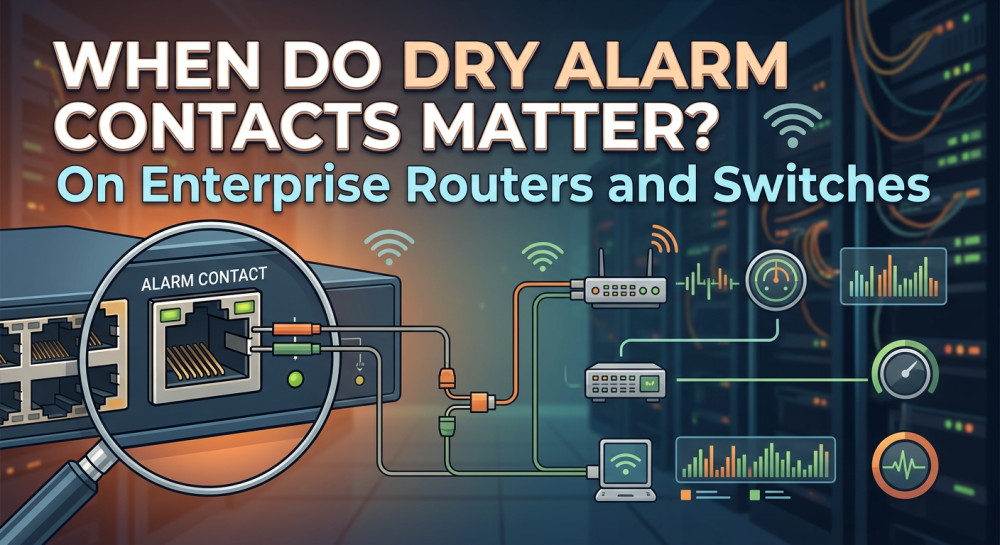
Dry alarm contacts are physical relay interfaces that provide hardware-level event signaling.
They work by opening or closing an electrical circuit to indicate status changes.
Unlike network telemetry protocols, dry contacts operate independently of software systems and network connectivity.
They create a direct bridge between IT infrastructure and facility management systems.
Part 3: Critical Enterprise Use Cases
Telecommunications and ISP Networks
Telecom operators frequently deploy dry contacts to monitor tower site power status, backup battery systems, and cabinet environmental conditions.
Industrial Networking and OT Environments
In industrial environments, network equipment often integrates with operational control systems such as PLC and SCADA platforms.
Dry contacts can connect networking hardware to control systems, allowing facility operators to receive instant alerts when network or environmental failures occur.
Data Center Infrastructure Monitoring
In modern data centers, dry contacts can be integrated with building management systems, alarm panels, and environmental monitoring systems.
Part 4: Dry Contacts vs SNMP and Syslog Monitoring
Modern enterprise monitoring strategies typically combine multiple technologies.
Monitoring Technology Comparison
Technology
Function
Limitation
Dry Contact
Physical failure signaling
Limited data detail
SNMP
Network performance monitoring
Requires network connectivity
Syslog
Event logging
Software dependent
Cloud Monitoring
Analytics
Requires internet access
Part 5: Design Patterns for Enterprise Alarm Integration
Multi-Device Alarm Wiring
Organizations can wire multiple network devices into centralized alarm systems to reduce monitoring complexity.
UPS and Power Protection Monitoring
Dry contacts are commonly connected to UPS systems to monitor power failure, battery status, and voltage anomalies.
Environmental Sensor Integration
Advanced deployments connect networking hardware to temperature sensors, humidity monitors, and HVAC control systems.
Part 6: Hardware Procurement Considerations
When selecting enterprise networking equipment, organizations should evaluate hardware reliability, monitoring interface availability, vendor technical support, and supply chain stability.
Infrastructure suppliers that maintain global inventory and provide rapid delivery options, such as Router-Switch, can help enterprises reduce procurement risk while deploying mission-critical networking equipment faster.
Working with specialized infrastructure suppliers can help enterprises validate configuration compatibility and reduce deployment risk before equipment enters production.
Technical verification and configuration consultation services can further reduce deployment risks in complex enterprise environments.
Part 7: Real Business Impact
Organizations implementing hardware-level alarm monitoring typically experience faster incident response, reduced downtime costs, and improved operational visibility.
In telecom and industrial sectors, physical alarm monitoring can directly reduce service disruption risks.
Part 8: Future Trends in Network Monitoring
The industry is moving toward AI-driven fault prediction, unified hardware and software telemetry, and zero trust infrastructure monitoring.
However, physical alarm signaling remains essential for mission-critical reliability.
Learn more infrastructure options from IT-Price for pricing comparison and procurement insights.
Expertise Builds Trust
20+ Years • 200+ Countries • 21500+ Customers/Projects CCIE · JNCIE · NSE7 · ACDX · HPE Master ASE · Dell Server/AI Expert