Solving Warehouse WiFi Coverage and Uptime IssuesDesign reliable warehouse WiFi coverage and uptime with warehouse wifi 6 ap, industrial wireless access points, and warehouse poe switches for racks and docks.
OLT Capacity Planning for GPON Access NetworksPlan OLT capacity for GPON OLT systems and EA5800 capacity planning, optimizing GPON split ratio and OLT uplink design for scalable fiber access.
Enterprise OLT Platform Selection for Fiber AccessDesign enterprise OLT platform strategy for GPON OLT platform, modular OLT chassis, and OLT service boards to scale passive optical LAN and XG-PON evolution.
Scale Data Center Networking Under Long Lead TimesScale data center networking faster under long lead times with data center spine switches, leaf spine data center designs and Cisco UCS fabric interconnects.
Tunnel Video Surveillance VLAN Stability over FiberDesign stable tunnel video surveillance VLANs using optical transport backbone and Arista fiber aggregation for resilient Huawei OptiX OSN CCTV networks.
Fiber vs Copper in Industrial Networks Design GuideCompare fiber vs copper in industrial ethernet, plan hybrid industrial fiber network designs, and select rugged ethernet switches and industrial SFP transceivers.
For IT professionals, network engineers, and system administrators, understanding core network ports is essential for secure and efficient network management. Among all ports, 80, 443, 8080, and 8443 are crucial for web communication. While they may seem similar, their protocols, encryption, and deployment scenarios differ, affecting security, performance, and application behavior. This guide explains the difference between port 80/443/8080/8443 and practical deployment insights.
Part 1: Understanding the Foundation: What is a Network Port?
A port is a logical endpoint, identified by a number, that directs network traffic to the correct application or service. Ports operate mainly at the Transport Layer (Layer 4) and usually use TCP for reliable communication.
Well-Known Ports: Ports below 1024 are "Well-Known Ports," reserved for core services. Port 80 (HTTP) and 443 (HTTPS) are in this category.
Part 2: Standard Web Communication: Port 80 (HTTP) and Port 443 (HTTPS)
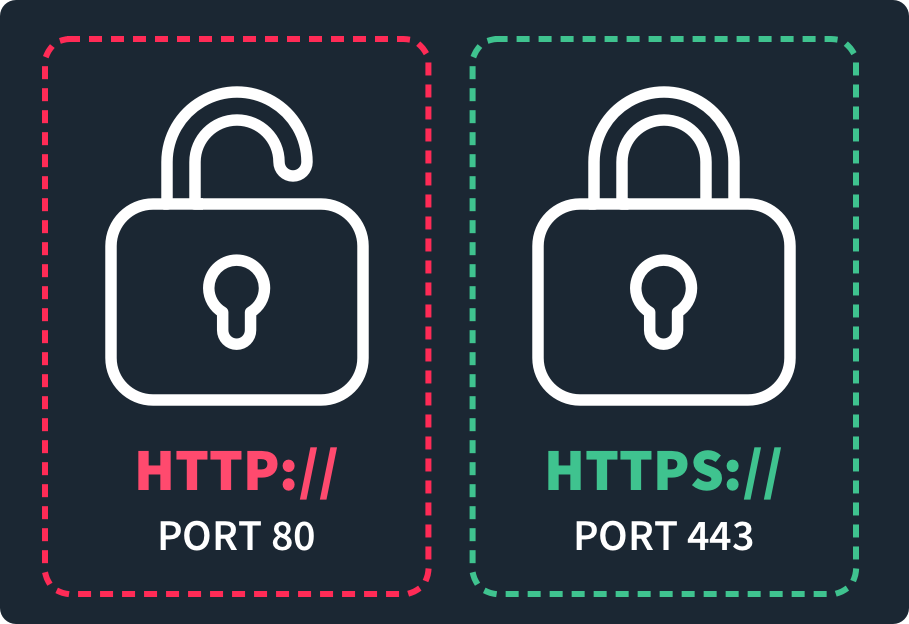
Port 80: The Unencrypted Gateway
Protocol: HTTP
Security: Insecure (plaintext)
Function: Default port for unencrypted web traffic. Often redirects users to HTTPS (Port 443).
Port 443: The Secure Standard
Protocol: HTTPS
Security: Encrypted via SSL/TLS
Function: Main port for secure web communication. Indicates SSL/TLS certificate installed.
Part 3: Alternate Ports: Port 8080 and Port 8443
Port 8080: HTTP Alternate
Used for testing, development, proxy, caching, or multiple web servers on the same host. Requires explicit URL inclusion (e.g., http://example.com:8080).
Port 8443: HTTPS Alternate
Secure alternative to 443, often used for application servers like Apache Tomcat or in internal management scenarios. Uses SSL/TLS encryption.
Part 4: Key Differences and Deployment Scenarios
Feature
Port 80
Port 443
Port 8080
Port 8443
Protocol
HTTP
HTTPS
HTTP
HTTPS
IANA Status
Default
Default
Alternate
Alternate
Encryption
None
SSL/TLS
None
SSL/TLS
Standard Use
Web traffic
Secure web access
Development, proxy
App servers, secure internal access
Privileged Port
Yes (<1024)
Yes (<1024)
No (>1024)
No (>1024)
Deployment Scenarios
Public web servers use 443, redirect 80 to 443.
Reverse proxies/load balancers may use 8080/8443 internally.
Application servers like Tomcat often use 8443 for secure connections without root privileges.
Router-switch Advantage: For network deployment requiring specific hardware and configuration, Router-switch provides fast support, global stock, and technical guidance, ensuring seamless implementation across ports and protocols.
Part 5: Troubleshooting and Best Practices
Firewall Management
Keep Port 80 open only to redirect to 443.
Ensure 443/8443 have valid SSL/TLS certificates.
Alternate ports (8080/8443) help avoid privilege conflicts and separate services.
Server Configuration Examples
Tomcat SSL connector for 8443
NGINX reverse proxy listening on 8443
Frequently Asked Questions (FAQ)
Q1: What is port 80 vs 8080 vs 443?
Port 80 is HTTP (unencrypted), 443 is HTTPS (encrypted), and 8080 is an HTTP alternate port often used for testing, proxy, or multiple servers.
Q2: Are port 8443 and 443 the same?
No, 8443 is an alternate HTTPS port. Encryption is the same, but 8443 is often used for application servers or internal services when 443 is occupied.
Q3: What is the 8080 port used for?
Port 8080 is primarily for HTTP alternate uses: development, testing, proxies, caching, and running multiple web services on the same host.
Q4: Is opening port 80 and 443 safe?
Port 443 is secure (encrypted), but Port 80 transmits plaintext. Keep 80 open only to redirect to 443 to maintain security.
Q5: What is the primary difference between Port 80 and Port 443?
Port 80 is unencrypted HTTP; Port 443 is HTTPS with SSL/TLS encryption, providing confidentiality and integrity.
Q6: Why use 8080 or 8443 instead of defaults?
To run services without root privileges, separate multiple web services, or provide secure alternative channels when standard ports are occupied.
Conclusion: Securing Your Network Edge
Understanding the difference between port 80/443/8080/8443 is crucial for network security, application performance, and compliance.
Use 443 for all secure communications.
Redirect 80 to 443 to avoid plaintext exposure.
Deploy 8080/8443 strategically for testing or internal services.
Router-switch provides rapid support, global stock, and technical guidance, ensuring correct port deployment, secure configuration, and smooth implementation across your network infrastructure.
Disclaimer: Configuration and behavior may vary slightly per platform, server, and network design. Always validate configurations and SSL/TLS settings against vendor documentation and security best practices.
Expertise Builds Trust
20+ Years • 200+ Countries • 21500+ Customers/Projects CCIE · JNCIE · NSE7 · ACDX · HPE Master ASE · Dell Server/AI Expert