Solving Warehouse WiFi Coverage and Uptime IssuesDesign reliable warehouse WiFi coverage and uptime with warehouse wifi 6 ap, industrial wireless access points, and warehouse poe switches for racks and docks.
OLT Capacity Planning for GPON Access NetworksPlan OLT capacity for GPON OLT systems and EA5800 capacity planning, optimizing GPON split ratio and OLT uplink design for scalable fiber access.
Enterprise OLT Platform Selection for Fiber AccessDesign enterprise OLT platform strategy for GPON OLT platform, modular OLT chassis, and OLT service boards to scale passive optical LAN and XG-PON evolution.
Scale Data Center Networking Under Long Lead TimesScale data center networking faster under long lead times with data center spine switches, leaf spine data center designs and Cisco UCS fabric interconnects.
Tunnel Video Surveillance VLAN Stability over FiberDesign stable tunnel video surveillance VLANs using optical transport backbone and Arista fiber aggregation for resilient Huawei OptiX OSN CCTV networks.
Fiber vs Copper in Industrial Networks Design GuideCompare fiber vs copper in industrial ethernet, plan hybrid industrial fiber network designs, and select rugged ethernet switches and industrial SFP transceivers.
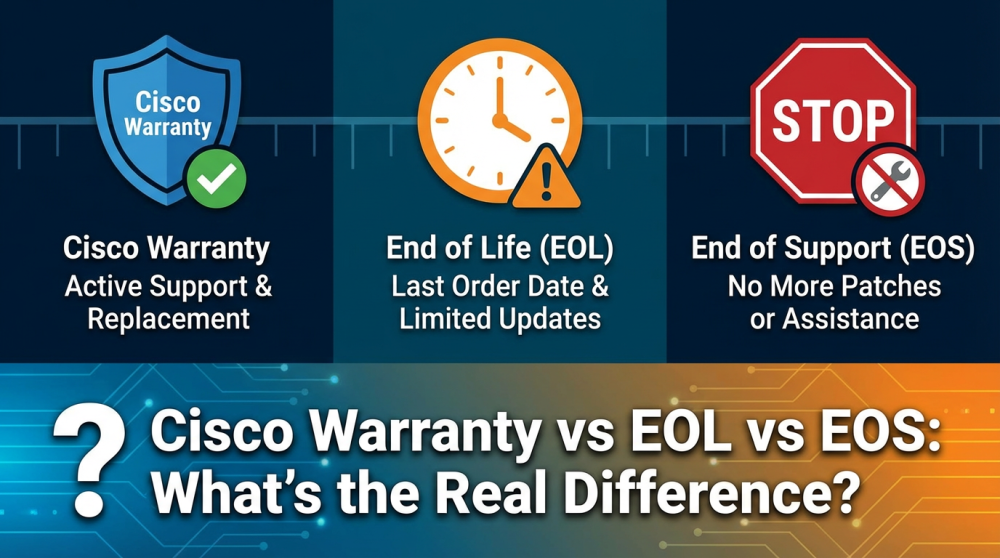
Managing a Cisco network is more than just handling hardware—it’s also about understanding the product lifecycle. IT managers, network administrators, and procurement teams need to know exactly what terms like EOL (End-of-Life), EOS (End-of-Sale), and Warranty mean. This knowledge helps in planning upgrades, managing risks, and deciding whether to buy new, second-hand, or gray market devices.
A Cisco Warranty is the baseline protection included with every new hardware purchase. It is designed to protect against manufacturing defects and ensure the device works as intended.
Key Points:
What it Covers: Defects in materials or workmanship.
Limitations: Standard warranties typically do not include 24/7 TAC support or software updates.
Enhanced Options: Some modern Cisco products, like Catalyst 9000 series switches, come with Enhanced Limited Lifetime Warranty (E-LLW). This may include next-business-day hardware replacement and basic software updates.
Pro Tip: Warranties are generally non-transferable. If you buy second-hand or gray-market devices, the original warranty usually does not apply.
Part 2: Understanding EOL vs EOS Meaning
When a product reaches the end of its lifecycle, Cisco uses milestones to guide users:
EOL (End-of-Life) Meaning: The official announcement of a product’s phase-out. It marks the start of a transition period, giving customers roughly five years to plan replacements or upgrades.
EOS (End-of-Sale) Meaning: The specific date within the EOL timeline after which Cisco stops selling the product.
Sequence: EOL announcements always come before EOS. This allows customers to plan purchases and support contracts before sales end.
Understanding these milestones helps avoid unexpected downtime and ensures compliance with Cisco’s support policies.
Part 3: The Comparison: Warranty vs EOL vs EOS
Below is a simplified table highlighting the differences between these terms:
Feature
Cisco Warranty
End-of-Sale (EOS)
End-of-Service-Life (EOSL)
Primary Goal
Protect against manufacturing defects.
Stop new hardware sales.
Terminate all official support.
Availability
Included with new purchase.
Still available via active support or secondary market.
High risk; no official support.
Support (TAC)
Limited or none.
Available via active SmartNet.
Terminated.
Software Updates / Security Patches
Generally not included.
Provided via active support contracts.
Terminated; device becomes vulnerable to new threats.
Part 4: EOSL / Last Date of Support Risks
Once a device reaches EOSL:
Cisco no longer provides technical support, hardware repairs, or replacement parts.
Security updates are terminated, leaving devices vulnerable to zero-day exploits.
For mission-critical environments, upgrading to supported series like Catalyst 9000 or Nexus 9000 before EOSL is recommended.
Tip: Use the Router-switch EOL/EOSL Checker to verify the current lifecycle status of your Cisco devices. For multi-brand inventory checks, IT-Price provides free tools.
Part 5: Strategic Decision Support
Buying Used Equipment: Always verify serial numbers and EOS/EOSL dates. EOS devices may still be supported under active SmartNet; EOSL devices carry high risk.
Active Support Contracts: A Cisco SmartNet contract offers 24/7 TAC access, faster hardware replacement, and firmware/security updates—superior to a basic warranty.
Inventory Planning: Proactive management reduces emergency downtime. Check your hardware lifecycle status regularly to schedule upgrades or replacements efficiently.
Part 6: FAQ
Q1.What is the difference between EOS and EOL?
EOL is the multi-stage process of phasing out a product, whereas EOS is the specific date after which Cisco no longer sells that product.
Q2.What comes first, EOL or EOS?
The EOL announcement comes first, providing the timeline for the EOS date, usually occurring about one year later.
Q3.What does Cisco EOL mean?
Cisco End-of-Life (EOL) marks the start of the product's final lifecycle phase, from announcement to Last Date of Support (LDoS), after which Cisco ceases all updates and support.
Q4.What is the difference between EOL and EOSL vulnerability types?
An EOL device may still receive patches if it hasn’t reached EOSL. An EOSL device is at high security risk, receiving zero updates and leaving it exposed to vulnerabilities.
Expertise Builds Trust
20+ Years • 200+ Countries • 21500+ Customers/Projects CCIE · JNCIE · NSE7 · ACDX · HPE Master ASE · Dell Server/AI Expert