Solving Warehouse WiFi Coverage and Uptime IssuesDesign reliable warehouse WiFi coverage and uptime with warehouse wifi 6 ap, industrial wireless access points, and warehouse poe switches for racks and docks.
OLT Capacity Planning for GPON Access NetworksPlan OLT capacity for GPON OLT systems and EA5800 capacity planning, optimizing GPON split ratio and OLT uplink design for scalable fiber access.
Enterprise OLT Platform Selection for Fiber AccessDesign enterprise OLT platform strategy for GPON OLT platform, modular OLT chassis, and OLT service boards to scale passive optical LAN and XG-PON evolution.
Scale Data Center Networking Under Long Lead TimesScale data center networking faster under long lead times with data center spine switches, leaf spine data center designs and Cisco UCS fabric interconnects.
Tunnel Video Surveillance VLAN Stability over FiberDesign stable tunnel video surveillance VLANs using optical transport backbone and Arista fiber aggregation for resilient Huawei OptiX OSN CCTV networks.
Fiber vs Copper in Industrial Networks Design GuideCompare fiber vs copper in industrial ethernet, plan hybrid industrial fiber network designs, and select rugged ethernet switches and industrial SFP transceivers.
Operational Technology (OT) networks are built to support physical processes, not office workflows. In these environments, network switches are expected to operate consistently over long lifecycles, integrate with legacy systems, and prioritize predictable behavior over rapid feature adoption.
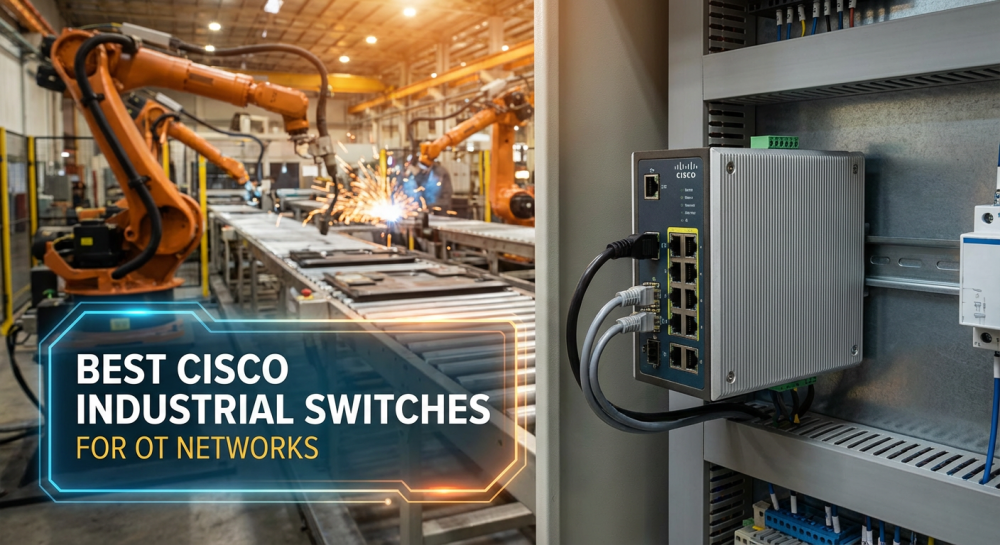
Cisco’s Industrial Ethernet (IE) portfolio is widely used in OT networks, but choosing the “best” model depends on where the switch sits in the OT topology and what role it plays, not on raw specifications alone. This article explains how Cisco industrial switches are typically selected for OT networks and which models are most commonly used in practice.
What Makes OT Networks Different from IT Networks
OT networks differ from traditional IT networks in several fundamental ways.
First, OT traffic is often deterministic and process-driven. Control systems, PLCs, and sensors rely on consistent communication patterns rather than bursty application traffic.
Second, segmentation is a design requirement, not an optimization. OT networks frequently isolate control, safety, monitoring, and enterprise-facing zones to reduce risk and limit fault propagation.
Third, OT environments expect long hardware and software lifecycles. Switches are commonly deployed for a decade or more, with limited tolerance for disruptive upgrades.
Finally, OT switches are often installed in locations where maintenance access is constrained, making stability and predictability more important than frequent feature changes.
Cisco addresses these requirements through its Industrial Ethernet (IE) switch family, which is positioned separately from standard Catalyst enterprise access switches.
Rather than being differentiated by access, distribution, and core in the traditional IT sense, Cisco IE switches are typically deployed as:
OT edge switches, close to machines and field devices
OT aggregation switches, consolidating multiple cells or lines
OT core or convergence switches, bridging OT and IT domains
Understanding this role-based placement is key to selecting the right model.
Best Cisco Industrial Switches for OT Networks
Cisco Catalyst IE3100 Series
The IE3100 series is commonly used at the micro-edge of OT networks, where space is limited and port requirements are fixed.
Typical use cases include:
Machine-level connectivity
Compact control cabinets
OEM-built systems
The IE3100 focuses on essential switching functions and is generally chosen when simplicity and footprint matter more than expandability.
Cisco Catalyst IE3200 Series
The IE3200 series is often selected when Power over Ethernet (PoE) is required in OT environments.
It is typically used for:
Industrial cameras
Wireless access points
Fixed OT deployments where port counts are unlikely to change
Because the IE3200 uses a fixed configuration, it is best suited for designs where future expansion is not a primary concern.
Cisco Catalyst IE3300 and IE3400 Series
The IE3300 and IE3400 series form the workhorse layer of many OT networks.
They are commonly deployed in:
Production lines
Manufacturing cells
Aggregation points within industrial facilities
A key distinction is modularity. These platforms support expansion modules, allowing fiber or additional copper ports to be added without replacing the entire switch. In environments where OT networks evolve gradually, this flexibility is often a deciding factor.
Some deployments also leverage these platforms for enhanced OT visibility and redundancy, depending on software version and configuration.
Cisco Catalyst IE9300 Series
The IE9300 is typically used in large-scale OT aggregation or OT core roles.
Common scenarios include:
Plant-wide fiber aggregation
Substation or control-room deployments
OT/IT convergence points
While the IE9300 shares architectural traits with enterprise platforms, its form factor and deployment model are aligned with industrial use cases where higher port density and aggregation capacity are required.
How to Choose the Right Cisco Industrial Switch for Your OT Network
Selecting the right Cisco industrial switch is less about choosing the “most powerful” model and more about aligning hardware capabilities with operational realities.
Key considerations include:
Network scale and hierarchy: Small OT cells and plant-wide aggregation have very different needs.
Expansion expectations: Fixed versus modular designs affect long-term flexibility.
Segmentation strategy: The number of zones and routing boundaries influences model choice.
Operational constraints: Downtime tolerance and physical access shape maintenance decisions.
In many OT deployments, simpler designs reduce operational risk. Over-specifying hardware rarely improves reliability.
Common OT Deployment Considerations and Limitations
OT networks frequently involve brownfield integration, where new switches must coexist with legacy devices and protocols. This can limit available features or require conservative configurations.
It is also important to note that:
Feature availability may vary by model and software version
Some capabilities depend on licensing and deployment architecture
Validation in a lab environment is recommended before production rollout
There is no single configuration that fits all OT networks.
Practical Takeaways
Cisco Industrial Ethernet switches are widely used in OT networks because they align with operational priorities such as stability, segmentation, and long-term support.
IE3100 fits compact, machine-level deployments
IE3200 is commonly chosen for fixed PoE-based OT use cases
IE3300 / IE3400 serve as flexible aggregation platforms in industrial environments
IE9300 supports larger OT core and convergence designs
The “best” Cisco industrial switch depends on network role, lifecycle expectations, and operational constraints. Availability and replacement continuity may also influence selection, and some organizations reference suppliers such as router-switch.com as an example source for mainstream industrial models, depending on internal procurement policies.
Ultimately, OT network design favors predictability over performance, and switch selection should reflect that priority.
Expertise Builds Trust
20+ Years • 200+ Countries • 21500+ Customers/Projects CCIE · JNCIE · NSE7 · ACDX · HPE Master ASE · Dell Server/AI Expert