Solving Warehouse WiFi Coverage and Uptime IssuesDesign reliable warehouse WiFi coverage and uptime with warehouse wifi 6 ap, industrial wireless access points, and warehouse poe switches for racks and docks.
OLT Capacity Planning for GPON Access NetworksPlan OLT capacity for GPON OLT systems and EA5800 capacity planning, optimizing GPON split ratio and OLT uplink design for scalable fiber access.
Enterprise OLT Platform Selection for Fiber AccessDesign enterprise OLT platform strategy for GPON OLT platform, modular OLT chassis, and OLT service boards to scale passive optical LAN and XG-PON evolution.
Scale Data Center Networking Under Long Lead TimesScale data center networking faster under long lead times with data center spine switches, leaf spine data center designs and Cisco UCS fabric interconnects.
Tunnel Video Surveillance VLAN Stability over FiberDesign stable tunnel video surveillance VLANs using optical transport backbone and Arista fiber aggregation for resilient Huawei OptiX OSN CCTV networks.
Fiber vs Copper in Industrial Networks Design GuideCompare fiber vs copper in industrial ethernet, plan hybrid industrial fiber network designs, and select rugged ethernet switches and industrial SFP transceivers.
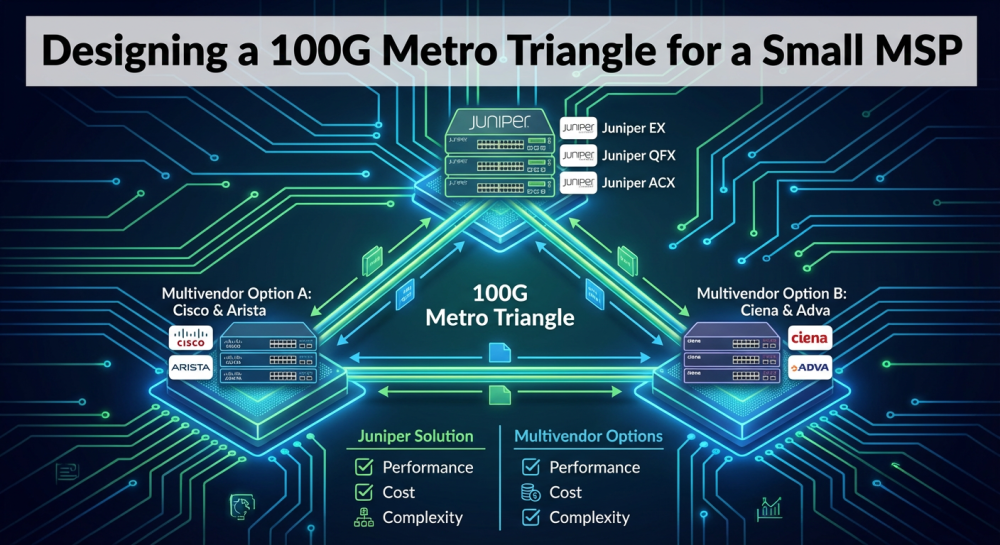
For small Managed Service Providers (MSPs), upgrading from a 40G to a 100G metro network is a crucial step in scaling operations and meeting the increasing demand for bandwidth. A typical MSP might have a 3-site metro dark fiber "triangle" topology, where high availability and network flexibility are paramount. To support 100G, the architecture needs to embrace advanced technologies like EVPN-VXLAN, VRF isolation, and support for large-scale routing. This blog will help MSPs evaluate the best options for upgrading to 100G, comparing Juniper’s EX, QFX, and ACX platforms with alternatives from Cisco, Aruba, and Fortinet.
Part 1: Use Case Overview: 3-Site Metro Dark Fiber, VRF Isolation, and Growth to 100G
In small MSP environments, scaling a 3-site metro dark fiber network to 100G is often driven by the need for high availability, better performance, and more efficient resource management. The goals are typically to:
Maintain Multi-Tenant Isolation: VRF allows isolation between customers, ensuring secure communication even when sharing the same physical infrastructure.
Deploy EVPN-VXLAN: This enables a flexible overlay network, decoupling the physical infrastructure from the logical network to streamline provisioning and reduce operational complexity.
Future-Proofing with High Port Density: Switching hardware must support scalable 100G core links, while providing adequate 10G or 25G connectivity for access and aggregation layers.
As MSPs face increasing competition and service demands, a solid 100G upgrade plan is essential for both maintaining service quality and expanding customer capacity.
Part 2: Platform Options: Juniper EX4650/QFX5120/ACX7024–7100 and Comparable Cisco/Aruba/Fortinet Solutions
Choosing the right hardware is crucial in determining both the long-term viability and cost-effectiveness of your 100G upgrade. Below is an overview of popular platform choices:
1. Juniper EX Series (EX4650)
The EX4650 is a powerhouse for campus distribution and aggregation, offering 48 x 10/25GbE ports and 8 x 100GbE uplinks in a 1U form factor. It supports EVPN-VXLAN and BGP. However, enabling these advanced routing and virtualization features requires purchasing Premium (PFL) or Advanced (AFL) feature licenses. For a small MSP, these recurring licensing costs can significantly impact the Total Cost of Ownership (TCO).
2. Juniper QFX Series (QFX5120)
Designed for high-density data centers, the QFX series is ideal for massive spine-leaf architectures. It offers deep buffers and scalability, but may be overkill for smaller metro sites that primarily need aggregation rather than high-end data center switching.
3. Juniper ACX Series (ACX710)
The ACX710 Universal Metro Router is purpose-built for metro architectures. It provides 24 x 1/10GbE ports and 4 x 100GbE ports, supporting a rich suite of L2, L3, and IP/MPLS functionality. It is uniquely tailored for service providers needing highly resilient, subscriber-aware IP transport.
4. Cisco & Aruba
Cisco Nexus 9000 and Aruba CX 8300 switches provide strong support for EVPN-VXLAN, MPLS, and SDN capabilities, offering reliable, high-performance solutions for 100G metro deployments.
5. Fortinet
FortiGate firewalls integrate seamlessly into 100G environments, offering secure SD-WAN and perimeter security. They provide unmatched price-to-performance for threat protection and secure multi-tenancy.
Part 3: Architectural Patterns: EVPN-VXLAN and MPLS for Small MSP Metro Cores
When upgrading to a 100G metro core, network design needs to support EVPN-VXLAN for overlay flexibility and MPLS for scalability. These architectural patterns allow MSPs to:
EVPN-VXLAN: Create a flexible and scalable network that can easily handle multi-tenancy and Layer 2/3 traffic isolation.
MPLS: Enable reliable, high-performance traffic engineering and VPN services across Layer 3 boundaries, ideal for connecting multiple metro sites.
Combining these technologies ensures a robust and future-proof architecture that can support increasing traffic demands and allow for network expansion without significant reconfiguration.
Part 4: License and Support Strategy: Balancing Feature Sets, Warranty, and TCO
The Total Cost of Ownership (TCO) of your 100G upgrade is significantly influenced by licensing, support, and warranty costs. Here’s how to balance these factors:
Licensing: Platforms like Juniper’s EX4650 and QFX5120 require advanced feature licenses (e.g., for EVPN-VXLAN). Ensure these licenses align with your current and future requirements to avoid unexpected costs.
Support & Warranty: Prioritize platforms that offer strong vendor support and warranty options. Router-Switch.com ensures that all equipment, whether from Juniper, Cisco, or Aruba, is genuine and includes full licensing and warranty.
Part 5: Migration Blueprint: Step-by-Step Upgrade from 40G to 100G with Minimal Downtime
Migrating from 40G to 100G can be complex, but careful planning ensures minimal disruption:
Assess Current Network: Evaluate current traffic patterns and pinpoint areas for improvement during the migration.
Hardware Selection: Choose the best platform based on your traffic requirements and budget. Router-Switch.com provides various options for Juniper, Cisco, Aruba, and Fortinet.
Configuration and Testing: Test software and hardware configurations thoroughly before full deployment. This includes upgrading routing protocols and verifying VRF isolation.
Cutover Plan: Plan your cutover carefully to minimize downtime. This may include staggered migration or use of backup systems.
Post-Upgrade Optimization: Once the migration is complete, optimize the network for performance, ensuring everything from EVPN-VXLAN to MPLS is operating efficiently.
Router-Switch offers support from CCIE-certified engineers to assist in this process and help ensure a smooth migration.
Conclusion
Upgrading to 100G for a small MSP involves careful consideration of hardware, software, and network design. Juniper, Cisco, Aruba, and Fortinet all offer reliable solutions, each with its strengths and trade-offs. By choosing the right platform and architecture, MSPs can ensure a scalable, secure, and future-proof network.
For MSPs looking to execute their 100G upgrade smoothly, Router-Switch.com is a trusted partner, offering a broad selection of network hardware, expert consultation, and full support to guide you through every phase of the migration.
FAQ
Q1.What is the difference between Juniper QFX and EX?
The EX series is designed for enterprise access and aggregation, while the QFX series is geared toward high-performance data center environments, ideal for spine-leaf architectures and high-throughput deployments.
Q2.Which Juniper router is designed for access aggregation and metro solutions?
The ACX710 is specifically designed for metro and aggregation applications, with support for high-density ports and IP/MPLS.
Q3.How do I check MPLS labels in Juniper?
Use the command show route table mpls.0 to view MPLS labels and forwarding information in Junos OS.
Expertise Builds Trust
20+ Years • 200+ Countries • 21500+ Customers/Projects CCIE · JNCIE · NSE7 · ACDX · HPE Master ASE · Dell Server/AI Expert